
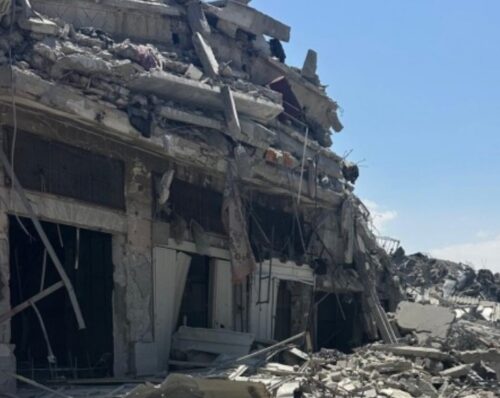
On the 694th day of Israel’s ongoing genocide in Gaza, and the 167th day since it violated the March 18, 2025, ceasefire agreement, Israeli forces escalated their attacks across the Strip, targeting densely populated areas, residential shelters, and civilians seeking humanitarian aid.
Since dawn Friday, more than 76 Palestinians were killed, including 21 individuals waiting for food assistance, according to medical sources.
At least 25 Palestinians were killed since dawn, Saturday, among them five near aid distribution centers, in addition to dozens of injuries.
A Palestinian woman and her child were killed, and several others injured when the army bombarded an apartment for the Daoud family in the Al-Karama area, northwest of Gaza city.
Palestinian Ministry of Health – Gaza
The Ministry of Health in Gaza recorded 10 deaths over the past 24 hours due to famine and malnutrition, including 3 children, bringing the total number of malnutrition-related deaths to 332, among them 124 children.
Since the IPC… pic.twitter.com/5y0hPUelGC
— Ramy Abdu| رامي عبده (@RamAbdu) August 30, 2025
Another strike hit a tent sheltering displaced families in Rimal neighborhood, in Gaza city, killing one and injuring several others.
A Palestinian woman was also killed, and several residents injured, in an Israeli bombing of the Zarqa’ area, east of Gaza city.
A separate attack on the Joha family home in al-Fawakhir area, in northern Gaza, resulting in the killing of three Palestinians, including a child, in addition to several injuries.
Occupation forces also continued demolishing homes in Sabra and Zeitoun neighborhoods of Gaza City, as well as in Jabalia al-Nazla.
In central Gaza, five members of the al-Hafi family were killed in an airstrike on their home in Nuseirat refugee camp.
The victims are Bara’a al-Hafi, Abdullah Fayed, his wife Shaima’ al-Hafi, their daughter Marwa, and Younes al-Khaldi. Several others were injured or remain missing.
Artillery fire also targeted the northern part of Nuseirat, and a child was killed in a separate strike on al-Bureij camp.
In the south, Israeli military vehicles opened fire on tents sheltering displaced families in al-Mawasi near Khan Younis, critically wounding one civilian.
Furtehrmore, a Palestinian fisherman Mohammad Ayman al-Jaabari was shot and killed by Israeli naval forces near Al-Qarara shore in Khan Younis.
Survivor and journalist Hatem Omar, injured in the Nasser Medical Complex massacre, described the devastating scene as he and his colleagues were covering the recovery of Reuters cameraman Hussam al-Masri.
The Israeli occupation carried out multiple strikes on the hospital’s… pic.twitter.com/3LLcPV0quP
— Translating Falasteen (Palestine) (@translatingpal) August 29, 2025
It is worth mentioning that nineteen Palestinians were killed in various areas of Khan Younis over the past 24 hours, including several aid seekers.
According to the latest casualty report, more than 60 Palestinians were killed and 224 injured in the past 24 hours.
Ten Palestinians, including three children, have died in Gaza over the past 24 hours because of starvation and acute malnutrition, according to the Ministry of Health.
These deaths underscore the rapid deterioration of food security across the Strip, where humanitarian aid remains blocked and basic survival needs are increasingly out of reach.
Recent assessments indicate that famine is now taking hold in Gaza Governorate, with more than half a million people facing extreme hunger, deprivation, and the threat of death.
The crisis is expected to spread to Deir al-Balah and Khan Younis by the end of the month if immediate humanitarian access is not granted.
Israel’s war on Gaza and aid blockade is fueling a shift in public opinion in the US, as most Americans now back recognition of Palestine, and are critical of Israel’s war on Gaza. pic.twitter.com/YzLRW37SGb
— Al Jazeera English (@AJEnglish) August 30, 2025
Specialists monitoring the situation warn that Gaza has already surpassed critical thresholds for starvation and mortality.
The unfolding catastrophe is described as entirely preventable, driven by the deliberate obstruction of aid and the collapse of essential services. Calls for urgent intervention continue to mount, with warnings that without a ceasefire and unrestricted relief operations, the death toll will escalate further.
The bombardment continued despite Israel’s claim of a “humanitarian pause” between 10 a.m. and 7 p.m. in Gaza City, which was immediately contradicted by ongoing airstrikes and artillery fire.
A source at the Shifa Hospital in Gaza city confirmed the death of infant Rania Ghaben due to severe malnutrition and lack of medical treatment. Her death adds to the growing number of children succumbing to starvation amid the collapse of Gaza’s healthcare system and the ongoing Israeli blockade.
Earlier, Munir al-Bursh, Director General of the Ministry of Health in Gaza, warned that the city is on the brink of what he described as “mass death operations” in the coming days.
He emphasized that residents categorically reject the Israeli military’s displacement plan and refuse to evacuate or abandon their homes.
In statements to Al-Jazeera, al-Bursh added that the situation in southern Gaza is even more devastating, and that death has become a constant presence across the Strip.
His remarks reflect the worsening humanitarian catastrophe, as aid remains restricted and medical infrastructure continues to collapse under relentless bombardment and siege.
The United Nations Relief and Works Agency for Palestine Refugees (UNRWA) announced that its aid warehouses in Egypt and Jordan are fully stocked and prepared to dispatch approximately 6,000 trucks loaded with humanitarian supplies to the besieged Gaza Strip. Despite the urgency, Israeli authorities continue to block the entry of UNRWA’s convoys.
“We now need pressure to turn that solidarity into action, to turn the tide on this dreadful, shameful famine,” our Sam Rose tells @BBCNews.
The man-made #famine in #Gaza was preventable. It can still be undone.
Humanitarian aid must be allowed in at full scale including… pic.twitter.com/jJ03C82J0G
— UNRWA (@UNRWA) August 30, 2025
In a public statement issued on the platform X, UNRWA stressed that the Israeli-imposed ban on its humanitarian operations must be lifted without delay.
The agency reaffirmed its capacity to deliver aid securely and efficiently, stating that its distribution system is fully operational and capable of reaching affected communities at scale.
“Our warehouses are ready. Thousands of trucks are waiting. What’s missing is permission,” the agency stated, underscoring the critical need to allow land-based access for life-saving relief.
UNRWA emphasized that the blockade is obstructing essential aid; food, medicine, and emergency supplies, from reaching civilians trapped under siege. The agency reiterated its demand for unrestricted humanitarian access, warning that continued delays risk deepening the already catastrophic conditions in Gaza.
Meanwhile, Israeli military sources have revealed preparations for a full-scale occupation of Gaza City, including logistical measures to manage the displacement of over two million Palestinians toward the southern Gaza Strip.
According to reports, including Walla Israeli news agency, infrastructure in the south has been reinforced to accommodate the anticipated influx of hundreds of thousands of displaced Palestinians, with new water lines laid and shelters expanded.
A water pipeline funded by the United Arab Emirates was recently completed, connecting Egypt to the al-Mawasi displacement zone. It is expected to provide 15 liters of water per person daily.
In addition, repairs have been carried out on water lines from Israel to areas such as Bani Suheila and Borkat Sa’id, with a combined capacity of 28,000 cubic meters per day.
Fuel deliveries have also been coordinated to power desalination plants and water wells, and a power line has been linked to the southern desalination station.
Israeli sources claim that local and international teams have begun restoring operations at the European Hospital in Khan Younis. Over the past two weeks, more than 1,000 tons of medical supplies have reportedly entered southern Gaza in coordination with international organizations. Discussions are underway to relocate medical facilities from the north to the south.
Humanitarian agencies have prepared over 3,000 family tents and tarpaulin shelters, with thousands more tents reportedly procured. Construction is also underway for new aid distribution centers to support displaced residents.
Israeli military officials allege that most humanitarian infrastructure in the south is now equipped to handle large-scale displacement. One source suggested that Palestinians have begun relocating in anticipation of the occupation, believing that early movement may allow them to settle in areas with better conditions.
Israeli military sources have announced the beginning of preparatory operations for a full-scale offensive on Gaza City, stating that forces are now advancing with significant intensity along the city’s perimeter.
Gaza City has been designated a high-risk combat zone, and the move coincides with the suspension of previously announced humanitarian pauses, deepening the siege and accelerating displacement.
These developments come amid escalating bombing, and growing concerns over forced displacement, with rights groups warning of violations under international law and the worsening humanitarian crisis across Gaza.
“People are dying from hunger. Families are being torn apart by displacement and despair. Pregnant women are facing unimaginable risks.
And the systems that sustain life — food, water, healthcare – have been systematically dismantled.
These are the facts.” pic.twitter.com/S8KxyCD5Ph
— United Nations Geneva (@UNGeneva) August 29, 2025
On the international stage, European Union foreign policy chief Kaja Kallas voiced alarm over the worsening humanitarian conditions in Gaza.
Speaking ahead of a diplomatic gathering in Denmark, she noted that the situation has barely improved and criticized Israel’s actions on the ground, saying they undermine efforts to ease the crisis
Since Israel breached the ceasefire agreement on March 18, 11,178 Palestinians have been killed and 47,449 injured. Among those seeking aid, 23 were confirmed dead and 182 wounded in the past 24 hours alone, bringing the total number of aid-related casualties to 2,203 dead and 16,228 injured.
The death toll from Israel’s genocide in Gaza has now reached over 63,025 Palestinians, the majority of whom are women and children. The number of wounded has risen to 159,490, with thousands of missing Palestinians, largely under rubble and unreachable by emergency crews in various parts of the destroyed coastal enclave.
