
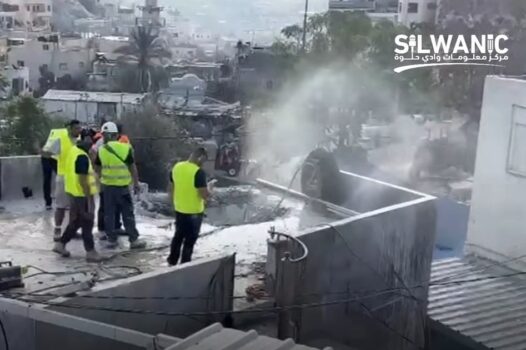
Israeli occupation forces demolished a Palestinian home in Silwan, south of Al-Aqsa Mosque in occupied Jerusalem in the West Bank, on Wednesday—marking another escalation in the campaign to forcibly displace residents of the city.
Local sources confirmed that crews from the Israeli municipality carried out the demolition in the al-Bustan neighborhood, targeting the home of Jerusalemite Mousa Badran.
The demolition followed days of pressure, during which Badran was forced to begin dismantling his own home to avoid steep fines imposed by Israeli authorities.
Just a week earlier, occupation forces had compelled Badran to self-demolish the property under threat of financial penalties and imprisonment—a tactic increasingly used to shift the burden of destruction onto Palestinian families.
The home lies in a zone under relentless pressure from Israeli authorities, who routinely issue demolition orders under the pretext of unlicensed construction, despite the near-impossibility of obtaining building permits in occupied Jerusalem.
Badran’s home demolition is part of a broader surge in home destruction across the city. By the end of May, Israeli forces had razed 93 structures in Jerusalem alone, including 53 homes.
Demolitions in al-Bustan reflect a policy of demographic engineering and coercive displacement. Residents describe the practice as a form of population cleansing—one that deepens daily suffering and worsens the housing crisis in the holy city.
Since the early 2000s, Israeli authorities have escalated efforts to uproot Palestinian families from Silwan, a neighborhood just south of Al-Aqsa Mosque.
Areas like al-Bustan and Baten al-Hawa have been repeatedly targeted under the claim of unauthorized construction, even though Palestinians face near-impossible odds in securing building permits.
The Israeli-controlled municipality routinely rejects applications, creating a bureaucratic trap that leads to demolition orders and forced displacement.
In Baten al-Hawa, the colonizer organization Ateret Cohanim has launched dozens of legal cases to evict Palestinian families, relying on Israel’s 1970 Legal and Administrative Matters Law.
This law permits Jewish individuals to “reclaim property” allegedly owned before 1948, while denying Palestinians the same right to reclaim homes lost in West Jerusalem. By mid-2025, at least 16 families had already been expelled from Baten al-Hawa, with many more facing imminent removal.
Al-Bustan has also been designated for conversion into a biblical-themed “King’s Garden” archaeological park—a project first proposed in 2004.
Palestinian residents have submitted alternative proposals that preserve both housing and historical significance, but these have been systematically rejected.
Demolitions in al-Bustan often occur with little notice, and families are pressured to carry out the destruction themselves to avoid heavy fines.
These demolitions are not isolated events. They are part of a broader strategy to fracture Palestinian territorial continuity in and around Jerusalem.
Through home seizures, permit denials, and the expansion of illegal colonies, Israeli authorities aim to sever East Jerusalem from the rest of the West Bank and consolidate control over the city.
As of early November 2025, Israeli authorities have demolished at least 1,744 Palestinian-owned structures across the occupied West Bank, including East Jerusalem. These include homes, agricultural facilities, water systems, shops, and donor-funded buildings.
The demolitions have displaced more than 2,339 people, with over half of those affected being women and children. The majority of these incidents occurred in Area C of the West Bank and in East Jerusalem, where Palestinians face near-total denial of building permits.
Between November 2024 and November 2025, there were 547 separate demolition incidents. Many of these involved forced self-demolition, where families were pressured to destroy their own homes under threat of heavy fines or imprisonment.
In East Jerusalem alone, dozens of homes were razed in neighborhoods like Silwan, Jabal al-Mukaber, and Shu’fat—areas targeted for settler expansion and “archaeological redevelopment.”
Additional data from humanitarian organizations shows that 1,288 structures were demolished under the pretext of lacking permits, even though Israeli authorities routinely reject Palestinian applications.
At least 138 of the destroyed structures were funded by international donors. The demolitions have affected nearly 38,000 people, disrupting access to shelter, water, and livelihoods.
Punitive demolitions—those carried out as collective punishment—have also surged, with 37 recorded cases this year, matching last year’s record.
These actions are part of a broader strategy to fragment Palestinian territorial continuity and entrench Israeli control. By seizing homes, denying permits, and expanding illegal colonies such as Ma’ale Adumim and Givat Hamatos, Israeli authorities aim to isolate East Jerusalem from the rest of the West Bank.
International bodies have repeatedly condemned these actions as violations of international law and as direct threats to any viable resolution based on justice or sovereignty.
While Israel continues to build and expand its illegal colonies, Palestinian communities and towns in occupied Jerusalem and various areas in the occupied West Bank continue to be denied the right to build homes and property under various allegations meant to prevent the expansion of Palestinian towns and neighborhoods.
All of Israel’s colonies in the occupied West Bank, including those in and around occupied East Jerusalem, are illegal under International Law, the Fourth Geneva Convention in addition to various United Nations and Security Council resolutions. They also constitute war crimes under International Law.
Article 33 of the Fourth Geneva Convention prohibits collective punishment and acts of terror against civilian populations.
Article 49 of the Fourth Geneva Convention states: “The Occupying Power shall not deport or transfer parts of its own civilian population into the territory it occupies.” It also prohibits the “individual or mass forcible transfers, as well as deportations of protected persons from occupied territory”.
Articles 53 and 147, prohibit the destruction of civilian property and classify pillage as a war crime.
