
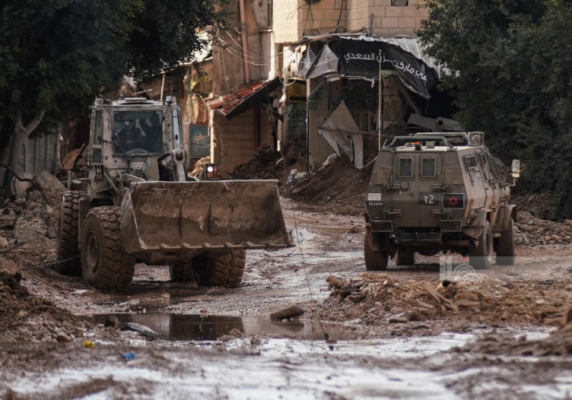
The city of Jenin and its refugee camp in the northern occupied West Bank marked on Wednesday the first anniversary of the ongoing Israeli military assault that has reshaped the city’s landscape, displaced thousands, and left deep humanitarian, economic, and educational wounds that remain visible today.
Over the past year, Israeli occupation forces have killed 62 Palestinians in Jenin governorate and injured more than 300 others.
The offensive has been defined by daily invasions into the city, its towns, and surrounding villages, along with continuous demolitions, bulldozing operations, and road‑clearing inside the refugee camp. The camp remains fully sealed, with all entrances closed and access prohibited.
Mass abductions and daily home invasions:
The Palestinian Prisoners’ Society said in a statement that Israeli forces have abducted approximately 1,470 Palestinians from Jenin governorate since 21 January 2025, the start of the year‑long assault.
Many of these abductions followed home invasions, during which soldiers broke into homes, interrogated residents, and converted several properties into military outposts, forcing families to evacuate.
Local sources reported that Israeli forces carried out another large‑scale invasion overnight, storming homes and interrogating dozens of residents in the towns of Ajjah, south of Jenin, and Yamun, west of the city.
In Burqin, west of Jenin, soldiers detained around 20 residents for an entire day on Tuesday before releasing them.
Widespread destruction and mass displacement:
According to the Jenin Municipality, Israeli forces have demolished nearly 300 residential buildings inside the refugee camp over the past year.
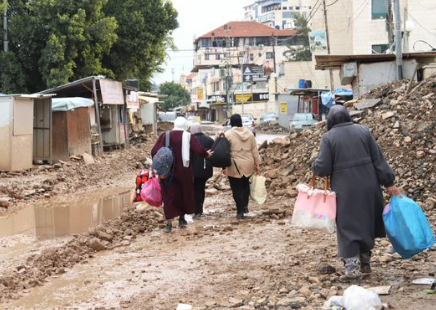
The destruction has forced around 22,000 residents to flee the camp and its surrounding neighborhoods.
Municipal officials say the Jenin refugee camp’s physical layout has been fundamentally altered, with entire streets and blocks bulldozed or rebuilt to facilitate military access.
Israeli forces have also shut down UNRWA facilities, preventing residents from receiving essential services, including education and humanitarian assistance — a move local officials describe as part of a broader effort to eliminate UNRWA’s presence in refugee camps.
Bashir Matahin, head of public relations at the Jenin Municipality, said the city’s direct losses during the first phase of the assault reached $320 million, citing massive destruction to infrastructure, roads, and public services.
“The impact on daily life across the governorate remains severe,” he said, noting that recovery efforts have been slow due to ongoing military restrictions.
Economic collapse and prolonged closures:
The Jenin Chamber of Commerce described the past year as one of the most difficult in the governorate’s modern history.
During the first six months of the assault, the city center experienced 74 full days of closure, crippling commercial activity.
Deputy Chamber President Mohammad Kamil said business owners were forced to pay rent for four and a half months without being able to open their shops, leading to stockpiles of unsold goods and significant financial losses.
He added that daily invasions force shops to close by 5:00 p.m., reducing purchasing activity by an estimated 10%.
Kamil noted that repeated invasions of towns across the governorate, including the closure of the Qabatiya wholesale market, result in daily losses of roughly 3 million shekels.
Meanwhile, the continued closure of the Al‑Jalama military roadblock, a key commercial gateway, deprives Jenin of shoppers who normally sustain the central market.
Israel now opens the roadblock only three Saturdays per month, causing estimated losses of 350 million shekels monthly.
Education and healthcare under strain:
The ongoing military onslaught has severely disrupted education in the Jenin refugee camp. UNRWA schools inside the camp remain closed, along with two government schools in the surrounding area.
The Directorate of Education was forced to relocate its offices to Burqin, and students have been dispersed across schools in the governorate depending on where their families sought refuge.
Healthcare services have also been affected. Israeli forces blocked one of the main entrances to Jenin Governmental Hospital with earth mounds near the camp’s edge, hindering the movement of ambulances and delaying access for patients.
 Humanitarian conditions at their worst in decades:
With the refugee camp sealed, daily invasions ongoing, and infrastructure repeatedly damaged, Jenin faces what local officials describe as its worst humanitarian, economic, and educational crisis in decades.
Residents and civil society groups continue to call for urgent international intervention to halt the violations and ensure the protection of civilians.
New abductions and invasions reported Wednesday:
Israeli forces abducted four Palestinians from Jenin governorate on Wednesday.
Local sources said soldiers invaded Yamun and abducted, Rayyan Hassan Zahir Abahra, Ubaida Hosni Abahra and Rami Maher Sammar, after breaking into their homes and ransacking them.
In a separate incident, Israeli forces abducted Shadi Hassan Rateb Owais from the Jenin refugee camp as he passed through the Huwara military roadblock near Nablus in the northern West Bank.
Israeli forces also continued their assault on Ajjah, where the military has been operating for nearly seven hours, carrying out field interrogations and detaining residents.
In Silat al‑Harithiya, west of Jenin, soldiers conducted additional home invasions and interrogations, while in Ya’bad, southwest of Jenin, residents in the al‑Malloul neighborhood were forced to evacuate their homes.
