
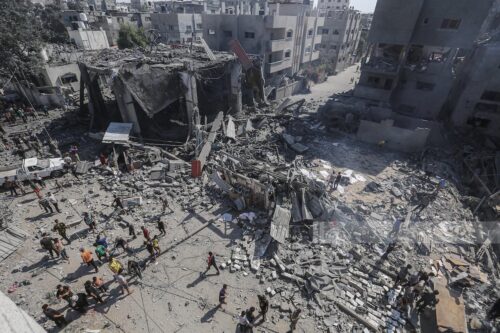
Israeli occupation forces launched a new series of airstrikes and artillery attacks across the devastated Gaza Strip on Sunday, injuring several Palestinians and adding to the mounting toll of the months‑long assault.
Local medical teams in Gaza City reported that multiple civilians were wounded after Israeli warplanes bombed a building in the al‑Rimal neighborhood west of the city.
The strike caused significant destruction and left residents trapped under debris until emergency crews managed to reach the area.
In southern Gaza, Israeli forces carried out a large demolition operation southeast of Khan Younis, detonating explosive charges that leveled structures in areas still under military control.
Artillery units simultaneously shelled the eastern outskirts of the city, while tanks opened sustained fire southeast of Deir al‑Balah in the central region.
Witnesses in central Gaza also reported heavy machine‑gun fire from Israeli armored vehicles positioned near the eastern boundary of the Strip, part of a pattern of continued military activity despite the declared ceasefire.
Continued Attacks Despite “Ceasefire”
Reports from Gaza, Al‑Jazeera, and local correspondents indicate that Israeli forces continue to fire on multiple areas across the Strip, including zones where civilians were told to move for safety.
Drone strikes and tank fire were reported in the Zeitoun neighborhood of Gaza City, in al‑Mawasi west of Khan Younis, and near the Netzarim corridor, where Israeli forces maintain a fortified presence.
Residents describe a situation in which Israeli units withdraw from certain areas only to return hours later with renewed fire, creating a climate of constant fear and instability.
Humanitarian Crisis Deepens
The ongoing attacks have worsened an already catastrophic humanitarian situation. More than two million Palestinians remain displaced, many living in makeshift tents that offer little protection from winter storms.
Aid agencies report that food, medicine, and shelter materials remain severely restricted, despite international pressure to allow full humanitarian access.
After brief celebrations over launching Gaza’s first radio station since the genocide, Israeli quadcopter drones blew up the transmission tower atop Shawwa Tower on Al-Wahda Street in Gaza City.
Israel’s message: there is no place for life in Gaza—contempt for Trump’s plan. pic.twitter.com/ZsFNjBZXej— Ramy Abdu| رامي عبده (@RamAbdu) January 25, 2026
Hospitals across Gaza, already operating far beyond capacity, continue to receive a steady flow of casualties. Many facilities lack electricity, clean water, and essential medical supplies, forcing doctors to perform surgeries without anesthesia and to prioritize only the most critical cases.
Since October 7, 2023, Israeli attacks have devastated the Gaza Strip, destroying large sections of residential neighborhoods, schools, hospitals, and public infrastructure.
Entire districts in Gaza City, Khan Younis, and the northern camps have been flattened. International organizations warn that the scale of destruction is unprecedented in the region’s modern history.
Despite the “ceasefire” agreement announced in October 2025, Israeli forces have continued operations across the Strip, with daily violations documented by Palestinian and international monitoring groups.
The continued bombardment, combined with the collapse of essential services, has left Gaza’s population facing one of the worst humanitarian crises in decades.
Rising Death Toll
Health authorities in Gaza announced that the overall number of Palestinians killed since October 7, 2023, has reached 71,657, with 171,399 injured. Medical teams say the real toll is likely higher, as many victims remain under rubble or in areas emergency crews cannot safely access.
Rescue teams continue to struggle to reach collapsed buildings due to ongoing bombardment, destroyed roads, and the absence of heavy equipment.
Over the past 48 hours, three Palestinians were killed and eight others wounded by Israeli fire and airstrikes.
Since the “ceasefire” took effect on October 11, 2025, the number of Palestinians killed has risen to 484, with 1,321 injured, and 713 bodies recovered from destroyed neighborhoods.
