
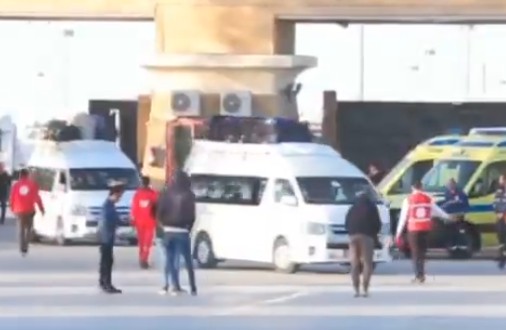
Israeli attacks across the Gaza Strip on Monday killed two Palestinians, including a three‑year‑old child, as Israeli forces continued shelling, detonations, and ground operations in several areas of the enclave, coinciding with the restricted reopening of the Rafah crossing for limited civilian and medical movement.
Medical sources confirmed that Eyad Ahmad Na’im Rabay’a, aged three, was killed when Israeli naval vessels shelled tents sheltering displaced families in the al‑Mawasi area west of Khan Younis in the southern Gaza Strip.
In northern Gaza, Ramadan Khair Muhammad Dardouna was killed in an Israeli strike targeting the al‑Joren area in Jabalia town.
Israeli armored units also opened fire east of Jabalia refugee camp in the northern Gaza Strip and east of Juhor al‑Deek in central Gaza.
In Rafah, at the southernmost edge of the Gaza Strip, Israeli forces detonated several residential buildings, continuing a pattern of controlled demolitions that has destroyed large sections of the city.
Meanwhile, the director of the Palestinian NGO Network in Gaza said that 50 Palestinians are expected to leave the Strip through the Rafah crossing, though patients awaiting medical evacuation were not informed in advance.
Al‑Jazeera’s correspondent confirmed that the crossing reopened in both directions after the Israeli army completed the installation of an internal inspection point.
A senior Egyptian official told the Associated Press that 50 Palestinians would be allowed to cross in each direction on the first day of operation.
However, the director of the Shifa Medical Complex in Gaza said the hospital has a list of 450 critically ill patients who urgently require treatment outside Gaza, yet only five patients, accompanied by two caregivers, were approved to exit on Monday. He stressed the need for clear, transparent mechanisms governing the evacuation of patients and wounded individuals from the Strip.
Israeli media reported that Egypt will send Israel a daily list of 50 Palestinians seeking entry into Gaza, while the European mission overseeing the crossing will send Egypt a list of 150 Palestinians seeking to leave, including their final destinations. Israel will inspect all individuals entering Gaza through a designated corridor to ensure, according to its claims, that no weapons are smuggled in.
Abdul Rahman Al-Sharafi (9 years old) is at risk of losing his eyesight, as the medical treatment he urgently needs is beyond a closed border crossing.
Any further delay could lead to permanent blindness. pic.twitter.com/wCIzwrRrLW
— Eye on Palestine (@EyeonPalestine) January 31, 2026
Egypt’s Minister of Health and Population, Khaled Abdel Ghaffar, ordered hospitals near the Rafah crossing to raise their state of readiness and ensure transportation and medical support for incoming patients.
Ministry spokesperson Hossam Abdel Ghaffar said the minister chaired a meeting of the national emergency coordination committee to prepare for receiving wounded Palestinians.
He said the emergency plan, now in its third phase, includes:
- 150 hospitals across Egypt on standby, with capacity to expand
- 250–300 fully equipped ambulances
- 12,000 doctors in critical specialties
- 18,000 nurses
- 30 rapid‑response teams
- A 24‑hour central control room linked to 27 regional emergency centers and more than 90 medical points
- A strategic stockpile of medicines and supplies coordinated with the National Blood Bank, capable of supporting up to 1,000 blood transfusions per day
The plan aims to ensure full readiness for any sudden humanitarian or medical developments linked to the reopening of the crossing.
Since the ceasefire announced on October 11, 2025, the Palestinian Ministry of Health reports:
- 523 Palestinians killed
- 1,433 injured
- 715 bodies recovered from destroyed areas
According to the Palestinian Ministry of Health in Gaza and Al‑Jazeera’s verified casualty tracker, the cumulative toll since October 7, 2023, has reached:
- 71,551 Palestinians killed
- 171,372 injured
These figures do not include thousands still missing under rubble or those who have died from starvation, disease, or the collapse of Gaza’s healthcare system.
