
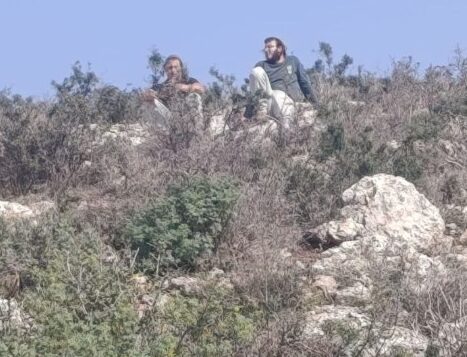
By Olla Moqudy — Published in Arabic by WAFA News: From the hilltops overlooking the town of Bruqin, west of Salfit in the central West Bank, the small community of Khirbet Jalaluddin has become an exposed target for daily assaults by illegal paramilitary Israeli colonizers.
Situated on the eastern outskirts of Bruqin, the hamlet consists of seven homes belonging to the Barakat family. Its residents rely on farming and herding, and the area is known for its archaeological, historical, and environmental significance. Yet despite its quiet rural character, Khirbet Jalaluddin has witnessed a sharp escalation in colonizers’ violence aimed at reshaping the area and pressuring its residents toward forced displacement.
For families, especially children, fear has become a constant companion. Routes to school, home courtyards, and surrounding fields have been turned into intimidation zones.
Gunfire, colonizer incursions, and invasions by Israeli occupation forces have become routine scenes, embedding themselves in the children’s memories and deepening their sense of insecurity.
The violence has also resulted in serious physical harm. In one recent attack, a child suffered a brain hemorrhage after being assaulted, requiring several days of hospitalization and close medical supervision.
Resident Farouq Barakat says the attacks are no longer sporadic but occur almost every day, particularly on Saturdays and during late afternoon hours. He describes colonizers descending from the surrounding mountains, moving among the family’s livestock, and at times entering the very courtyards of their homes.
According to Barakat, these assaults unfold alongside Israeli occupation forces and include livestock theft, poisoning, attempts to harm children, and surveillance of homes intended to terrorize residents.
He notes that small groups of colonizers, usually three or four, frequently appear near the homes, but larger groups sometimes arrive on six or seven agricultural tractors and position themselves on the elevated terrain overlooking the hamlet.
Colonizers, he adds, monitor the barns daily and spend long hours near the livestock shelters in attempts to steal or poison the animals.
Barakat recalls previous incidents in which colonizers tried to break into the barns and poisoned more than 50 sheep, inflicting repeated financial losses in an area with no fencing, barriers, or any form of protection.
Environmental and colonization researcher Raed Moqudy says the region is home to a uniquely diverse ecosystem and forms part of a broader natural and agricultural landscape. This diversity, he warns, is now under threat from expanding colonization that targets the land, its people, and the environment.
He notes that the area includes a historic shrine reflecting the site’s cultural and historical importance, emphasizing that Palestinian farmers have lived and worked these lands for decades.
Moqudy points to a recent colonizer action involving the fencing of more than 400 dunams of land stretching from Khirbet Qarqash through Jalaluddin and Wadi al‑Matwi to the al‑Ras area. These lands, he stresses, are privately owned by local farmers.
He warns that the fencing marks a pre‑planned step toward formal takeover, paving the way for the construction of a new water well and the expansion of colonial activity—an unmistakable indication of intentions to fully Judaize the area.
Despite the mounting pressure, the residents of Khirbet Jalaluddin insist they will not leave. They affirm their commitment to remain on their land, even if it means living in tents, as they confront systematic attacks and accelerating colonization amid international silence and the absence of protection.
Archaeological and cultural heritage researcher Omar al‑Silkhi explains that Khirbet Jalaluddin is one of four historical sites on the lands of Bruqin, alongside Qarqash (the City of the Sun and Moon), Khirbet al‑Fakhakhir (Dar Hammad), al‑Shuqfan (Dar Abdullah), and Khirbet al‑Ras.
Dating back to the early Ottoman period, the site lies about two kilometers east of Bruqin on a hilltop rising roughly 455 meters above sea level and covering about three dunams.
Locally, it is also known as Khirbet al‑Matwi and Khirbet Dar Abu Salma, names linked to a nearby spring and a branch of the Barakat family that once lived there. The name “Jalaluddin” refers to a shrine dedicated to a revered figure located just east of the site.
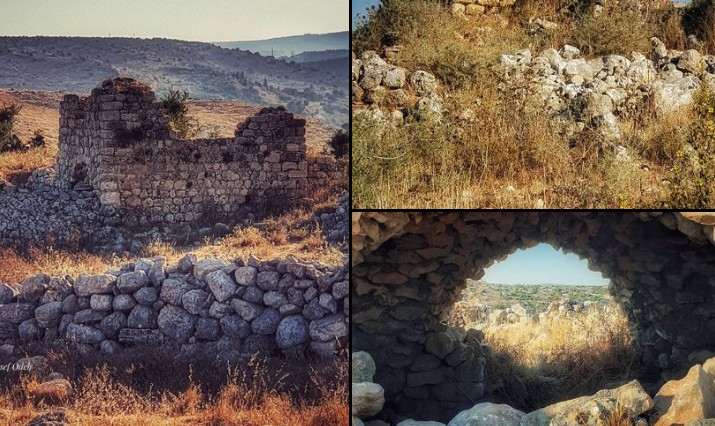
The area is enclosed by a stone wall built from large and medium‑sized stones arranged in semi‑regular horizontal layers.
The wall is 80–90 centimeters thick, with sections in the southeast rising to about two meters. The site has two entrances of similar width, one to the west and one to the east, and includes a tower in the northern corner with remains standing about four meters high.
At the center of the site is a rectangular structure built from large and medium stones, with walls about 50 centimeters thick. It appears to have served as a mosque, as indicated by a semi‑circular arch on its eastern façade and a mihrab‑shaped niche in the southern wall, along with northern and eastern entrances of varying shapes.
The western section contains houses arranged in an orderly pattern separated by narrow alleys.
Their walls, about 50 centimeters thick, were once coated with plaster, and pottery fragments remain scattered across the area.
The eastern section includes another rectangular structure with walls rising about two meters, and five meters away stands another building with remains reaching 2.5 meters, adjacent to a stone‑carved water well now filled with soil.
In Khirbet Jalaluddin, the struggle extends far beyond land. It encompasses memory, history, childhood, and the basic right to daily safety.
Seven families continue to hold their ground, resisting systematic violence and accelerating colonization in the absence of protection and amid global silence.
