
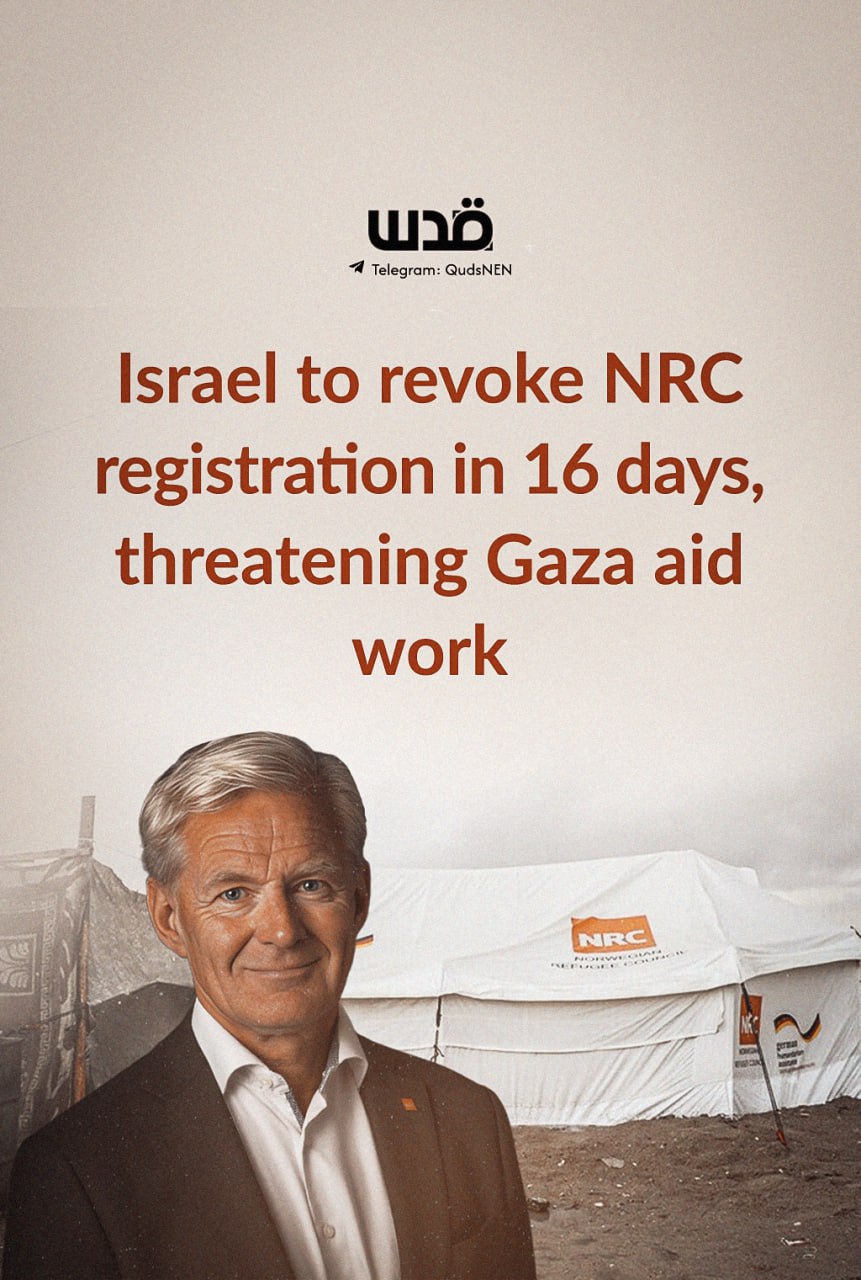
Israel is set to revoke the Norwegian Refugee Council’s registration within 16 days, part of a broader move that has already stripped dozens of aid groups of their licences under new regulations requiring detailed staff and funding disclosures. Experts say the rules undermine humanitarian principles and aim to restrict aid to Palestinians.
In 16 days, Israel is set to remove NRC’s registration and make our life-saving work for Palestinians much more difficult.
Since 2009, NRC has provided essential humanitarian aid in Gaza and the West Bank.
We have reached over one million people in Gaza, and 100,000 on the West Bank, since October 2023.
This includes, in Gaza alone:
🟠Water and sanitation to over 500,000 people
🟠Shelter to almost 300,000 people
🟠Legal aid to over 50,000 people
International NGOs in Gaza collectively:
– run 60% of field hospitals
– run all the stabilisation centres for children with severe malnutrition
– fund more than half of all mine and explosive hazard clearance
At least 40 aid groups will lose registration and access. This will prevent life-saving assistance.
Deregistration
= fewer humanitarian organisations
= fewer services reaching families in desperate need
There are only 16 days to reverse this dangerous and damaging policy.
NRC chief Jan Egeland warned the decision will hinder life-saving assistance, with at least 40 organizations affected, reducing services for families in urgent need.“This will prevent our life-saving assistance,” he wrote on X, adding that at least 40 aid groups also will lose their registrations.
That will mean “fewer humanitarian organizations” as well as “fewer services reaching families in desperate need”.
In January, 53 International NGOs issued a joint statement warning Israel’s recent registration measures will impede critical humanitarian action.
International humanitarian organizations operating in the occupied Palestinian territory warn that Israel’s recent registration measures threaten to halt INGO operations at a time when civilians face acute and widespread humanitarian need, despite the ceasefire in Gaza. On 30 December, 37 INGOs received official notification that their registrations would expire on 31 December 2025. This triggers a 60-day period after which INGOs would be required to cease operations in Gaza and the West Bank, including East Jerusalem.
INGOs are integral to the humanitarian response, working in partnership with the United Nations and Palestinian civil society organizations to deliver lifesaving assistance at scale. The United Nations, the Humanitarian Country Team, and donor governments have repeatedly affirmed that INGOs are indispensable to humanitarian and development operations and have urged Israel to reverse course.
Despite the ceasefire, humanitarian needs remain extreme. In Gaza, one in four families survives on just one meal a day. Winter storms have displaced tens of thousands, leaving 1.3 million people in urgent need of shelter. INGOs deliver more than half of all food assistance in Gaza, run or support 60 per cent of field hospitals, implement nearly three-quarters of shelter and non-food item activities, and provide all treatment for children with severe acute malnutrition. Their removal would close health facilities, halt food distributions, collapse shelter pipelines, and cut off life-saving care. In the West Bank, ongoing military raids and settler violence continue to drive displacement. Further restrictions on INGOs would sharply reduce the reach and continuity of lifesaving assistance at a critical moment.
Recent efforts to assess the impact of deregistering INGOs through selective metrics do not capture how humanitarian assistance is delivered in practice. Humanitarian access must be measured by whether civilians receive the right assistance, in the right place, at the right time.
INGOs operate under strict donor-mandated compliance frameworks, including audits, counterterror financing controls, and due diligence requirements that meet international standards. More than 500 humanitarian workers have been killed since 7 October 2023. INGOs cannot transfer sensitive personal data to a party to the conflict since this would breach humanitarian principles, duty of care and data protection obligations. False narratives delegitimize humanitarian organizations, endanger staff, and undermine the delivery of assistance.
