
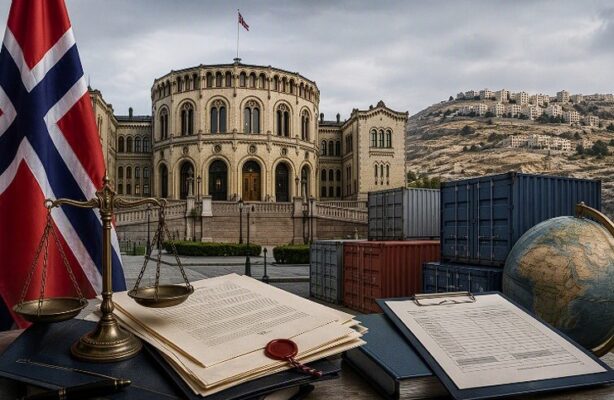
Norwegian Foreign Minister Espen Barth Eide said he believed Parliament would approve Norway’s proposed restrictions on trade and business activities linked to Israeli colonies this autumn, according to an interview that NRK reportedly published on September 13, 2026. The reported interview also said violations under the draft law could carry prison terms of up to three years.
Meanwhile, foreign ministers from 12 countries said on September 8, 2026, that they intended to introduce national restrictions, support European measures, or were actively considering steps to restrict trade in goods from Israeli colonies.
The joint statement was issued by Canada, Denmark, Finland, France, Iceland, Ireland, Norway, Poland, Portugal, Spain, Sweden, and the United Kingdom.
It said the United Kingdom, France, and Canada would bring forward national measures to ban trade in goods from the colonies and acknowledged action already taken by Ireland, Spain, the Netherlands, Norway, and Belgium.
Norway is reviewing legislation that would ban specified trade and business activities linked to Israeli colonies in Palestine. The proposal remains under public consultation until September 19, 2026.
The proposal would ban imports of goods from Israeli colonies and exports of goods to them.
It would also prohibit purchasing real estate in the colonies, providing specified construction, engineering, architectural, property brokerage, and settlement services directly connected to building, purchasing, or selling real estate there, and acquiring businesses whose headquarters and production facilities are located in the colonies.
The proposal includes safeguards for legitimate Palestinian activities and humanitarian assistance, and violations would carry criminal liability.
Norwegian Foreign Minister Espen Barth Eide said the proposal is intended to ensure that Norwegian individuals and companies do not profit from or support activities that sustain Israeli colonies, which Norway considers illegal under international law.
The proposal was issued for public consultation after resolutions adopted by the Norwegian Parliament in June and December 2025 instructed the government to propose such a prohibition.
The proposal follows earlier Norwegian measures concerning Israel’s colonial activity in occupied Palestinian territory.
In March 2024, the government advised Norwegian companies against trade or business cooperation that helps sustain illegal Israeli colonies.
In October 2024, it broadened that advice to activities that help perpetuate Israel’s illegal presence in the occupied Palestinian territory.
Norway’s position aligns with United Nations Security Council Resolution 2334, which states that Israeli colonies in the Palestinian territory occupied since 1967, including East Jerusalem, have no legal validity and constitute a flagrant violation of international law.
In its July 2024 advisory opinion, the International Court of Justice concluded that Israel’s continued presence in the occupied Palestinian territory is unlawful. It said all states are obligated not to recognize the situation as legal or provide aid or assistance in maintaining it.
The proposed legislation comes amid growing international scrutiny of Israeli policies in the occupied West Bank. The United Nations and human rights organizations have documented expanding Israeli colonies and rising attacks by colonizers against Palestinian communities.
On June 9, 2026, Norway aligned itself with European Union sanctions against three Israeli individuals and four organizations accused of serious human rights violations against Palestinians. In a separate coordinated measure, Norway imposed entry bans on more than 20 violent colonizers alongside Australia, Canada, France, New Zealand, and the United Kingdom.
If enacted, Norway’s proposal would replace its existing advisory policy with legally binding restrictions on specified trade and business activities connected to Israeli colonies.
The September 8 statement places that proposal within a broader international move toward trade restrictions, although the participating countries are pursuing different measures under their own legal procedures.
