
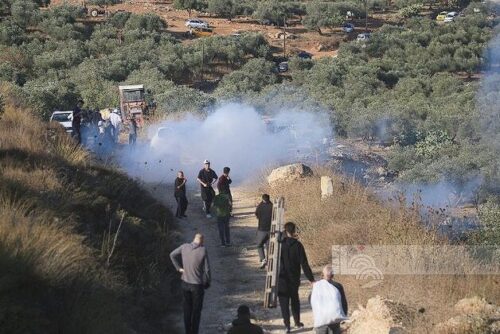
Israeli forces and illegal paramilitary Israeli colonizers carried out 11 attacks against Palestinian olive harvesters and their lands across five governorates in the occupied West Bank during a 12-hour period, to The Wall & Colonization Resistance Commission said.
In a statement issued Sunday and published by WAFA, the Commission said the attacks injured farmers, damaged agricultural property, and prevented Palestinians from reaching their lands or completing the harvest.
The Commission said the incidents occurred between 6 a.m. and 6 p.m. It reported beatings, theft of agricultural equipment and other property, damage to trees and vehicles, and obstruction of access to farmland.
Israeli bulldozers also cleared olive-planted land to build roads serving colonies and expand existing colonial outposts.
The Commission also reported an Israeli decision to deport 14 international solidarity activists, coinciding with the attacks. Soldiers had abducted the activists while they were supporting Palestinian farmers near al-Lubban al-Gharbi, northwest of Ramallah in the central West Bank.
The activists are from the United States, Italy, Ireland, Switzerland, Portugal, the Netherlands, and Australia.
The Commission described the deportation decision as part of escalating Israeli measures against international activists who help protect and support farmers during the olive harvest.
In Ramallah and al-Bireh governorate, colonizers entered Palestinian farmland in Kafr Malik, assaulted olive harvesters, and forced them to leave. They also smashed the windows of a vehicle belonging to a Palestinian resident.
In Burqa, colonizers released livestock onto agricultural land, damaging trees, and stole a donkey belonging to a farmer.
In al-Mughayyir, colonizers invaded farmland in the eastern plain and the ath-Thahra area. They used an agricultural tractor belonging to colonizer Evyatar Karwa to cultivate privately owned Palestinian land while preventing its owners from reaching it. Colonizers also released livestock into olive groves near the home of al-Hajj Abu Ata.
In Salfit governorate in the central West Bank, Israeli forces compelled farmers in Yasuf to leave their lands in the Bab Arsab area and prevented them from completing the olive harvest. At the same time, Israeli bulldozers began clearing tree-planted land in the al-Hariqa area to prepare for a road serving colonies.
Colonizers also attacked farmers in the western area between Deir Istiya and Qarawat Bani Hassan, beating them and causing bruises before seizing their agricultural equipment.
In Bethlehem governorate in the southern West Bank, colonizers attacked farmers harvesting olives near the entrance to Marah Rabah. In a separate incident, colonizers assaulted residents of Beit Fajjar while they worked in the Wadi Seif area, south of Bethlehem.
In al-Minya, Israeli forces invaded agricultural fields and detained Mohammad Yasser while he worked on his land. The Commission described the incident as another measure obstructing the harvest and restricting farmers’ movement.
In Nablus governorate in the northern West Bank, Israeli bulldozers began clearing olive-planted land west of the colonial outpost on Jabal Sabih in Beita, south of Nablus. The Commission said the work was intended to expand the outpost and take control of surrounding farmland.
In Salem, colonizers expelled several farmers from their lands in the Najmat Salem area and prevented them from continuing to harvest olives.
In an additional incident in Tubas governorate in the northeastern West Bank, colonizers released their livestock onto Palestinian-owned land in the northern Yarza community and assaulted farmers.
In Hebron governorate in the southern West Bank, colonizers attacked the family of Obeid al-Masri while they harvested olives in the ar-Rihaniya area of Masafer Yatta, attempting to force them off their land and prevent them from completing the harvest.
The Commission said the attacks extend beyond seasonal harassment and form part of broader efforts to impose colonial control over Palestinian land.
It linked the continuing violence against olive harvesters to plans for colonial expansion, saying these were not merely isolated or seasonal incidents but attempts to establish new realities on the ground.
The Commission cited the clearing of olive groves for a road in Yasuf, expansion of the outpost on Jabal Sbeih, and cultivation of privately owned Palestinian land in al-Mughayyir using colonizers’ machinery as forms of de facto land seizure. It said these practices change how the land is used and deprive its owners of access to and benefit from it.
It added that assaults on farmers, theft of their equipment, and damage to their trees, alongside the targeting and deportation of international solidarity activists, undermine Palestinians’ ability to protect and cultivate their lands and weaken the civilian support available to them during the harvest.
The Commission warned that continued restrictions on access to farmland could entrench permanent exclusion and colonial control. It called on the international community to intervene to stop attacks by Israeli forces and colonizers, protect Palestinian farmers and their right to reach their lands safely, and end the targeting of international activists supporting them.
