
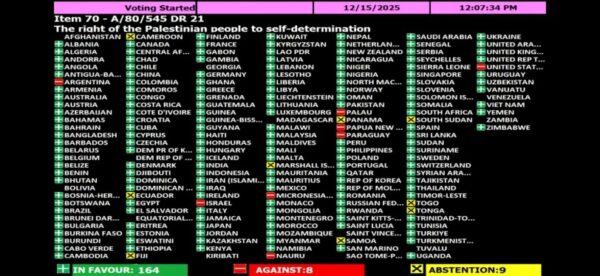
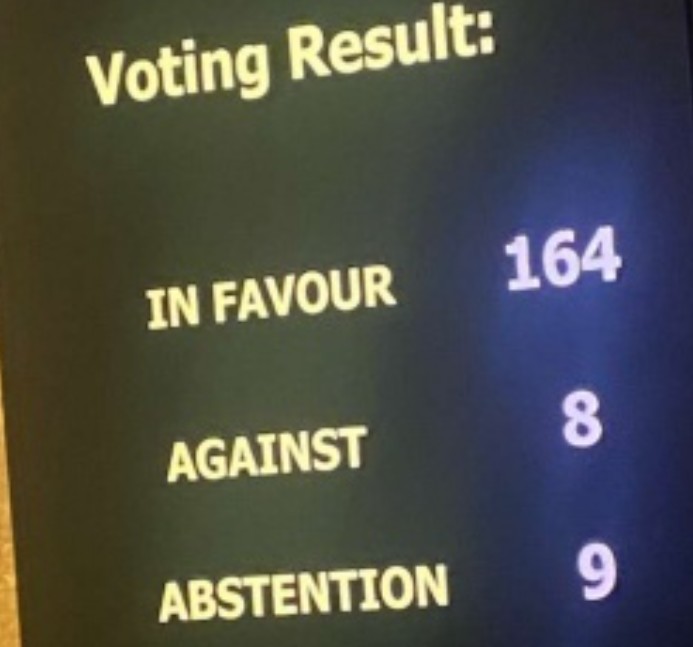
The United Nations General Assembly has adopted, by an overwhelming majority, a resolution reaffirming the Palestinian people’s right to self‑determination. The vote, held Monday, saw 164 countries in favor, only 8 opposed, and 9 abstentions—a result that underscores the near‑universal rejection of Israel’s ongoing occupation and colonialist expansion.
The countries voting against were Israel, the United States, Micronesia, Argentina, Paraguay, Papua New Guinea, Palau, and Nauru.
Abstentions came from Ecuador, Togo, Tonga, Panama, Fiji, Cameroon, the Marshall Islands, Samoa, and South Sudan.
 Observers noted that the abstentions and negative votes reflected the positions of governments with far‑right or hardline agendas, particularly in Argentina, Paraguay, and Ecuador, which have consistently resisted resolutions tied to human rights and international law.
The resolution explicitly references the International Court of Justice’s advisory opinion, which concluded that Israel’s occupation of Palestinian territory is illegal under international law and must end immediately.
The ICJ stressed that the occupation gravely undermines Palestinians’ ability to exercise their right to self‑determination, a principle enshrined in the UN Charter and multiple international treaties.
This vote builds on earlier UN initiatives, including the New York Declaration adopted in September 2025, which charted a path toward Palestinian statehood and called for irreversible steps toward the two‑state solution.
Together, these measures reflect mounting international frustration with Israel’s settlement expansion and military actions that obstruct Palestinian sovereignty and perpetuate humanitarian crises.
Palestine’s Permanent Representative to the UN, Riyad Mansour, welcomed the resolution as a demonstration of “near‑unanimous international consensus” on the Palestinian people’s rights.
He expressed gratitude to the states that supported the measure and emphasized that the vote sends a clear message: “the global community rejects Israel’s occupation and affirms the Palestinians’ right to live in dignity within an independent state.”
The Palestinian Presidency also described the decision as a “victory for justice,” stressing that East Jerusalem, the West Bank, and Gaza are indivisible parts of a future Palestinian state. Officials underscored that without recognition of Palestinian sovereignty, there can be no lasting peace, stability, or prosperity in the region.
Although the resolution is not legally binding, it carries significant political weight. It strengthens Palestine’s case in international forums and increases pressure on Israel and its allies.
Analysts note that the overwhelming support highlights a deepening isolation of Israel and the United States on this issue, as the vast majority of nations—including major powers in Europe, Asia, Africa, and Latin America—back Palestinian self‑determination.
The vote also signals growing impatience with the stalled peace process and the humanitarian crisis in Gaza, where reconstruction and aid delivery remain obstructed by occupation policies.
By reaffirming the ICJ’s opinion, the UN General Assembly has effectively reinforced the legal argument that Israel’s occupation must end to allow Palestinians to exercise their fundamental rights.
This decisive UN vote represents a powerful international rebuke of Israel’s occupation and a reaffirmation of the Palestinian people’s right to self‑determination. While symbolic, it adds momentum to global calls for accountability and strengthens Palestine’s diplomatic standing.
As Riyad Mansour noted, the resolution reflects a near‑universal consensus: the Palestinian people’s right to freedom and statehood are not negotiable—it is a matter of international law and justice.
