
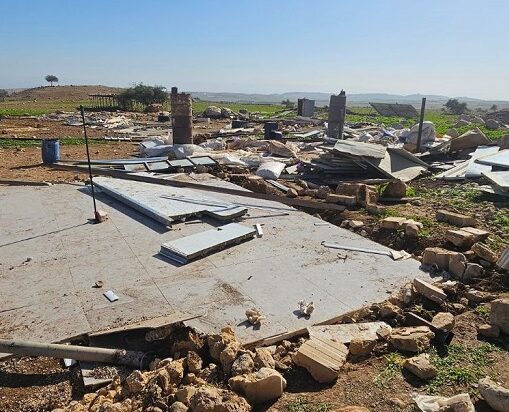
Twenty Palestinian families from the Az‑Zayed tribe were forced on Monday evening to take down their homes and livestock shelters and leave the Shalal al‑Auja Bedouin community north of Jericho in the occupied West Bank’s northeastern part, after a sharp escalation in attacks and harassment by illegal paramilitary Israeli colonizers.
The Al-Baydar Organization for the Defense of Bedouin Rights said the families had been living under growing pressure for weeks, facing conditions that made staying in the area “nearly impossible.”
According to the organization, the families endured a series of coordinated assaults in recent weeks — threats, the pursuit of herders, blocked access to grazing areas, and repeated damage to property.
Colonizer groups also increased their presence around the community, roaming the area in provocative tours, approaching tents late at night, and issuing direct warnings telling residents to leave.
Several families reported that colonizers brought their livestock to graze on Palestinian‑owned land, a tactic increasingly used to seize territory and push Bedouin communities off their land.
Al‑Baydar emphasized that the forced departure of the Az‑Zayed families is not an isolated incident but part of a systematic campaign of coercive displacement targeting Bedouin communities throughout the Jordan Valley.
The organization warned that these actions reflect a broader strategy aimed at emptying the region of its Indigenous Palestinian population to clear the way for settlement expansion and tighten Israeli control over strategic areas.
A Broader Pattern of Displacement in the Jordan Valley
What happened in Shalal al‑Auja fits into a much larger pattern unfolding across the eastern West Bank, where colonizer outposts have expanded rapidly since late 2023.
Human rights groups have documented a sharp rise in colonizer violence: assaults on shepherds, destruction of agricultural infrastructure, and the establishment of new outposts just meters from Palestinian homes.
These attacks are often followed — or accompanied — by Israeli military invasions, which further increase pressure on residents and reinforce the message that remaining in place is unsafe.
In the nearby community of Ras Ein al‑Auja, dozens of families have already fled under similar circumstances.
Residents there cite relentless harassment, the destruction of water and electricity lines, and colonizers deliberately grazing their livestock inside Palestinian communities.
UN agencies and local rights groups describe this model as “pastoral colonization,” where herding outposts are used as tools to seize land and displace Palestinian residents.
A Community Under Siege
Residents of Shalal al‑Auja say the situation deteriorated rapidly in recent weeks. Colonizer groups filmed families at night, blocked access roads, and patrolled the area with increasing frequency.
Shepherds were chased from grazing areas, and several families received direct threats warning them to leave immediately.
The pressure reached its peak on Monday evening, when the twenty families — unable to withstand the escalating harassment — dismantled their homes and animal shelters and left the area.
Currently, they are taking temporary shelter in neighboring communities, uncertain about their future and unable to go back because colonizer groups remain active near the area.
Calls for Protection and Accountability
Al‑Baydar urged international organizations, diplomatic missions, and human rights bodies to intervene immediately to stop the ongoing violations and provide protection for communities facing similar threats.
The organization stressed that the displacement was not voluntary but the result of sustained, targeted coercion.
Local advocates warn that without urgent action, more Bedouin communities in the Jordan Valley will face the same fate.
They argue that the combination of colonizer violence and the absence of protection for Palestinian residents is creating conditions that amount to forcible transfer, which is prohibited under international humanitarian law.
The forced removal of the Az‑Zayed families is another step in a long‑term strategy to reshape the demographic landscape of the Jordan Valley — a strategy that continues to advance with little accountability.
All of Israel’s colonies in the occupied West Bank, including those in and around occupied East Jerusalem, are illegal under International Law, the Fourth Geneva Convention, in addition to various United Nations and Security Council resolutions. They also constitute war crimes under International Law.
Article 33 of the Fourth Geneva Convention prohibits collective punishment and acts of terror against civilian populations.
Article 49 of the Fourth Geneva Convention states: “The Occupying Power shall not deport or transfer parts of its own civilian population into the territory it occupies.” It also prohibits the “individual or mass forcible transfers, as well as deportations of protected persons from occupied territory”.
Articles 53 and 147 prohibit the destruction of civilian property and classify pillage as a war crime.
