
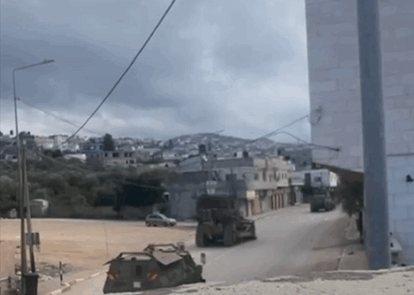
Israeli occupation forces conducted massive overnight invasions across various areas in the occupied West Bank on Monday, abducting many Palestinians and violently breaking into residential homes. They also renewed the closure of Al Jazeera’s office in Ramallah and issued a demolition order for a home and other structures in Jerusalem.
In occupied Jerusalem, numerous military and police vehicles invaded the Al-‘Isawiya town, northeast of the city, before soldiers began storming and ransacking homes, abducting several Palestinians.
In related news, the City Council in occupied Jerusalem issued a demolition order targeting the home of Mohammad Omar Somrein in Silwan town, south of the Al-Aqsa Mosque.
Somrein was informed he has 21 days to demolish his property under the pretext of it being built without a permit.
The home consists of only two rooms, and Somrein was ordered to pay a 24,000 shekel fine following years of legal battles to obtain a construction permit.
Also, the army invaded Al-Eizariya town, east of Jerusalem, and delivered demolition orders of several structures and shops.
In Bethlehem, the army abducted three young men: Ehab Khaled Sabah, Rayyan Issam Al-Amour from Tuqu’ in the southeast, and Ahmad Mohammad Thawabta from Beit Fajjar town, south of the city, after invading their family homes and ransacking them.
Meanwhile, in Ramallah and al-Bireh in the central West Bank, three Palestinians were abducted following invasions into the villages of Burqa and Beitunia.
The detainees were identified as Ahmad Farid Ahmad Barakat, 37, Mohammad Raed Mohammad Nawabeet, 24, and Mohammad Jamal Yaqub Jaber, 19.
During the incursion, Israeli forces stormed central Ramallah, breaking into and sealing the Al Jazeera Media Network office for an additional 60 days.
Military vehicles were also seen patrolling neighborhoods in al-Bireh, including Jabal al-Tawil and Al-Balou’, though no detentions were reported there.
Elsewhere, widespread invasions targeted villages west of Ramallah in Shuqba, Ni’lin, Shabtin, Deir Qaddis, and Qibya, with multiple homes broken into and searched.
Furthermore, illegal Israeli paramilitary colonizers launched a predawn attack Monday on a privately owned property in the town of Turmus Ayya, north of Ramallah.
Media sources said the assailants set fire to parts of the estate belonging to Wadea’ Alqam, destroyed trees, ripped through barbed wire fencing, and vandalized the area with racist Hebrew graffiti calling for the “killing of Arabs” and for “revenge.”
This assault forms part of a broader wave of colonizers escalating violations across the occupied West Bank under the protection of Israeli forces, further threatening Palestinian safety, property, and livelihoods.
In Nablus, in the northern West Bank, Israeli troops abducted Karam Rateb Sanaqra in the village of Tilk after violently breaking into his family’s home.
Occupation forces also swept through various neighborhoods in the city, conducting searches and vandalizing property, though no additional abductions were reported.
In Sebastia, northwest of Nablus, Israeli troops stormed the town, forced businesses to shut down, and deployed ground units throughout the streets.
The most extensive invasions occurred in Hebron, in the southern part of the West Bank, where seven Palestinians were abducted after military units invaded towns and villages across the region, including Nuba, Surif, and Kharas.
The detainees included Omar Naeem Ziyada, Bassam Mohammad Shroof, Nabil Anwar Bahar, Mohammad Ismail Abu Ammar, Ahmad Kamal Ghneimat, Ma’n Hamdallah Hmeidat, and Ismail Ahmad Abdelqader Hroub.
The army also confiscated two private vehicles in the Al-Arroub refugee camp, north of Hebron, belonging to Hassan Mohammad Adawi and Mohammad Kawamla.
Eyewitnesses reported various assaults against some of the abductees during the home invasions, with occupation soldiers beating and abusing detainees in front of their families.
The military further tightened its grip on Hebron by erecting new checkpoints and closing key roads across towns and refugee camps using cement blocks, metal gates, and earthen mounds.
