
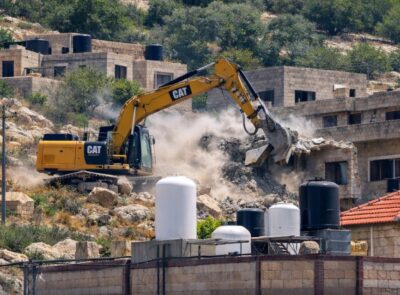
Israeli occupation forces carried out a wide series of demolitions across the occupied West Bank on Thursday, targeting homes, agricultural structures, livestock shelters, and residential facilities in multiple districts, including Salfit, Nablus, Bethlehem, and the northern Jordan Valley.
The violations followed the familiar pattern of sudden military incursions, area closures, and actions that directly support the expansion of illegal colonial outposts.
In Salfit, in central West Bank, the army demolished two agricultural structures in Khallet al‑Haramiya west of Kafr ed‑Deek, detaining five Palestinian citizens for more than two hours while bulldozers leveled the 600‑square‑meter structures.
Soldiers also seized four privately owned vehicles and transferred them into the illegal colonial grazing outpost in the area.
Residents said illegal paramilitary colonizers had forced the owners to evacuate the livestock structures months earlier, paving the way for the demolition.
In the Nablus district, in northern West Bank, Israeli forces demolished an agricultural livestock shelter in the village of Douma. Military vehicles and a bulldozer invaded the village at dawn and demolished the structure belonging to Ibrahim Abdul‑Razzaq Dawabsha, which was used for raising animals and formed part of the family’s livelihood.
In Bethlehem’s eastern district, the army began demolishing a two‑story home in Tuqu‘. The home, 200 square meters per floor, belongs to Ali Mahmoud Suleiman and was targeted under the pretext of lacking a permit.
The army sealed off the entire area, preventing residents from reaching the site or moving through the neighborhood.
In Bruqin, west of Salfit in the central West Bank, Israeli forces demolished part of a single‑story home belonging to Atta Mohammad Hussein Rabea’. The 100‑square‑meter home was completed and ready for occupancy but not yet inhabited.
Residents noted that Israeli authorities had previously issued stop‑work orders for around eight homes in the same northern area of the town, indicating a broader effort to halt Palestinian construction.
In the northern Jordan Valley, Israeli bulldozers demolished residential structures and livestock shelters in the ‘Ein al‑Hilweh community.
Mahdi Daraghma, head of the al‑Maleh village council, said the army demolished structures belonging to Adel ‘Elian Daraghma despite an Israeli High Court order temporarily prohibiting the demolition.
Across all districts, residents reported that demolitions were carried out without prior coordination, often at dawn, and accompanied by road closures, detentions, and confiscation of civilian property.
Human rights organizations have repeatedly documented that such demolitions violate the Fourth Geneva Convention, which prohibits the destruction of civilian property by an occupying power unless strictly required for military necessity.
UN Security Council resolutions—including 2334, 446, 452, and 465—affirm that Israeli colonies in the occupied West Bank have no legal validity and demand an end to measures that alter the demographic and geographic character of the territory.
International human rights instruments, including the Universal Declaration of Human Rights and the International Covenant on Economic, Social and Cultural Rights, protect the right to property, adequate housing, work, food security, and livelihood—all of which are undermined when homes, barns, livestock shelters, and residential structures are destroyed.
Organizations such as OCHA, Amnesty International, Human Rights Watch, and Al‑Haq have documented that demolitions frequently occur near illegal colonial outposts, where Palestinian families are pressured or forced to abandon land.
