
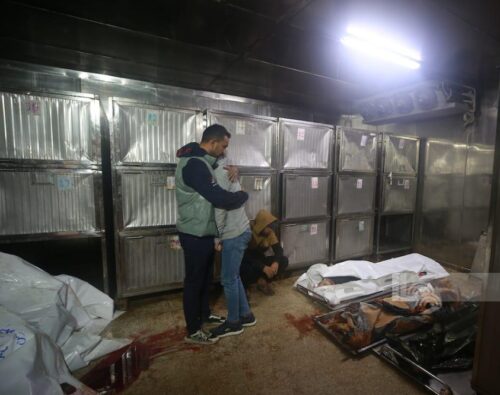
Israeli occupation forces on Monday carried out renewed artillery attacks across several areas of the Gaza Strip, killing one Palestinian in the eastern part of Gaza City and wounding others, in continued violations of the “ceasefire” that formally took effect on October 11, 2025.
Medical sources confirmed that a Palestinian man was killed when Israeli artillery shells struck the Shuja’iyya neighborhood, east of Gaza City.
Residents said the shelling began early in the morning and continued intermittently for hours, preventing emergency crews from reaching several affected areas.
In related news, a widely circulated video from Shuja’iyya showed a child giving a final farewell to his father, Hussam al‑Ja’bari, who was killed earlier in the day by armed groups believed to be affiliated with Israel in the same neighborhood.
In the central Gaza Strip, Israeli artillery units again targeted areas east of al‑Bureij refugee camp, firing several shells into agricultural and open lands.
Residents described the bombardment as a “renewed escalation,” noting that similar attacks have occurred repeatedly in recent days.
Families living near the eastern edge of the camp said the explosions caused widespread panic, particularly among children who have been displaced multiple times since the start of the war.
👶Annem babam nerede? 😢
Bu miniğin sorusuna cevap verebilecekmisiniz?
🚨 Gazzeye Acil Çözüm
⏰ #UrgentSolutionForGaza pic.twitter.com/Apw16ogvSh— Abdulhamid (@kdsflstn3) February 15, 2026
Further south, Israeli artillery units shelled the eastern areas of Khan Younis, striking farmland, and open terrain. Local sources said the bombardment disrupted efforts by residents to return to damaged homes or tend to agricultural plots.
In Rafah, in Gaza’s southernmost area, Israeli forces opened live fire toward the al‑Mawasi coastal zone, where thousands of displaced Palestinians have been sheltering in tents and makeshift structures. No injuries were immediately reported, but residents said the gunfire forced people to flee exposed areas and seek cover.
In #Gaza, learning continues despite immense challenges.
Over 68,000 children are attending classes in UNRWA’s Temporary Learning Spaces, while nearly 300,000 are using the Agency’s self-learning materials and digital platforms.#UNRWAworks to keep children connected and… pic.twitter.com/k7aXVuDHko
— UNRWA (@UNRWA) February 16, 2026
Human rights organizations warn that these continued violations — combined with the blockade, widespread destruction, and mass displacement — are entrenching a deepening humanitarian crisis and undermining any prospects for a durable calm.
Inside a damaged home in Deir al-Balah in #Gaza, contemporary visual artist Maysa Yousef is giving children a lifeline.
Through Maysa Atelier, children traumatized by the genocidal war on Gaza are using art to release fear, grief, and psychological distress.
With few supplies… pic.twitter.com/z6uvRMuVsg
— Al Mayadeen English (@MayadeenEnglish) February 15, 2026
According to the latest figures from the Palestinian Health Ministry in Gaza, the number of Palestinians killed since the ceasefire took effect on October 11 has risen to 603, while at least 1,618 have been wounded in ongoing Israeli attacks and violations. In addition, the bodies of 726 Palestinians were recovered from beneath the rubble across the coastal enclave.
Residents across Gaza say the repeated artillery strikes, sporadic gunfire, and ongoing military presence along the perimeter have prevented any sense of safety or recovery.
In the weeks before reaching the ceasefire in October 2025, Israeli engineering units were given orders to flatten absolutely everything during the Gaza City ethnic cleansing mission.
A glimpse into one of the battalions promo. pic.twitter.com/UTfBNXWJAO
— Israel Genocide Tracker (@trackingisrael) February 15, 2026
The cumulative toll since the beginning of the genocide on October 7, 2023, has reached 72,063 Palestinians killed and 171,726 injured. The majority of the victims are children, women, and elderly civilians, and the toll includes hundreds of medics, civil defense workers, and journalists killed in the line of duty.
Health officials warn that the real toll is likely higher, as many areas remain inaccessible due to destroyed infrastructure, unexploded ordnance, and the continued presence of Israeli forces near the eastern and northern edges of the Strip.
