
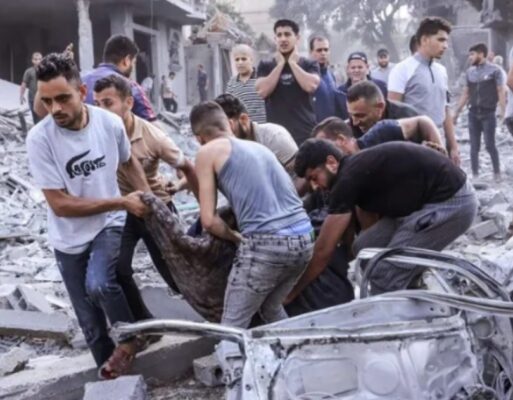
On Tuesday, November 11, 2025, Palestinian rescue teams recovered the bodies of two slain Palestinians from beneath the rubble of a home previously bombed in Khan Younis, in the southern part of the devastated Gaza Strip.
The recovery took place amid renewed Israeli fire from drones and armored vehicles targeting areas east of Khan Younis and southeast of al-Bureij refugee camp, in central Gaza.
The two bodies were located during civil defense operations in a residential neighborhood that had been struck in an earlier Israeli air assault.
Their retrieval highlights the ongoing danger faced by rescue workers and the persistent presence of unrecovered victims across the Strip.
Since the ceasefire was announced on October 11, Israeli forces have killed at least 242 Palestinians and injured 622 others.
The total death toll since the beginning of the genocide on October 7, 2023, has now reached at least 69,179, with more than 170,693 wounded, the majority of whom are children and women.
Thousands remain missing or trapped under debris, and many of the injured are without access to medical care due to the destruction of hospitals and the blockade on medical supplies.
Tuesday’s attacks are part of a broader pattern of Israeli military aggression that includes airstrikes, random fire, home demolitions, and the obstruction of humanitarian aid.
Israeli forces have violated the ceasefire more than 280 times, including direct assaults on civilians, incursions beyond the designated withdrawal zones, and the targeting of aid convoys and distribution centers.
In parallel, Israel continues to restrict the entry of humanitarian assistance. UN agencies report that aid trucks are being delayed, rerouted, or denied entry altogether.
The World Food Programme confirms that food deliveries remain far below the minimum required to prevent famine, while UNRWA has been barred from operating its own convoys.
On Monday, Israel returned the remains of 15 Palestinians as part of a body exchange arrangement.
Most of the bodies showed signs of severe trauma, and only 89 of the 315 returned since the ceasefire have been identified. The rest remain in refrigerated storage or mass graves, awaiting forensic analysis that Gaza’s health system is no longer equipped to perform.
The continued bombardment, obstruction of aid, and destruction of civilian infrastructure reflect a deliberate policy of collective punishment and demographic erasure.
Human rights organizations and legal experts have warned that Israel’s actions in Gaza constitute genocide and crimes against humanity.
The ceasefire, nominally in place, has failed to halt the violence or protect civilians. Instead, it has provided diplomatic cover for the continuation of a military campaign that has already displaced over 1.7 million people and rendered large parts of Gaza uninhabitable.
