
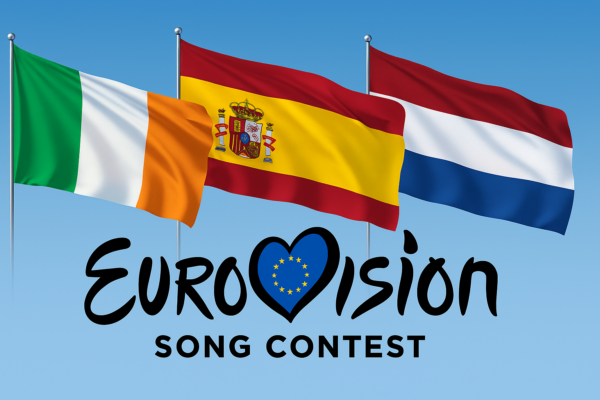
National broadcasters in Ireland, Spain, and the Netherlands have announced they will boycott the 2026 Eurovision Song Contest after the European Broadcasting Union (EBU) confirmed Israel’s participation. The decision has ignited criticism across Europe, with opponents arguing that the contest cannot remain neutral in the face of the humanitarian crisis in Gaza.
The three countries were among several broadcasters that had urged the EBU to exclude Israel, citing the “unprecedented civilian losses in Gaza” and concerns about unfair voting practices. Spain’s public broadcaster RTVE stated: “We cannot celebrate music while thousands of children are being killed. Eurovision must reflect values, not double standards.” Ireland’s RTÉ echoed that sentiment, calling participation “unconscionable,” while Dutch broadcaster Avrotros declared that Israel’s inclusion was “incompatible with the public values essential to us.”
EBU’s Response
At its semi-annual general assembly in Geneva, the EBU approved reforms designed to limit government influence on voting, including stricter monitoring of advertising campaigns and safeguards against coordinated blocs. However, the EBU did not hold a separate vote on Israel’s participation.
EBU Director-General Noel Curran defended the decision: “Eurovision is a cultural event, not a political forum. Our reforms ensure fairness in voting, but exclusion of a member broadcaster is not a step we take lightly.”
Israel’s President Isaac Herzog welcomed the stance, insisting: “Israel deserves to be represented on every stage around the world. Eurovision is about culture and unity.”
Critics argue the EBU is applying double standards, noting Russia’s exclusion in 2022 after its invasion of Ukraine. Spain’s culture minister remarked: “If Russia was excluded for violating international law, why is Israel treated differently?”
Wider European Reactions
- Slovenia has joined the boycott, citing the humanitarian toll in Gaza.
- Belgium and Iceland are reviewing their positions, with public petitions urging withdrawal.
Historical Significance
Spain’s withdrawal marks its first absence from Eurovision since 1961. For Ireland, which has won the contest a record seven times, the boycott underscores a deep moral stance. The Netherlands, a consistent participant since 1956, has rarely missed the competition.
The boycott transforms Eurovision 2026 from a celebration of music into a symbolic battleground over human rights and cultural diplomacy. While the EBU insists on neutrality, broadcasters argue that neutrality cannot mean silence in the face of humanitarian catastrophe.
On the ground, Israeli occupation forces killed at least seven Palestinians, including two children and one woman, and injured dozens more on Thursday, December 4, 2025, in multiple attacks across the Gaza Strip.
In the past 24 hours: 8 slain Palestinians were transferred to Gaza hospitals; 7 newly killed and 1 body recovered — alongside 16 injuries.
Medical sources announced Thursday that the overall death toll in Gaza has risen to 70,125 Palestinians, in addition to more than 171,015 injured, the majority women and children, since October 7, 2023. Many victims remain trapped beneath collapsed buildings, unreachable by rescue teams.
- Deadline – “Eurovision Allows Israel To Compete In 2026; Spain, The Netherlands & Other Countries Immediately Say They Will Boycott Competition”1
- Yahoo News – “Netherlands, Spain and Ireland among countries set to boycott Eurovision after Israel allowed to compete”2
- Times Now – “Why Israel’s Eurovision 2026 Entry Has Triggered a Boycott by Ireland, Spain, Netherlands and Slovenia”3
- The Economic Times – “Israel Eurovision controversy explained: Why did Ireland, Spain, Netherlands and Slovenia boycott Eurovision Song Contest 2026 and who else may follow suit?”4
- AOL News – “Multiple countries boycott Eurovision after Israel allowed to compete next year”5
- The Independent – “Multiple countries boycott Eurovision after Israel allowed to compete next year”6
- NBC News – “Ireland, Spain, Slovenia and Netherlands to boycott Eurovision over Israel’s participation”7
- NME – “Four countries announce Eurovision 2026 boycott after Israel allowed to compete”8
- News Letter – “Eurovision song contest 2026: BBC supports decision allowing Israel to participate as four countries withdraw”9
- Yahoo UK – “Several countries boycott Eurovision 2026 over decision to allow Israel to compete”10
- ESCToday – “Iceland: RUV set a date for its Eurovision 2026 participation decision”11
- Newsweek – “Eurovision 2026: Full List of Countries Boycotting Contest”12
- Times of Israel – “Israel cleared for Eurovision 2026 in EBU vote; Netherlands, Spain, Ireland, Slovenia quit”13
- Eurovision World – “Israel remains in Eurovision”14
