
A Palestinian child was critically wounded on Friday after Israeli forces opened fire in the northern Gaza town of Beit Lahia, in yet another violation of the “ceasefire” that has been in place since October 11, 2025.
The shooting unfolded against the backdrop of tightening restrictions on aid, worsening shortages, and renewed warnings from UN agencies that Gaza’s civilian population remains in acute danger.
Medical sources said the child was struck by live fire near Beit Lahia and rushed to the hospital in critical condition.
By late Friday, medical teams in Beit Lahia said the wounded child remained in critical condition.
Medical teams in the area said the incident is part of a pattern of constant ceasefire violations documented across the northern and central parts of the Strip.
Gazze’deki aileler için acı gerçek👇🏻
Çocuk: “Nereye gidebiliriz, nereye gidebiliriz?”
Anne: “Yürü, Allah’ın diyarı geniştir. Allah’a hamd olsun.”pic.twitter.com/JCRLVmPPrR
— Yekvücut (@yekvucutcom) March 20, 2026
Families in the area expressed fear that further Israeli fire could lead to new casualties, underscoring the fragility of the “ceasefire” and the ongoing risks facing civilians across the Gaza Strip.
UN humanitarian monitors reported continued Israeli fire toward civilians working or moving near agricultural lands and residential areas. They also noted that Israeli forces are still imposing severe limits on the entry of food, fuel, and medical supplies.
Aid convoys attempting to reach northern Gaza again faced delays today, with UNRWA confirming that several planned distributions were blocked due to Israeli restrictions.
Sizden bir ricam olabilir mi? Filistin hakkında konuşmayı bırakmayın 💔🇵🇸 pic.twitter.com/F1wWKlWlse
— Savci Sayan 🇹🇷 (@sayanparody) March 20, 2026
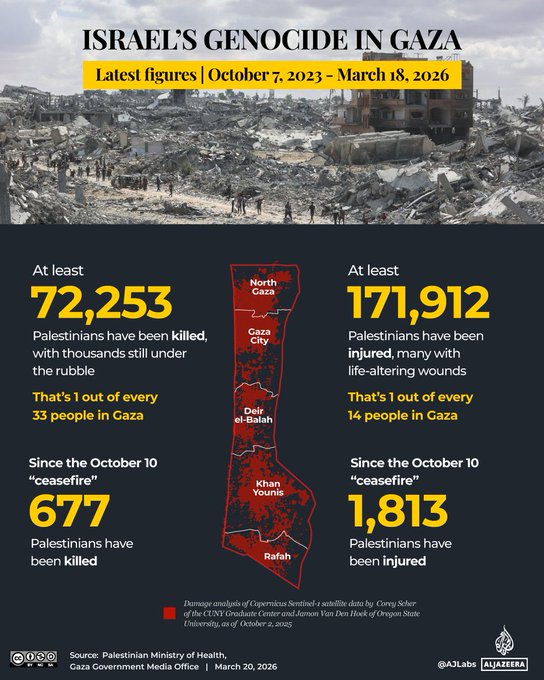
The Palestinian Health Ministry said that 677 Palestinians have been killed and 1,813 injured since the “ceasefire” was declared.
Many of these casualties occurred in areas where Israeli forces continue to operate, including along Salahuddin Street, the coastal road, and the northern agricultural belt.
Since the start of the genocide in Gaza on October 7, 2023, the overall toll has risen to 72,253 Palestinians killed and 171,912 injured, the majority women and children.
In #Gaza, there is nowhere to hide.
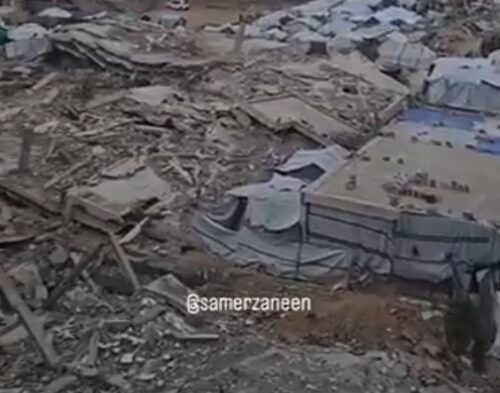
Strong wind, heavy rain, dust and heat make daily life unbearable in fragile makeshift shelters.
For displaced people already facing extreme living conditions, the weather compounds the challenges they endure.
Day in, day out, the struggle… pic.twitter.com/xVyHqlgyCP
— UNRWA (@UNRWA) March 20, 2026
UN agencies stressed that the true figures are likely higher, as many victims remain under rubble or in areas unreachable to emergency teams.
Al‑Jazeera reporters in Gaza described a persistent Israeli military presence around Beit Lahia, Beit Hanoun, and the outskirts of Jabalia.
 Residents spoke of intermittent gunfire and the constant buzz of drones overhead. Displaced families sheltering in damaged buildings said they continue to struggle without reliable access to clean water, electricity, or basic supplies.
Humanitarian officials warned that the collapse of sanitation systems and the spread of preventable diseases are deepening the crisis.
The World Health Organization noted that several clinics in northern Gaza are operating at minimal capacity, lacking essential medicines and fuel for generators.
Despite repeated international calls for full adherence to the ceasefire and unhindered humanitarian access, Israeli authorities have not eased the restrictions that have pushed Gaza deeper into catastrophe.
Aid agencies cautioned that without a significant increase in the entry of food, medical supplies, and shelter materials, the humanitarian emergency will continue to worsen.
