
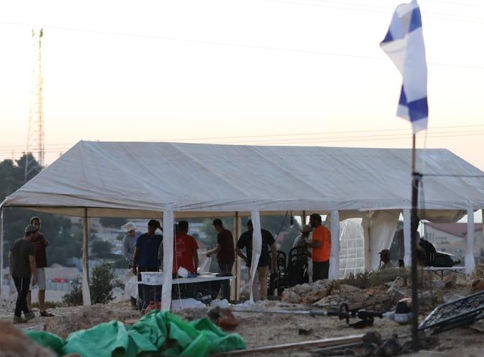
Illegal paramilitary Israeli colonizers carried out a coordinated escalation across the occupied West Bank on Wednesday, establishing new outposts near occupied Jerusalem and south of Nablus, attacking residents in Qusra under military protection, and destroying extensive agricultural land in Turmus Ayya north of Ramallah.
The incidents, spanning land seizures, armed assaults, and the uprooting of olive trees, reflect a unified push to expand colonizer control and further fragment Palestinian communities.
Israeli colonizers established a new outpost on Wednesday in the Bedouin community of Khan al-Ahmar, east of occupied Jerusalem, in a move Palestinian officials warn poses an immediate threat to the survival of the community and its school.
According to the Wall & Colonization Resistance Commission and the Jerusalem Governorate, colonizers began installing structures roughly 60 meters from the local school that serves the Khan al-Ahmar community.
Palestinian officials described the move as part of a long‑standing strategy to forcibly displace Bedouin communities in the Jerusalem periphery to clear space for settlement expansion and to fragment Palestinian territorial continuity.
Khan al-Ahmar has been at the center of international attention for years, with the International Criminal Court, UN agencies, and European governments warning that its demolition and the forced transfer of its residents would constitute a grave breach of international humanitarian law.
The area lies within the so‑called E1 corridor, a strategic zone Israel seeks to annex de facto through colonialist expansion to connect Ma’ale Adumim with Jerusalem—an act widely viewed as fatal to any viable Palestinian state.
In the northern occupied West Bank, illegal paramilitary Israeli colonizers erected tents on Wednesday on lands situated between the villages of Qusra, Talfit, and Jalud, south of Nablus.
Hani Odeh, head of the Qusra municipal council, stated that colonizers began bulldozing land early in the morning in an area known as Ras Ein Einya before pitching several tents. He warned that Qusra is already encircled from the north, east, and south by colonies and outposts, and that seizing the western side would complete the encirclement of the village.
Later in the evening, dozens of colonizers—under the protection of Israeli occupation forces—invaded Qusra and attacked residents, firing live ammunition. Local sources said villagers confronted the attackers, leading to clashes in the area. Wednesday morning’s illegal occupation of village lands was part of the same escalation.
At dawn on Wednesday, illegal paramilitary Israeli colonizers carried out a large‑scale arson attack in the village of Urif, south of Nablus, destroying heavy machinery, vehicles, and equipment at a local quarry in one of the most severe assaults on Palestinian economic infrastructure in recent weeks.
The Nablus district has witnessed a sharp rise in coordinated colonizer violence over the past two years, particularly after the establishment of new outposts that serve as hubs for armed groups operating with military backing.
UN OCHA has documented a record number of colonizer attacks in 2024–2025, many involving live fire, arson, and the destruction of agricultural property.
In addition, Israeli occupation bulldozers uprooted dozens of olive trees and razed agricultural land in the fertile plain of Turmus Ayya, north of Ramallah in the central West Bank.
Resident Abdullah Abu Awad stated that Israeli bulldozers uprooted 30 olive trees and leveled more than 20 dunams belonging to his family since early morning.
He added that Israeli machinery has been operating in the area for several weeks, uprooting more than 2,000 olive saplings and trees and bulldozing thousands of dunams.
Olive cultivation is a cornerstone of Palestinian rural life and economy, and the systematic destruction of orchards has long been documented as a tool used to pressure landowners to abandon their property. Human rights groups note that such actions are often followed by the establishment or expansion of nearby outposts.
The incidents reported on Wednesday reflect a broader pattern of accelerated land seizure across the occupied West Bank. Since 2023, Israeli authorities and colonizer groups have intensified efforts to set up new outposts—many of them unauthorized even under Israeli law but later retroactively legalized.
Key trends include targeting strategic corridors such as E1, the Jordan Valley, and the Nablus–Ramallah highlands to sever Palestinian geographic continuity.
Using colonizer violence as an enforcement tool, often with military protection, to push Palestinian communities off their land.
Rapid outpost expansion, beginning with tents or mobile homes, followed by roads, fencing, and agricultural takeovers. Destruction of agricultural assets, especially olive groves, to undermine Palestinian land claims.
International law experts emphasize that all Israeli colonies and outposts in the occupied West Bank are illegal under the Fourth Geneva Convention, and that the transfer of the occupier’s civilian population into occupied territory constitutes a war crime.
All of Israel’s colonies in the occupied West Bank, including those in and around occupied East Jerusalem, are illegal under International Law, the Fourth Geneva Convention, in addition to various United Nations and Security Council resolutions. They also constitute war crimes under International Law.
Article 33 of the Fourth Geneva Convention prohibits collective punishment and acts of terror against civilian populations.
Article 49 of the Fourth Geneva Convention states: “The Occupying Power shall not deport or transfer parts of its own civilian population into the territory it occupies.” It also prohibits the “individual or mass forcible transfers, as well as deportations of protected persons from occupied territory”.
Articles 53 and 147 prohibit the destruction of civilian property and classify pillage as a war crime.
