
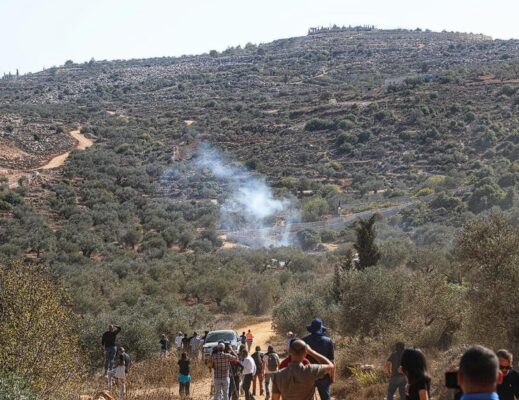
The Wall & Colonization Resistance Commission documented 409 attacks by Israeli occupation forces and illegal paramilitary Israeli colonizers against Palestinian olive farmers, olive trees, agricultural land, and agricultural equipment between October 1 and 21, 2026. Illegal paramilitary Israeli colonizers carried out 317 of the documented attacks, while Israeli soldiers were responsible for 92.
The documented violations included preventing farmers from accessing their fields, assaulting them and forcing them to leave, stealing harvested olives, and damaging olive trees and agricultural equipment.
The Commission reported that the Nablus governorate recorded the highest number of attacks, with 166, followed by Salfit with 91, Ramallah and Al-Bireh with 69, Jenin with 36, Hebron with 30, Qalqilia with nine, Bethlehem with five, and Jerusalem with three. Nablus and Salfit together accounted for approximately 63% of all documented attacks.
The Commission documented 287 attacks directly targeting farmers, including 149 incidents of intimidation and threats, 50 physical assaults, 29 incidents involving restrictions on movement and denial of access, 18 abductions during the harvest, and 15 cases in which farmers were detained in olive groves.
It also documented 14 incidents involving the use of pepper spray or the firing of gas bombs at farmers, as well as 11 incidents involving live fire.
On October 7, 2026, Israeli paramilitary colonizers killed Ali Hassan Bazari, 44, a resident of Burqa town, northwest of Nablus, while he was harvesting olives. Sixteen Palestinians were injured by the colonizers and Israeli soldiers in the attack.
Among the incidents documented by the Commission was an October 17 attack by Israeli colonizers, under the protection of the Israeli army, against olive harvesters in the Ma’in area of Masafer Yatta.
One Palestinian was shot in the thigh with live ammunition, while two others fainted and sustained burns after being sprayed with pepper spray.
The Commission also documented injuries to three farmers who sustained wounds and bruises when illegal paramilitary Israeli colonizers assaulted them during the harvest in Asira al-Qibliya on October 16. Two farmers were also injured in Beita on the same day.
The Commission further documented 122 attacks targeting olive trees, agricultural land, equipment, and other property associated with the harvest.
These attacks included 57 incidents of olive theft, 23 cases involving the confiscation or theft of agricultural equipment, 12 incidents in which olive trees were broken, 11 cases in which trees were cut down or uprooted, seven incidents in which land planted with olive trees was set on fire, five cases of tree vandalism, four incidents involving the burning of property, and three cases of land bulldozing.
The documented incidents included the theft of olives, harvesting machines, and tarpaulins, as well as attacks on farmers’ vehicles while they were transporting their crops.
In Qabalan on October 16, illegal paramilitary Israeli colonizers attacked and overturned a Palestinian farmer’s vehicle before stealing sacks of olives.
In Rantis, farmers were detained for more than two hours, while Israeli soldiers confiscated two sacks of olives and two harvesting machines.
The Commission stated that protecting the olive harvest requires guaranteeing farmers access to all their land and enabling them to remain there, complete the harvest, and transport their crops safely. It also called for an end to the attacks and for those responsible to be held accountable.
The Commission warned that the continued denial of access, violence, and theft imposes mounting human and economic costs on Palestinian families and undermines their ability to continue cultivating their land.
It emphasized the inalienable right of Palestinians to access and cultivate their land and to harvest its produce, adding that confronting colonizer terrorism requires concrete measures to halt the attacks, protect farmers, and prevent the use of armed force to deprive them of their land and livelihoods.
