
At least ten vessels from the Gaza Sumud Flotilla were targeted by drone strikes early Wednesday, according to Al Jazeera’s correspondent aboard the convoy. Explosions were heard across the fleet, though no injuries have been confirmed.
Organizers say the attacks are part of a broader campaign to obstruct humanitarian efforts aimed at breaking the Israeli blockade on Gaza.
UN Special Rapporteur Francesca Albanese reported seven separate drone strikes in the Mediterranean Sea, following the appearance of 15 unmanned aircraft circling the flotilla.
She called for immediate international protection, warning that repeated assaults on civilian aid missions violate international law.
The flotilla’s organizing committee said it recorded 13 explosions and widespread communication interference.
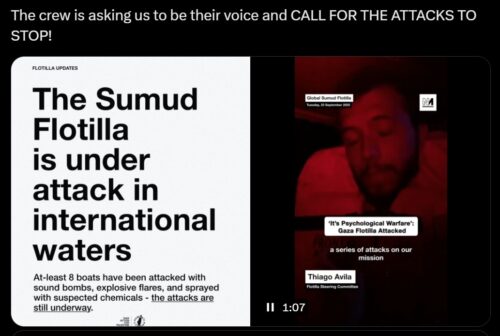
🚨 BREAKING: The Sumud Flotilla is UNDER ATTACK in International Waters!
There were at least 8-9 attacks. PLEASE raise the alarm.
The crew is asking us to be their voice and CALL FOR THE ATTACKS TO STOP! https://t.co/MtJYKYwQJ4 pic.twitter.com/bLqbMGMHAp
— Ryan Rozbiani (@RyanRozbiani) September 24, 2025
Unknown objects were dropped on ten boats, causing material damage. The committee accused Israel of launching a disinformation campaign to justify a potential military strike, stating that any attack on the convoy would constitute a war crime.
Earlier reports from Al-Jazeera indicated drones had released a chemical substance with a gunpowder-like odor over several ships. No injuries were reported.
This is not the first time drones have harassed the flotilla. Surveillance flights were observed two days prior, as the convoy continued its mission to challenge the blockade on Gaza—a blockade that has intensified over the past two years amid what organizers and rights groups describe as an ongoing campaign of genocide.
The flotilla previously reported drone attacks on September 8 and 9. Two days ago, Israel warned the convoy against entering what it called an “active combat zone,” threatening to block the ships from reaching Gaza.
In a statement Monday, Israel’s Foreign Ministry said it would not allow the vessels to breach what it described as a “legal maritime blockade,” accusing Hamas of orchestrating the flotilla for political purposes. The ministry suggested that aid could be offloaded at Ashkelon port for transfer to Gaza.
🚨 BREAKING: Thiago Avila Confirms The Global Sumud Flotilla Fleet was Attacked
Calls for the World to “Sound the Alarms” https://t.co/oGW5ykDkJY pic.twitter.com/3qSab1CKmh
— Ryan Rozbiani (@RyanRozbiani) September 23, 2025
The Sumud Flotilla includes humanitarian workers, doctors, artists, and activists from 44 countries.
It departed Tunisia earlier this month after multiple delays due to security concerns, vessel readiness, and weather conditions.
A group of ships left Barcelona in late August, followed by another convoy from Genoa on September 1. By September 7, both fleets had reached Tunisian waters before heading toward Gaza.
This marks the first time such a large number of vessels have sailed together toward the besieged enclave, home to 2.4 million Palestinians. Israel, which controls Gaza’s borders, has tightened restrictions in recent months.
In previous missions, Israel— the occupying power under international law—has intercepted and seized ships headed for Gaza, deporting those on board.
Since March 2, Israel has closed all border crossings into Gaza, blocking food and humanitarian aid despite relief trucks piling up at the perimeter. The blockade has triggered a famine, with 442 Palestinians—147 of them children—dying from starvation.
Backed by the United States, Israel has carried out a campaign of genocide in Gaza since October 7, 2023. Over the past 23 months, this has resulted in 65,382 deaths and 166,985 injuries, most of them women and children.
