
A report by the National Bureau for Defending Land and Resisting Colonies indicates that both Jerusalem and the northern Jordan Valley, located in the occupied West Bank, are experiencing a renewed escalation of illegal Israeli paramilitary colonizer activity.
The report warns of significant implications for the future of the areas surrounding Jerusalem and the extensive agricultural lands in Tubas and the northern Jordan Valley.
Systematic Land Seizure and Expansion
According to the bureau’s weekly monitoring (November 22–28), Israeli occupation authorities have intensified their use of various mechanisms—military orders and judicial decrees—to seize Palestinian land. The report states that these measures, regardless of their official designation, serve to expand illegal colonization at the expense of Palestinian land and communities.
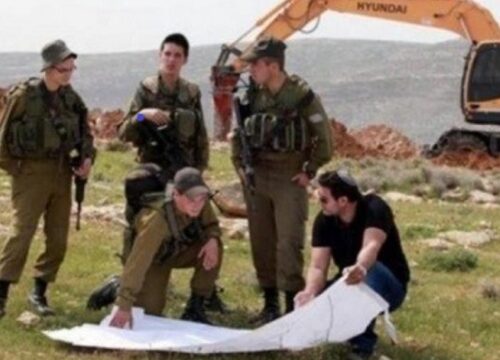
Recently, Israeli authorities issued new military orders to confiscate significant areas of land in Tubas and the northern Jordan Valley for the construction of a military road. This land grab affects both privately owned and state lands, stretching from Ein Shibli through Al-Baqi’a Plain, Ainoun near Tubas, Yerza east of Tubas, and reaching east of Tayasir village.
Estimates of the road’s length vary, with some sources indicating it exceeds 22 kilometers and seizes approximately 1,042 dunams of Palestinian land.
|Colonizer Violence Unprecedented, Israel Must Uphold International Law|
The report notes that this transforms what was initially presented as a temporary military route into a strategic corridor, redrawing the geographic landscape of the northern Jordan Valley and laying the groundwork for gradual annexation.
The project systematically denies farmers and herders access to the eastern plains, which are vital for the region’s economic and environmental sustainability.
Other sources suggest the true objective is to construct a military road from Ein Shibli to the Tayasir military roadblock, spanning over 40 kilometers.
Ongoing bulldozing at the eastern entrance of Ein Shibli aims to relocate the Hamra military checkpoint closer to the village, further isolating the governorate and facilitating the seizure of 180,000 dunams of land. This will reinforce the longstanding Israeli policy of isolation and fragmentation of Palestinian territories.
Judicial Expansion and Colonialist Regularization
In parallel, and as part of the broader campaign to forcibly seize West Bank land for colonial expansion, the Israeli military’s Central Command has signed ten new judicial authorities to intensify colonization.
This move will convert several outposts, grazing farms, and neighborhoods near existing illegal Israeli colonies into independent colonies, granting them new privileges and development plans.
Among the areas affected by these judicial updates are: Judar in Tulkarem, Leshem in Salfit, Karm Ra’im—formerly a neighborhood separated from Talmon colony in Ramallah and now an independent colony—Neria east of Deir Ammar in Ramallah, Abot, Gilad Farm in Qalqilia, Ivi Hanahal in Bethlehem, Frashim (El Neveh), and boundary changes for Mishua and Har Adar settlements in Jerusalem.
This wave of “regularization,” led by the Settlement Administration, has resulted in 39 new judicial jurisdictions and the official recognition of 30 new colonies since the beginning of 2025, in line with the government’s plan to establish 50 new illegal colonies in the occupied West Bank. Defining a judicial jurisdiction is a critical step in establishing a settlement, enabling infrastructure development and planning.
Far-right Finance Minister Bezalel Smotrich commented: “We continue to strengthen settlement and deepen its roots throughout the Land of Israel. Defining jurisdictions is a Zionist, security, and national step that brings stability and a future to tens of thousands of citizens.”
Intensified Land Seizure in Occupied Jerusalem
On Monday, the Israeli military issued an order to seize more than 77 dunams of land belonging to residents of Al-Za’im and Isawiya, east of Jerusalem. This order is part of ongoing Israeli policies aimed at seizing land around East Jerusalem.
On November 17, a group of illegal Israeli paramilitary colonizers established a new outpost in East Jerusalem’s Sur Baher neighborhood, fencing off approximately ten dunams of open land near the eastern ring road.
Sources in the Jerusalem municipality indicate that the project is likely linked to the Elad colonialist organization, and the establishment of this outpost is seen as the first step toward creating a new settlement.
A study by the NGO Bimkom, which monitors settlement activity in East Jerusalem, found that the government is exploiting settlement processes to enable the state and colonizer groups to seize Palestinian land in East Jerusalem, registering it under the 2018 settlement law.
Demolition and Eviction Orders
Israeli authorities have issued demolition and eviction orders for commercial properties in the Al-Eizariya area, east of Jerusalem, citing lack of building permits. Palestinians link these orders to a colonial project passing through the town.
All affected properties are located in Area C, under full Israeli civil and security control according to the Oslo Accords.
This measure threatens the local economy and social cohesion, especially in the context of the E1 colonial project approved by the Civil Administration in August, which covers 12 square kilometers east of occupied Jerusalem.
Researcher Aviv Tatarsky from human rights organization Ir Amim notes that Israel aims to “take the land in Area C without the people,” increasing the number of settlers and displacing Palestinian communities.
Legislative Moves to Facilitate Land Acquisition
The Knesset’s Foreign Affairs and Security Committee recently approved a bill allowing colonizers to purchase property anywhere in the West Bank directly, bypassing the Civil Administration.
The bill seeks to repeal the Jordanian law restricting foreign ownership of property in the West Bank, which settlers view as an obstacle to land acquisition.
The proposed law, titled “Elimination of Discrimination in Property Purchase in Judea and Samaria,” would allow any colonizer to buy property rights in Areas A, B, and C without Civil Administration approval.
Human Rights Violations and Violence
According to B’Tselem, the Israeli Information Center for Human Rights, the situation in the occupied West Bank is marked by unchecked violence against Palestinians by colonizer organizations and the Israeli military.
Since October 2023, Israel has killed approximately 1,004 Palestinians, including 217 minors, with at least 21 killed by colonizers.
B’Tselem’s director general, Yuli Novak, stated that the situation is deteriorating daily due to the absence of internal or external mechanisms to prevent what she described as ethnic cleansing. She called on the international community to end Israel’s immunity and hold those responsible for crimes against Palestinians accountable.
Novak added that the Israeli military employs a permissive and unrestricted policy of live fire, including airstrikes, and recruits and arms thousands of colonizers in regional defense battalions and emergency teams within settlements.
Armed colonizers attack Palestinians daily, burning homes and crops, looting, and killing, while law enforcement rarely investigates or prosecutes these crimes.
Weekly Violations by Region
- Jerusalem: Three Bedouin families from the Al-Ara’ara community were forced to leave their homes near Khan al-Ahmar due to escalating colonizer attacks following the establishment of a new outpost. In Mikhmas, colonizers attacked farmers, attempted to prevent them from working their land, burned agricultural structures, and assaulted a child herding livestock.
- Hebron: Colonizers from Shimon, Karmiel, and other outposts attacked vehicles with batons and stones, blocked roads, plowed and sowed Palestinian land while preventing owners from accessing their fields, and stole livestock under military protection.
- Bethlehem: Israeli forces demolished a three-story house under construction in Al-Khader, citing lack of permits. Colonizers vandalized vehicles and attacked farmers in Wadi Abu Ayash.
- Ramallah: Israeli Soldiers and colonizers opened fire on residents in Deir Jarir, killing a young man. Colonizers uprooted olive trees, bulldozed land near Shilo colony, and burned olive trees in Atara. Poisoning of livestock and arson attacks were also reported.
- Nablus: Bulldozers began clearing land in Al-Mas’udiya for tourist roads serving colonial projects. Illegal Israeli colonizers uprooted trees, destroyed infrastructure, and set fire to villas under construction.
- Jenin: Israeli authorities issued orders to remove trees from 59 dunams of land in Zabbouba.
- Northern Jordan Valley: Colonizers established a new outpost in Shalal Al-Auja, built structures, and began construction in Khirbet Al-Hadidiya after military orders to seize hundreds of dunams. Archaeological sites and springs were also targeted.
All of Israel’s colonies in the occupied West Bank, including those in and around occupied East Jerusalem, are illegal under International Law, the Fourth Geneva Convention in addition to various United Nations and Security Council resolutions. They also constitute war crimes under International Law.
Article 33 of the Fourth Geneva Convention prohibits collective punishment and acts of terror against civilian populations.
Article 49 of the Fourth Geneva Convention states: “The Occupying Power shall not deport or transfer parts of its own civilian population into the territory it occupies.” It also prohibits the “individual or mass forcible transfers, as well as deportations of protected persons from occupied territory”.
Articles 53 and 147, prohibit the destruction of civilian property and classify pillage as a war crime.
