
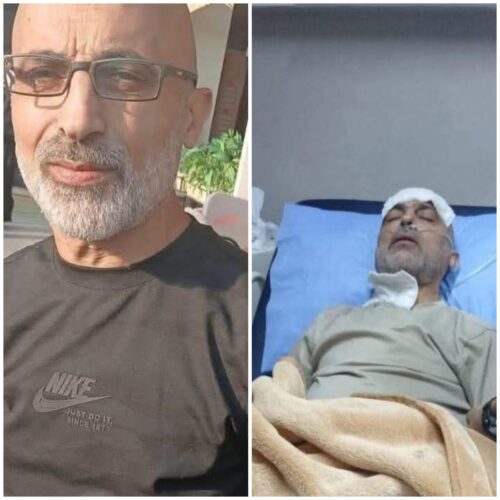
The Palestinian Detainees and Ex‑Detainees Affairs Commission and the Palestinian Prisoners’ Society announced on Friday the death of Riyad al‑Amour, a former political prisoner who had been forcibly transferred to Egypt following his release by Israel in late 2025.
Al‑Amour, 55, spent more than two decades in Israeli prisons and lived with severe, untreated medical conditions that rights groups say were the result of systematic medical neglect.
In a joint statement, the two organizations said al‑Amour endured 23 years of imprisonment marked by consistent medical violations, including the denial of essential treatment for chronic heart disease.
He was released as part of the prisoner‑exchange and ceasefire agreement reached between Hamas and Israel in October 2025, after his health had sharply deteriorated.
Al‑Amour, originally from the town of Tuqu’ near Bethlehem in the occupied West Bank, suffered from serious cardiac complications.
According to the statement, the Israeli Prison Service delayed for more than a decade the replacement of his pacemaker, despite repeated legal appeals. By the time of his release, his condition had become critical, and he underwent several surgeries in Egypt in recent months.
The Commission and the Prisoners’ Society held Israeli authorities fully responsible for his death, describing it as part of a broader policy of “slow killing” practiced against Palestinian detainees.
They said thousands of ill prisoners remain in Israeli custody without adequate medical care, and that al‑Amour’s case reflects a pattern of deliberate neglect.
His death comes only days after the Israeli Knesset approved the so‑called “Detainees’ Execution Law,” which authorizes the hanging of Palestinian detainees and grants legal immunity to those who carry out the executions. The legislation has drawn widespread international condemnation.
In related news, Palestinian rights groups warned of the rapidly worsening health of detainee Akram al‑Qawasmi, a Jerusalemite Palestinian political prisoner, held in the Israeli Gilboa prison.
More than 9,500 Palestinians are currently held in Israeli prisons, including women and children. Rights groups report that detainees face systematic torture, medical neglect, and degrading treatment, while 117 prisoners are now at risk of execution under the newly enacted Israeli law.
