
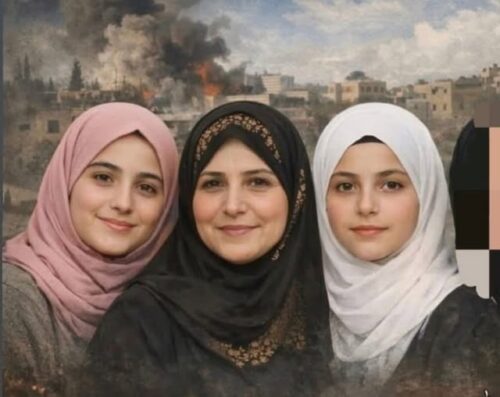
The Palestinian Red Crescent Society (PRCS) has confirmed that three Palestinian women were killed, and thirteen others were injured when missile debris struck a women’s beauty salon in the town of Beit Awwa, southwest of Hebron, in the occupied West Bank’s southern region.
The PRCS stated that the slain women, including a teenage girl, have been officially identified as:
- Mais Ghazi Masalma, 17.
- Sahera Rezeq Masalma, 50.
- Amal Sobhi Abdul‑Karim Motawe’ (Masalma), 36.
It added that its medical teams, along with medics from the Doura Town Council, treated thirteen Palestinians for various injuries, including two women who suffered life‑threatening wounds.
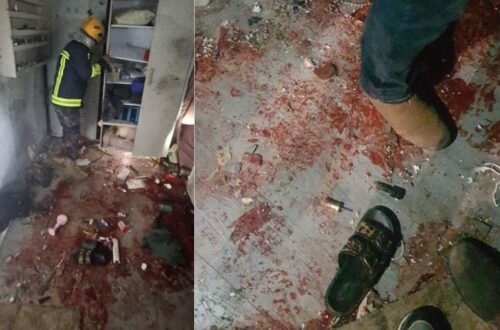
Yousef al‑Sweiti, head of the Beit Awwa municipality, salon was operating inside a metal container structure, which contributed to the severity of the casualties.
Hebron Governor Khaled Dudin said fragments fell in around ten different locations across the governorate, but the most serious impact occurred at the salon, where several women were inside at the time of the explosion.
The Palestinian Red Crescent Society reported that its teams treated multiple casualties, including one woman with a critical head injury who required field resuscitation before being transported to hospital. Civil defense crews said the metal structure of the salon intensified the impact of the blast.
Three women in the occupied West Bank were the first Palestinian victims of the US-Israeli war on Iran after the hair salon they were in was hit by falling debris. pic.twitter.com/ZdVWIijT99
— Al Jazeera English (@AJEnglish) March 19, 2026
Hebron Governor Khaled Dudin said fragments fell in around ten different locations across the governorate, but the most serious impact occurred at the salon, where several women were inside at the time of the explosion.
The Palestinian Red Crescent Society reported that its teams treated multiple casualties, including one woman with a critical head injury who required field resuscitation before being transported to hospital. Civil defense crews said the metal structure of the salon intensified the impact of the blast.
Security sources in the West Bank said the origin of the projectile has not yet been determined, and specialized teams will examine the remnants to identify the source.
The Emergency Response Media Committee said in a statement that Civil Defense crews, the Police Explosives Engineering Department, medical teams, and other relevant authorities worked together to follow up on the incident, secure the area, and address all resulting hazards.
In light of the situation, the committee urged residents to remain inside safe, reinforced locations, avoid sites where objects have fallen, and refrain from gathering near impact areas to allow specialized teams to operate. It also stressed the need to follow safety instructions issued by the competent authorities.
Since the start of the U.S.–Israeli war with Iran on February 28, the Police Explosives Engineering Department and Civil Defense teams have responded to multiple incidents involving falling missile fragments and remnants across several governorates, which have caused injuries and property damage.
The Explosives Engineering Department had previously warned residents not to approach missile fragments or remnants under any circumstances.
In its statement, the department said: “Given the current conditions and the possibility of missile fragments or remnants falling in various areas, the police urge citizens to follow these safety guidelines: do not approach any foreign object, fragment, or missile remnant that may fall in residential areas; avoid standing in open spaces during bombardment or climbing onto rooftops; take cover in a safe location; and do not touch or move any such objects, as they may contain hazardous, toxic, incendiary, or unexploded materials.”
The department also called on residents to keep children and others away from the site of any fallen object, prevent gatherings near the area, and immediately notify the police through the emergency number (100) or Civil Defense at (102), providing the exact location when possible.
It further urged citizens not to attempt to photograph the object or approach it, due to the danger this poses to public safety, and to comply with the instructions of security services until specialized teams arrive to neutralize the threat.
The police affirmed that Explosives Engineering teams are working around the clock to handle these objects and ensure affected areas are free of hazards, emphasizing that public cooperation and rapid reporting are essential to protecting lives and property.
The Israeli military issued a statement claiming the incident was caused by an Iranian cluster munition that fell in the area during the recent exchange of fire between Israel and Iran. The army said additional cluster submunitions also landed in nearby areas.
Palestinian officials have not confirmed this assessment, and no independent verification has been made.
Analysts note that while Israel attributes the incident to an Iranian munition, interception systems—such as Israeli air‑defense missiles—can also produce hazardous debris when intercepting incoming projectiles.
In previous escalations, including recent interceptions over the West Bank, fragments have fallen on residential areas, causing fires, structural damage, and injuries.
This is the first incident involving multiple fatalities not directly caused by Israeli soldiers and paramilitary colonizers in the West Bank since the beginning of the Israel–Iran War. However, it is not the first time debris or fragments have caused injuries or damage across the occupied West Bank.
In recent days, residents in Hebron, Bethlehem, and parts of the Jerusalem district have reported falling fragments, loud explosions, and shrapnel impacts linked to regional missile exchanges and interception activity.
The Palestinian Emergency Response Media Committee said Civil Defense teams, police explosive‑engineering units, medical crews, and other relevant authorities secured the area and handled the aftermath of the incident.
The committee urged residents to remain inside safe, reinforced locations during such events, avoid approaching impact sites, and refrain from gathering to allow emergency teams to work safely. It also called on the public to follow official safety instructions issued by relevant authorities.
