
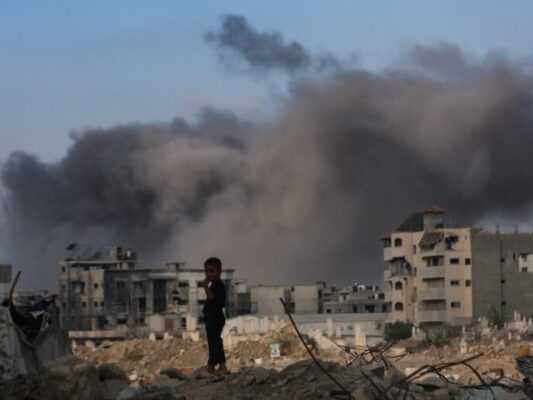
Israeli artillery and airstrikes continued across the Gaza Strip on Friday, killing and injuring Palestinians in clear violations of the declared ceasefire. Despite international announcements of a ceasefire, attacks on residential areas, displacement zones, and civilian shelters have persisted, leaving families with no safe place to flee.
Six Palestinians were killed, and others injured, including children, after Israeli artillery shelled a school sheltering displaced families near Ad‑Durra Hospital in the Tuffah neighborhood, east of Gaza City.
The school had been serving as a refuge for families displaced from northern and central areas. Rescue teams reported difficulty reaching the site due to continued shelling, and the death toll is expected to rise.
In a separate incident, four Palestinians, including a woman, were killed in a series of airstrikes on the town of Bani Suheila, east of Khan Younis, over the past 24 hours.
The strikes hit residential areas where civilians had gathered. Civil defense crews were unable to retrieve several bodies because Israeli aircraft continued to circle overhead, making the area too dangerous to access.
Early Friday, Israeli forces carried out further attacks on Khan Younis and Rafah, striking residential districts and displacement zones with warplanes and artillery.
Families who had already been displaced multiple times described renewed panic as shelters, tents, and makeshift camps came under fire.
Casualties Since the Ceasefire and Since October 7, 2023
Updated figures from the Palestinian Ministry of Health in Gaza show that at least 70,373 Palestinians have been killed and 171,079 injured in the Gaza Strip since October 7, 2023. The majority of the victims are women and children. Thousands more remain missing under rubble or in areas that rescue teams cannot reach.
Since the “ceasefire” began on October 11, 2025, at least 383 Palestinians have been killed and 1,002 injured.
These figures include people killed in ongoing Israeli attacks as well as those who died from earlier wounds, untreated injuries, and the collapse of medical care during the ceasefire period.
The World Health Organization reported that 1,092 patients in Gaza died while awaiting medical evacuation between July 2024 and last November, underscoring the collapse of the health system and the inability of critically ill patients to access life‑saving treatment.
Humanitarian organizations warn that the real toll is higher. Many bodies remain trapped under destroyed buildings, and deaths from starvation, dehydration, exposure, and preventable disease are rising sharply as essential services continue to collapse.
Humanitarian Conditions: A War Without a Real Pause
Despite the “ceasefire,” Palestinians in Gaza continue to face airstrikes, artillery fire, sniper attacks, mass displacement, and severe shortages of food, clean water, fuel, and medicine.
The destruction of hospitals and clinics has left large parts of the Strip without functioning medical services.
A spokesperson for the UN’s International Organization for Migration, Avand Aziz Agha, said that people in Gaza urgently need improved living conditions that ensure access to clean water, sanitation services, toilets, and protection from the cold.
Agha made the remarks alongside World Health Organization spokesperson Tarik Jasarevic during the UN Office’s weekly press briefing in Geneva.
He noted that winter conditions—heavy rain, intense winds, and recurring storms—are causing flooding in destroyed neighborhoods, submerging tents, and exposing displaced families to greater risks of illness and disease.
He called for immediate and unrestricted humanitarian access to the Gaza Strip at a time when Israel continues to block the entry of tents and shelter materials, forcing hundreds of thousands of people to live in worn‑out, makeshift shelters that offer little protection from the elements.
Freezing temperatures in makeshift shelters have already caused preventable deaths. In al‑Mawasi, west of Khan Younis, a one‑month‑old infant died of hypothermia after the family was unable to find adequate shelter or heating.
Humanitarian agencies report a sharp rise in indirect deaths caused by hunger, dehydration, untreated injuries, infectious disease, and exposure. Aid workers warn that these deaths may soon surpass the number of people killed directly by Israeli strikes.
Continued Attacks Across the Gaza Strip
The shelling of the school near Al‑Durra Hospital, the airstrikes on Bani Suheila, and the renewed bombardment of Khan Younis and Rafah reflect a broader pattern of a continued Israeli military offensive across Gaza. Residential neighborhoods, market streets, displacement camps, and public facilities have all been struck during the ceasefire period.
Many of the families affected had already been displaced multiple times, moving from one area to another in search of safety. Each new attack forces them to abandon what little they have managed to gather, deepening the humanitarian crisis and leaving thousands without shelter, food, or medical care.
Despite international calls for a genuine halt of all attacks, Palestinians in Gaza continue to be killed, injured, and uprooted on a near‑daily basis.
The gap between diplomatic language and reality on the ground remains stark, with civilians bearing the full weight of a war that has not meaningfully stopped.
