
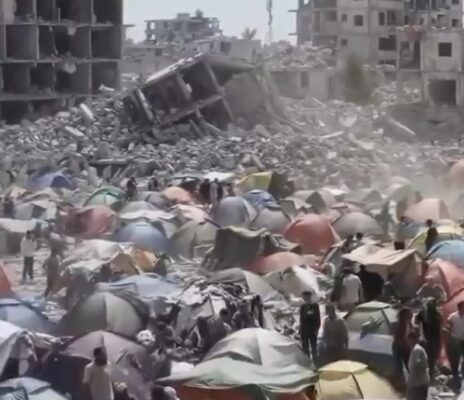
Medical sources in the Gaza Strip reported on Saturday that the cumulative death toll has climbed to 72,051 Palestinians, while the number of wounded has reached 171,706 since the beginning of the genocide on October 07, 2023. The majority of the victims are women and children, according to hospital officials.
New Casualties in the Last 24 Hours
Hospitals across the Strip received the bodies of two Palestinians, both recovered from beneath the rubble of destroyed homes, along with 15 wounded.
Emergency and civil defense teams continue to warn that the figures do not reflect the full scale of casualties, as many victims remain trapped under collapsed buildings and in areas inaccessible due to ongoing Israeli military activity and the destruction of roads and infrastructure.
The Israeli genocide army continues to systematically target every aspect of life in Gaza, destroying it to make conditions unlivable and force its people into displacement and exile. pic.twitter.com/8yC0FYEzFS
— Ramy Abdu| رامي عبده (@RamAbdu) February 14, 2026
Field medics say that repeated Israeli fire in several districts has prevented ambulances from reaching the injured, particularly in northern Gaza and the central refugee camps, where Israeli forces maintain heavy presence and impose movement restrictions.
Casualties Since the Ceasefire Announcement
Despite the declared ceasefire framework on October 11, 2025, Israeli attacks have persisted.
Medical authorities confirmed that the number of Palestinians killed since that date has risen to 591, while 1,598 have been injured. Civil defense teams have also managed to recover 726 bodies from destroyed neighborhoods during this period.
Gaza has been reduced by the Israeli military to a huge refugee camp with unlivable conditions. pic.twitter.com/XXsvw8CU2O
— Nicola Perugini (@PeruginiNic) February 13, 2026
Reports from Al‑Jazeera and local agencies note that Israeli forces continue to carry out strikes and open fire in areas designated as “buffer zones,” often claiming to respond to alleged ceasefire violations.
Residents and humanitarian workers describe a pattern of daily attacks that undermine the ceasefire’s credibility and impede relief operations.
Ongoing Israeli Violations Across the Strip
Multiple news outlets, including Al‑Jazeera Arabic and Maan News, documented several incidents in the past 48 hours:
- Israeli drone fire targeted civilians in eastern Gaza, including areas near Deir al‑Balah and the central camps, resulting in additional casualties.
- Live fire from Israeli military positions east of Gaza City killed and wounded Palestinians attempting to move between neighborhoods.
- Artillery shelling was reported near the northern districts, where thousands of displaced families remain without adequate shelter, food, or medical care.
- Civil defense teams estimate that thousands of bodies remain under the rubble of destroyed residential blocks, particularly in Gaza City and Jabalia, where heavy bombardment earlier in the war flattened entire streets.
Humanitarian organizations warn that the inability to retrieve the dead is contributing to a growing public health crisis, as decomposing bodies remain in densely populated areas.
Humanitarian Conditions Continue to Deteriorate
Al‑Jazeera’s latest reporting highlights severe shortages of food, clean water, and medical supplies. Winter conditions have worsened the suffering of displaced families, many of whom are living in makeshift shelters or open areas without heating or sanitation.
Israeli drones are systematically targeting and destroying solar energy panels across northern Gaza, wiping out the area’s last remaining source of power. pic.twitter.com/BZaitj2bER
— Middle East Eye (@MiddleEastEye) February 14, 2026
Aid agencies say that only a fraction of the promised humanitarian convoys is entering Gaza, far below the levels required to sustain the population. The destruction of hospitals, clinics, and water networks has left entire districts without essential services.
A Worsening Humanitarian Catastrophe
The cumulative toll—more than 72,000 killed and 171,000 injured—reflects what health officials describe as an unprecedented humanitarian catastrophe.
International legal experts and human rights organizations continue to warn that the real number of victims may be significantly higher, given the thousands still missing under the rubble and the collapse of Gaza’s health system.
Despite international calls for accountability and the protection of civilians, Israeli military violations continue to inflict heavy casualties, raising further concerns about the sustainability of the ceasefire framework and the prospects for meaningful humanitarian relief.
