
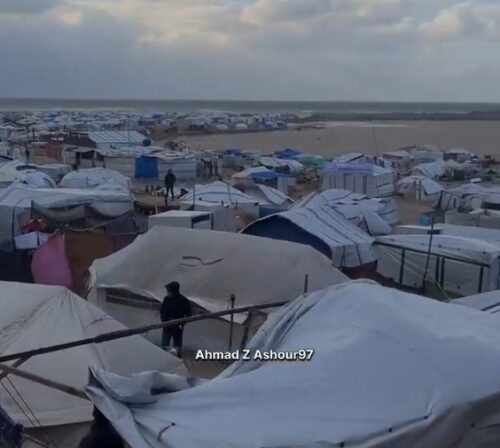
Four Palestinians, including two young girls and a two‑month‑old infant, were killed and several others were injured over the past two days in separate incidents across the Gaza Strip, as ongoing Israeli attacks, collapsing bombarded buildings, and severe winter storms continue to create lethal conditions for displaced families.
Medical sources said a child was injured when an Israeli drone fired at the town of Bani Suheila, east of Khan Younis in southern Gaza.
In the Al‑Mawasi area of Rafah, Gaza’s southernmost region, a girl was killed, and several displaced civilians were injured when a wall of a previously bombarded property collapsed onto tents during heavy storms.
The collapse occurred in an area designated as a “safe zone,” where thousands of displaced families have been forced to shelter in fragile tents beside damaged structures.
Earlier, eleven‑year‑old Dana Hussein Ahmad Muqat was killed by Israeli fire in the Zarqa area of al‑Tuffah in Gaza City. Local sources said she was shot without warning while walking near her family’s shelter.
In central Gaza, a woman was shot in the back by Israeli forces east of Deir al‑Balah, near the Israeli‑imposed “Yellow Line,” where troops continue to enforce a lethal perimeter despite the declared “ceasefire.”
Residents say the boundaries of the zone shift without notice, placing civilians at constant risk.
These incidents come as the Palestinian Ministry of Health in Gaza reported on Monday that one body was recovered and three people were injured over the past 48 hours.
Medical teams said the recovered body was pulled from beneath rubble in an area civil defense crews had previously been unable to reach due to flooding and structural instability.
Emergency workers warn that an unknown number of victims remain trapped under destroyed homes and in streets that rescue teams cannot access because of debris, damaged roads, and the risk of renewed fire from Israeli forces.
The Ministry of Health also confirmed the death of a man after a building collapsed due to severe weather, raising the number of people killed by weather‑related structural failures to seventeen.
In addition, two‑month‑old Arkan Firas Musleh died from extreme cold, bringing the number of weather‑ and cold‑related fatalities to three. Health officials say these deaths reflect the extreme vulnerability of displaced families living in unheated tents, many of which have been flooded or destroyed.
Humanitarian agencies, including UNRWA and OCHA, have warned that heavy rain, flooding, and intense winds are creating life‑threatening conditions for displaced families across the Strip.
Sewage overflows have contaminated water sources, increasing the risk of disease, while the lack of winter clothing, heating, and insulation has left infants and young children particularly vulnerable to hypothermia.
UN teams report that some families have been forced to burn plastic and scrap wood to stay warm, creating additional health hazards.
The severe weather has also caused further collapses of bombarded buildings, many of which were left structurally unstable after months of Israeli airstrikes.
Civil defense crews say they receive multiple calls each day about partial or full collapses in Gaza City, Khan Younis, Rafah, and central Gaza, often in areas where displaced families have set up tents next to damaged structures.
Since the “ceasefire” took effect on October 11, the Ministry of Health has documented 414 Palestinians killed and 1,145 injured. During the same period, 680 bodies have been recovered from beneath collapsed buildings and destroyed neighborhoods.
Health officials say the toll is expected to rise as access improves to areas that remain cut off by debris, flooding, and damaged infrastructure.
The cumulative death toll since the start of the genocide in Gaza on October 7, 2023, has now reached at least 71,266 killed and more than 171,222 injured, most of them children, women, and elders.
Hospitals continue to receive casualties daily, including victims of structural collapses caused by winter storms that have battered the Strip for more than a week.
