
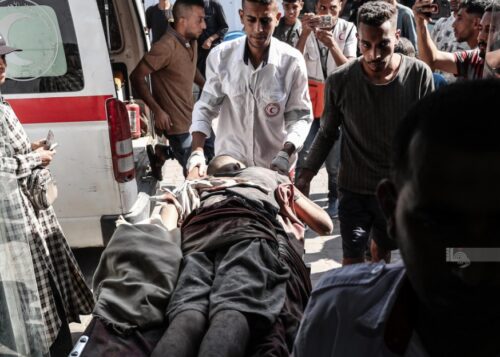
Israeli airstrikes on Wednesday killed one Palestinian and injured several others west of Khan Younis in the southern Gaza Strip, as humanitarian conditions across the enclave continue to deteriorate amid ongoing restrictions on aid and medical access.
Medical teams said the strike hit an area near Al‑Aqsa University, killing a man and wounding others.
The attack is part of continued Israeli bombardment despite the “ceasefire” framework announced in October of last year.
Since that period began, more than 677 Palestinians have been killed and nearly 1,813 injured, while 756 bodies have been recovered from destroyed areas.as confirmed by the Ministry of Health.
The ministry reported four deaths in the past 24 hours, including one person who died from earlier wounds, and 14 additional injuries.
Since October 7, 2023, the overall death toll in Gaza has risen to 72,253, with 171,912 injured.
Health officials say many victims remain under rubble or in areas emergency crews cannot reach due to ongoing bombardment and the collapse of civil defense services.
Continued Strikes Across the Strip
Reports from Al‑Jazeera Arabic and English indicate that Israeli forces also struck areas in eastern Gaza City, northern Gaza, and the eastern and southern outskirts of Khan Younis.
Naval fire was reported off the coast, and drones carried out additional attacks in Gaza City’s eastern neighborhoods.
Recent strikes have killed women, children, and entire families, according to medical teams, who say field hospitals and emergency points are struggling to cope with the influx of casualties.
UN and UNRWA Warn of Worsening Humanitarian Conditions
UNRWA said Wednesday that the humanitarian situation in Gaza remains “catastrophic,” with aid restrictions and the continued closure of key crossings—particularly Rafah—leaving hundreds of thousands of displaced Palestinians without sufficient food, water, or medical care.
Anyone claiming Gaza has “recovered”
This is the bare minimum of what we wake up to. pic.twitter.com/w1T4UtJquG— zinah𓂆 (@zhal80) March 18, 2026
The agency said it continues to provide primary healthcare, shelter, food distribution, and other essential services, but warned that needs far exceed available resources.
UN agencies report that:
- Patients requiring medical evacuation remain unable to leave Gaza, with hospitals operating at minimal capacity.
- Fuel shortages are forcing medical centers to ration electricity, affecting surgeries, dialysis, neonatal care, and refrigeration of medicines.
- Food insecurity has reached extreme levels, with families resorting to unsafe materials for cooking.
- Water scarcity is contributing to rising cases of dehydration and waterborne diseases.
Do your hearts feel for our children? 💔
If you see this video, put a dot to break the algorithm. pic.twitter.com/QObvkjSw6S— NADA 𓂆 (@nadaa01012) March 18, 2026
A recent analysis published in The Lancet Global Health estimated that more than 75,000 Palestinians were killed in the first 15 months of the genocide, highlighting the scale of destruction and the collapse of civilian infrastructure.
Civilians and Hospitals Under Severe Strain
Displaced families in Khan Younis and Gaza City report ongoing bombardment, limited access to shelter, and severe shortages of food and clean water. Many have been displaced multiple times, moving between overcrowded shelters, damaged schools, and makeshift tents.
Hospitals—already overwhelmed—say they cannot accommodate the number of patients suffering from burns, shrapnel wounds, respiratory injuries, and complications from untreated chronic illnesses.
International Agencies Call for Immediate Access
UN officials and humanitarian organizations continue to warn that without unrestricted aid access and protection for civilians, conditions in Gaza will worsen further.
UNRWA said the combination of continued strikes, displacement, and the collapse of essential services has created one of the most severe humanitarian crises in recent decades.
