
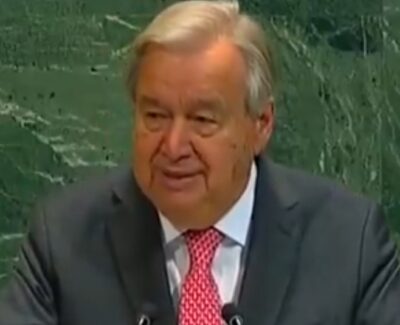
United Nations Secretary‑General António Guterres welcomed the International Court of Justice’s advisory opinion reaffirming core obligations that, under international law, rest on Israel as the occupying power in the Occupied Palestinian Territory.
In a statement issued by his office, Guterres said the ruling strengthens the legal basis for protecting the Palestinian people’s right to self‑determination and for guaranteeing the immediate and unhindered flow of life‑saving supplies to civilians in Gaza.
The opinion, requested by the UN General Assembly, interprets the duties of an occupying power in relation to the presence and activities of the United Nations, other international organizations and third States.
It places operational humanitarian responsibilities squarely within the law of occupation and international human‑rights law, and underlines that an occupying power must agree to and facilitate relief consignments, basic services, and the protection of civilians.
The Court made clear that security concerns cannot justify a blanket denial of humanitarian operations and that any measures taken for legitimate security purposes must remain within the legal limits that govern occupation.
The opinion highlights the relevance of the Fourth Geneva Convention’s provisions on relief consignments, affirms the duty to protect relief and medical personnel and facilities, and reiterates the prohibition of starvation as a method of warfare.
Guterres emphasized the need to preserve the privileges and immunities of UN personnel and premises so that agencies can operate safely. He singled out the UN Relief and Works Agency for Palestine Refugees (UNRWA) as a critical actor whose ability to deliver aid must be protected.
He urged all parties to comply fully with obligations under international humanitarian law and international human‑rights law.
Although advisory opinions are not binding, the Court’s analysis carries substantial legal and moral weight and is expected to shape diplomatic responses, operational planning by humanitarian agencies and the positions of member states.
UN bodies and aid organizations are likely to cite the ruling when pressing for restored supplies, fuel, and medical infrastructure and when arguing against actions that impede relief or endanger humanitarian staff.
The opinion arrives amid long‑running warnings from UN officials about the humanitarian conditions in Gaza, persistent obstacles to aid convoys and repeated appeals for unimpeded access.
For humanitarian actors on the ground, the immediate question is whether the Court’s conclusions will translate into concrete changes in access, enhanced protection for relief workers and the unblocking of essential supplies.
Diplomatically, the ruling is likely to intensify activity in New York, Geneva, and capitals around the world as governments and international institutions consider how best to implement the Court’s findings.
The General Assembly and other UN organs may use the opinion to underpin resolutions or coordinated measures aimed at ensuring compliance with the obligations the Court identified.
Guterres said the United Nations will transmit the advisory opinion to the General Assembly and other relevant UN organs and will press for steps that remove barriers to relief, protect civilians, and preserve humanitarian operations.
He framed the opinion not only as a tool for short‑term humanitarian response but also as a legal anchor for renewed efforts to address the political and legal roots of the conflict and to advance a credible path to self‑determination and durable peace.
