
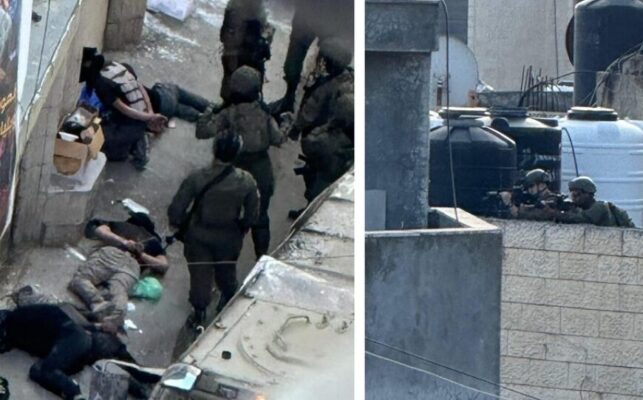
On Tuesday, Israeli occupation forces withdrew from Qalandia refugee camp and the nearby town of Kafr Aqab, north of occupied Jerusalem in the West Bank, after several hours of continuous military aggression that left multiple injuries, widespread property damage, and extensive detentions.
The Palestinian Red Crescent Society reported that its medical teams treated three Palestinians wounded by live ammunition, three others injured by rubber‑coated metal bullets, one person assaulted by soldiers, and 17 cases of tear‑gas inhalation resulting from the firing of toxic gas.
The Jerusalem Governorate said at least three Palestinians were shot by Israeli forces, in addition to dozens suffering from tear‑gas inhalation and stun‑grenade blasts, during the large‑scale invasion of Kafr Aqab and Qalandia refugee camp.
The offensive included heavy military deployment, broad home invasions, and the storming of shops.
According to the Governorate, Israeli forces abducted Anan Mohammad Taha and his father, Mohammad Taha, both residents of Qalandia refugee camp.
Troops also detained several other residents, assaulted them, and held them for extended periods.
During the invasion, Israeli forces stormed multiple residential buildings at the entrance to Qalandia refugee camp, taking over rooftops amid a wide military presence in the surrounding area.
Soldiers forced residents—under threat and the use of force—to evacuate three apartments inside the Hassan Awad building opposite the refugee camp’s main mosque.
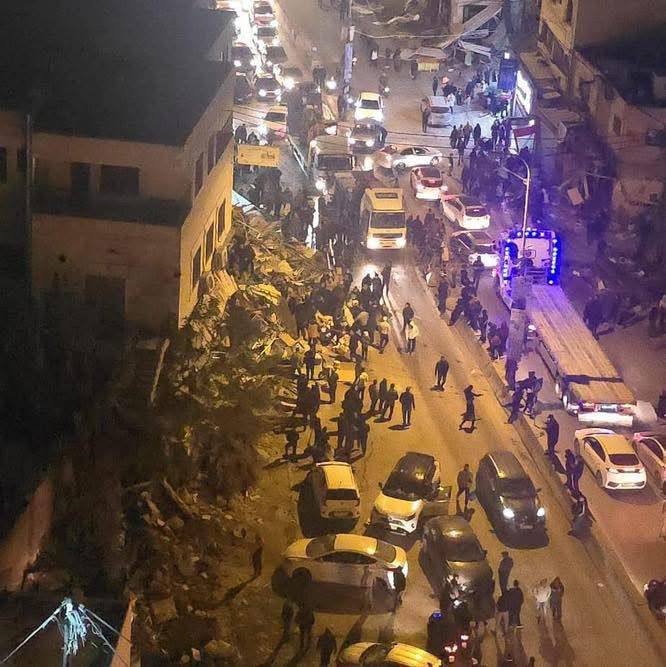 One of the evacuated apartments was converted into a military post after its occupants were removed by force. Israeli forces announced they intended to continue using the apartment as a military position until 9 a.m. the following day.
The invasion involved units from the Israeli army, police, Border Guard, tax authority, and the Jerusalem municipality, accompanied by numerous bulldozers, cranes, and mechanical cutters.
Troops also stormed dozens of shops, seizing as well as quantities of eggs and meat under the pretext of lacking permits. They additionally confiscated cigarette cartons, claiming unpaid taxes, with the value of seized goods amounting to tens of thousands of shekels.
The Jerusalem Governorate reported that Israeli forces seized the contents of an agricultural nursery opposite the refugee camp, obstructed the work of ambulance crews, and assaulted journalists covering the events.
Soldiers also fired stun grenades directly at schoolchildren returning home and confiscated private surveillance cameras from the area.
In a later development, Israeli forces began demolition operations along the main road extending from the Qalandia military roadblock to Kafr Aqab.
Troops damaged and destroyed several Palestinian‑owned vehicles and seized others, raising widespread fears that the demolitions would expand further.
The soldiers also removed advertising signs from the main road and from in front of commercial shops, demolished a bird‑selling shop belonging to Eyad Fiala, and destroyed a memorial structure dedicated to Mahmoud Awad at one of the refugee camp’s entrances.
During the extended invasion, Israeli forces demolished the memorial monument of slain Palestinian Mahmoud Awad al‑Ahti.
The Qalandia military roadblock remained closed throughout the invasion, leaving hundreds of Palestinians traveling to or from occupied Jerusalem trapped on both sides of the barrier.
