
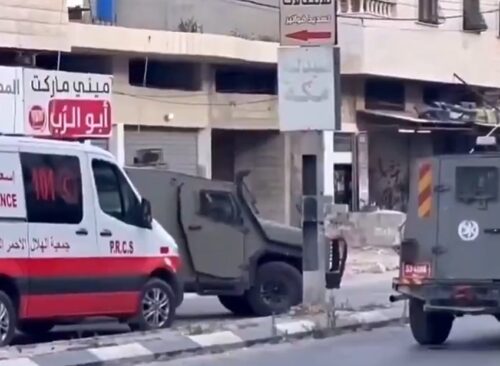
While headlines chase missiles and threats elsewhere, people in Gaza and the West Bank are being killed, buried, and pushed from their homes. The world’s attention has drifted; occupation and deadly violations have not.
This is not meant to undermine the suffering elsewhere; it is meant to show that Palestine is still facing the same fate — oppression, violations, and displacement.
A day like so many others
Not a day goes by without a bombing in Gaza. Not a day goes by without someone losing a home, a limb, a parent, or a child.
Hospitals run on fumes and improvisation. Food and fuel are rationed like contraband. Ambulances are delayed or turned back. Hunger and fear have become ordinary.
In the West Bank the violence looks different, but it is no less devastating. Night invasions, military roadblocks, and colonizer attacks have hollowed out villages.
Families who once tended olive groves now live with the constant threat of being forced out. Communities that have existed for generations are being depopulated in plain daylight.
 In one 24‑hour stretch, Israeli airstrikes in Gaza killed members of a family, in addition to killing nine police officers, while a collapsing wall crushed two women and a child; and in the West Bank, a family driving home was shot by Israeli soldiers, parents and two children killed, two more children wounded.
These are not isolated incidents. They are the daily arithmetic of a conflict that keeps adding names to lists and graves to cemeteries.
The human cost
Numbers flatten people. Behind every statistic is a person who loved and was loved. Funerals in Gaza are hurried, crowded, and raw. In the West Bank, parents bury children they once watched play in the street, and children participate in their parents’ funerals.
Survivors carry wounds that will not show up on any diplomatic brief: sleeplessness, the nightmares, the small children who flinch at the sound of a car door.
Displacement is not just a loss of shelter. It is the loss of memory, of routine, of the small certainties that make life livable.
When entire neighborhoods are razed or emptied, the social fabric tears. Aid that arrives is often too little, too late, and too politicized to reach everyone who needs it.
A politics of distraction
The current geopolitical spotlight has become a cover. As diplomats argue about threats and alliances, operations on the ground continue with little meaningful restraint.
Strategic calculations and political loyalties have, in practice, allowed impunity to persist. Investigations are slow or absent. Calls for accountability are drowned out by louder conversations about other theaters of conflict.
This is not a neutral observation. It is a moral one. When the protection of civilians is subordinated to geopolitical convenience, the predictable result is more death and more displacement.
The people living under occupation do not get to wait for the world to decide which crisis is more urgent.
What needs to happen now
Open the crossings and let aid through. Food, fuel, and medical supplies are lifesaving, not bargaining chips. Humanitarian access must be immediate, sustained, and protected from political games; every hour of delay costs lives, and every convoy blocked is a moral failure.
Protect civilians everywhere in the occupied territories. End the invasions that terrorize communities and colonizers’ violence that drives families from their homes.
The duty to protect is not optional: international law requires occupying powers to safeguard the population under their control and to prevent forcible displacement.
Investigate impartially and transparently. Independent inquiries into civilian deaths and violations are essential to deter future abuses and to deliver justice.
Accountability must lead to real consequences—criminal prosecutions where warranted, reparations for victims, and institutional reforms that prevent repetition.
Listen to the people who live this every day. Record their names, their testimonies, their funerals.
Let those stories shape policy rather than be erased by the next headline; human memory and legal record must work together to keep the truth alive.
This is not a footnote to another war. It is a living crisis. The world can look away, or it can act.
Silence and distraction are choices with consequences measured in bodies, broken homes, and children who will grow up knowing only loss.
If we claim to care about human life and dignity, words must be followed by action—now, not later. End the occupation and the structures of domination that make violence routine.
Enable people to live free in a sovereign, independent state without fear or oppression. That is both a legal obligation and a moral imperative; anything less is a betrayal of the values we say we hold.
