
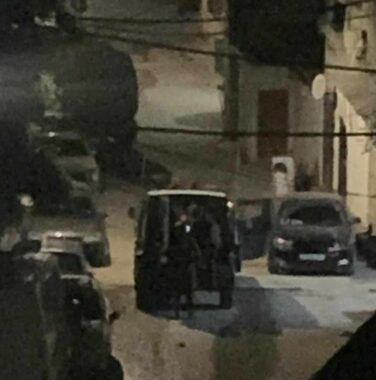
Israeli occupation forces escalated their military campaign across the occupied West Bank on Saturday, invading multiple towns and abducting civilians from their homes. The incursions were accompanied by road closures, military roadblocks, and assaults by the paramilitary colonizers.
In Jenin, several military vehicles invaded Qabatia town, before the soldiers stormed and searched several homes.
In Hebron, in the southern West Bank, Israeli troops invaded the town of ath-Thaheriya, south of the city, stormed the home of Ahmad Hassan Nasrallah, vandalized its contents, and abducted him.
Simultaneously, occupation forces erected military roadblocks at key junctions across Hebron’s towns, villages, and refugee camps, sealing off roads with iron gates, concrete blocks, and earth mounds, further entrenching the fragmentation of Palestinian movement.
In Bethlehem Governorate, six Palestinians were abducted during a series of coordinated invasions.
Troops invaded the town of al-Obeidiyya, east of Bethlehem, stormed and ransacked several homes, and abducted five residents: Hisham Dawoud Ahmad Radayda, 47, Eyad Yousef Safi Hassasna, 42, Fawzi Amer Mohammad Abu Sarhan, 48, Mojahid Mohammad Safi Hassasna, 24, and his brother Younes, 26.
From the Abu Njeim area east of Bethlehem, Israeli forces abducted Issa Nasser Issa Shawka, from his home.
In a related incident, occupation troops invaded the town of Tuqu’, southeast of Bethlehem, stormed the home of Habis Dakhlallah Ahmad al-Amour, and handed him a summons for interrogation.
Meanwhile, in Jericho, in the northeastern West Bank, illegal paramilitary Israeli colonizers invaded the Shallal al-Awja Bedouin community, unleashing livestock into residential areas to destroy property and intimidate residents.
Hassan Mleihat, General Coordinator of the Al-Baidar Organization for the Defense of Bedouin Rights, reported that colonizers from nearby colonialist outposts routinely invade the community multiple times daily, conducting systematic assaults aimed at forcibly displacing families.
“These attacks are part of a broader campaign of coercive transfer,” Mleihat stated, “daily life here has become a persistent tragedy for families struggling to survive under siege.”
