
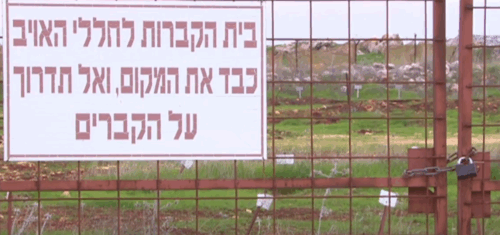
In a statement released on Wednesday, the National Campaign for the Recovery of Martyrs’ Bodies, announced that the Israeli occupation continues to withhold the bodies of 726 Palestinians from the West Bank, and at least 1,500 from Gaza.
The group announced that on August 27, National Recovery of Martyrs’ Bodies Day, the bodies of 726 slain Palestinians from the West Bank are still held by Israeli authorities in refrigerators and buried in cemeteries of numbers, while the bodies of 1,500 slain Palestinians from Gaza are held at the Sde Teiman detention camp.
The National Campaign for the Recovery of Martyrs’ Bodies stated that Israel has persisted with its policy of withholding bodies since occupying the west Bank and Gaza in 1967, adding that this constitutes a flagrant violation of the Geneva Conventions.
The campaign was launched in 2008 by the Jerusalem Legal Aid and Human Rights Center (JLAC) to document cases and pursue legal action.
The Palestine Chronicle quoted that the Islamic Resistance Movement Hamas who said “The occupation’s detention of our people’s martyrs’ bodies is a heinous Zionist crime that reveals its sadism and brutality, and we call for international action to expose the occupation and pressure it by all means to recover them,” adding that this practice “confirms to the world that this is a rogue entity that warrants isolation, boycott, and prosecution.”
Below is the translation of the fact sheet from the Palestinian News and Information Agency (WAFA).
FACT SHEET | Withholding Bodies: The Israeli Occupation’s Policy of Punishing Palestinians After Death
-
Overview
For more than five decades, the Israeli occupation authorities have continued their policy of withholding the bodies of Palestinian martyrs killed by its forces without dignity.
Their families are denied the most basic rights to bid farewell and bury their loved ones, known as “cemeteries of numbers.”
The bodies are placed in secret cemeteries or in refrigerators, but rather in morgues.
This policy is not merely a gradual consolidation of the Israeli system. It is an extension of the logic of colonial control that extends beyond the lives of Palestinians to their deaths, depriving them of dignity, memory, and the right to bid farewell.
-
The Politics of Controlling Death
The withholding of bodies represents one of the most prominent forms of what researchers call “necropolitics,” the use of the posthumous body as a means of domination and oppression.
By denying Palestinians public mourning, the occupation authorities impose their control over the deepest feelings of loss, often forcing families to wait endlessly to retrieve the bodies of their children.
Even after their release, harsh conditions are imposed on them: nighttime burials, a limited number of participants, and a heavy security presence.
In this way, the Israeli occupation controls not only the lives of Palestinians but also their death rituals and memories.
-
Withholding Bodies in Israeli Law
The withholding of bodies began as an irregular military practice, but it quickly became entrenched in Israeli legal structure.
Since 1967, hundreds of bodies have been buried in secret numbered cemeteries.
In 2004, a directive was issued restricting this practice, based on the British Emergency Regulations of 1945.
In 2017, the Supreme Court ruled temporarily that there was no legal basis for the detention, but postponed implementation of the ruling to give the government an opportunity to legislate to give it “legitimacy.”
The Knesset responded by amending the Anti-Terrorism Law in 2018, giving the police formal authority to withhold bodies.
In 2019, the court reversed its decision and authorized detention for “bargaining” purposes, before the policy was expanded in 2020 to include all Palestinians accused of carrying out attacks.
Thus, an illegal practice is transformed into a comprehensive legal system through a combination of military orders, judicial decisions, and new legislation.
-
The Human Impact on Families
This policy leaves devastating human consequences. Families live in a state of “suspended mourning,” unable to begin the natural process of grieving in the absence of the body.
Often, the bodies are handed over while they are gathered, disfigured, or disfigured, and the family is robbed of the opportunity to say a final goodbye.
In many cases, the occupation authorities demand exorbitant sums of money, impose nighttime funerals, or transport the body to cemeteries far from the family.
Thus, the oppression and humiliation extend even after death.
-
Numbers and Size
Data from the National Campaign for the Recovery of Martyrs’ Bodies indicates that the occupation continues to detain the bodies of 726 martyrs in its refrigerators and numbered cemeteries.
Of these, 256 are buried in numbered cemeteries, and 469 are still being held since the return of this policy in 2015, a clear indication of its escalation in recent years.
Israeli sources also document the detention of the bodies of more than 1,500 martyrs from the Gaza Strip since the start of the war of extermination in 2023.
They are being held in the Sde Teiman camp under inhumane conditions, confirming the systematic and long-term nature of these violations.
-
Violation of International Law
International human rights and humanitarian law strictly prohibit these practices. The Geneva Conventions require the dignified treatment of the dead and the return of their remains to their families.
Withholding bodies constitutes a violation of the right to dignity, family life, and religious freedom, and in some cases amounts to the crime of enforced disappearance.
-
Popular Action
In 2008, the Jerusalem Legal Aid and Human Rights Center launched the National Campaign to Recover the Bodies of Martyrs and mobilize international support.
Families were at the forefront of this struggle, organizing protests and insisting on their natural right to bury their children, documenting cases, and pursuing legal action.
The voices of mothers and fathers transformed an individual tragedy into a national cause, linking personal dignity and collective memory. This cause became a cornerstone of the occupation’s policies of erasure.
-
The struggle continues
The systematic withholding of bodies represents an extension of colonial domination.
The Palestinian body is held twice: during life and after death. By turning bodies into bargaining chips and denying families the opportunity to mourn, Israel seeks to erase memory and control humanity’s holiest rituals.
Nevertheless, Palestinian families and civil society continue their struggle, transforming the battle for the return of bodies into an integral part of the broader struggle for justice, dignity, and the right to remembrance.
International solidarity and legal accountability have become more than a necessity to stop these practices and ensure the universal human right to dignity even after death.
