
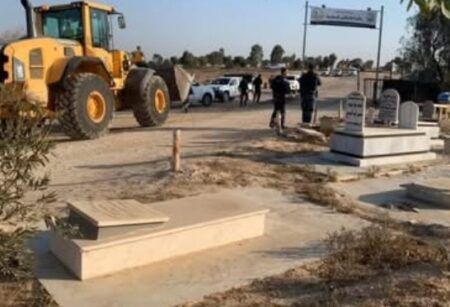
Israeli authorities, backed by police units and special forces, demolished the tents and structures of the unrecognized Palestinian village of al‑Arakib in the Naqab (Negev) region on Wednesday, marking the 244th demolition since the village was first destroyed on 27 July 2010. The previous demolition occurred on 28 July 2025.
Local sources reported that Israeli forces invaded the village early in the morning, demolished the residents’ tents and makeshift homes, and abducted Sheikh Sayyah al‑Turi, one of the community’s most prominent figures.
This marks the tenth demolition carried out against al‑Araqib, which predates Israel, since the beginning of 2025, following 11 demolitions in 2024, 11 in 2023, 15 in 2022, and 14 in 2021.
Residents and rights groups describe these repeated demolitions as part of a sustained campaign aimed at exhausting the community and forcing them off their land.
Despite the continuous destruction, the families of al‑Araqib insist on remaining on their ancestral land.
After every demolition, they rebuild their tents using wood and nylon sheets to withstand the extreme summer heat and winter cold, in defiance of ongoing displacement policies.
Al‑Araqib is home to 22 families, totaling around 86 residents, who rely on livestock herding and desert agriculture for their livelihood.
In the 1970s, residents succeeded—under Israeli legal procedures and requirements—in proving ownership of 1,250 dunams of their land, part of a much larger area historically belonging to the community.
Beyond al‑Araqib, dozens of unrecognized Palestinian villages across the Naqab (Negev) face daily threats of demolition and forced displacement.
Palestinian residents and rights organizations emphasize that the Israeli authorities’ use of “unlicensed construction” as a pretext is intended to undermine Palestinian land claims and consolidate control over Arab communities in the region.
These villages endure what residents describe as a severe humanitarian crisis, as they are denied basic services and infrastructure due to long‑standing discriminatory policies.
Communities continue to resist displacement efforts, asserting their right to remain on their land despite repeated demolitions and state pressure.
The village is located to the north of the city of Beersheba in the Negev desert (southern Palestine). It was established for the first time during Ottoman rule.
It is one of the 51 Arab villages in the Negev that the Israeli government does not recognize, although they predate Israel.
The occupation authorities have worked since 1951 to expel its residents to control their lands through extensive house demolitions and the vast lands equivalent to two-thirds of historic Palestine.
Israeli bulldozers demolished the village on July 27, 2010; Israeli troops demolished all its homes and displaced hundreds of its residents under the pretext of building without a permit.
About 240,000 Palestinians live in the Negev desert, half of whom live in villages and Bedouin camps, some of which have been in place for hundreds of years.
The Israeli occupation authorities do not recognize their ownership of the lands of these villages and communities, refuse to provide them with basic services such as water and electricity, and try by all means and methods to push the Palestinian Arabs to despair and frustration to uproot and displace them.
Article 17 of the United Nations Universal Declaration of Human Rights states in section 1: Everyone has the right to own property alone as well as in association with others, and in section 2: No one shall be arbitrarily deprived of his property.
It is worth mentioning that the so-called “Negev Development Plan,” launched in 2006 under Prime Minister Ehud Olmert, was presented as a national strategy to “revitalize” southern Israel.
However, its implementation began with the demolition of homes in unrecognized Arab villages such as Al-Za’roura and Al-Boheira. Bulldozers, backed by police and special forces, razed homes belonging to families like the Abu Jouda and Farraj families, many of whom were preparing for weddings or living with young children.
Rights advocates, including Hussein Al-Rafai’a of the Regional Council of Unrecognized Villages and Atiyya Al-A’sam of the Association of Forty, condemned the demolitions as acts of institutional racism and displacement.
They argue that the development plan was never intended to benefit the Indigenous Bedouin population, but rather to clear land for Jewish colonies and military-industrial expansion.
Recent iterations of the plan, including a 2025 government announcement, allocate billions of shekels for infrastructure, agritech, and innovation hubs in Jewish-majority towns such as Netivot, Ofakim, and Ashkelon.
Yet, unrecognized Bedouin villages remain excluded from these planning schemes, receiving no funding, legal recognition, or basic services.
The plan also coincides with the relocation of Israeli military bases to the south, as part of a broader strategy to militarize and industrialize the region.
A 2021 Times of Israel report highlighted a NIS 500 million investment tied to this move, including the creation of a military-academic-industrial ecosystem, again, with no inclusion of Bedouin communities.
