
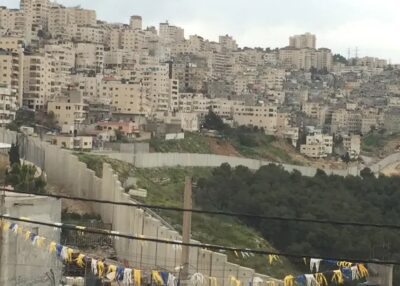
Occupied Jerusalem — Israeli occupation authorities issued new land confiscation orders on Saturday targeting privately owned Palestinian property in the town of Anata, northeast of Jerusalem.
The orders were distributed by the Israeli municipality to facilitate the construction of a parking lot and the expansion of roads leading to the Ma’ale Adumim colony.
Local sources confirmed that the targeted area spans approximately 140 dunums, stretching from the Shu’fat military roadblock through Ma’ale Adumim to the military base east of Anata town.
The confiscation is part of the so-called “E1,” a long-standing colonial project designed to link Ma’ale Adumim with Jerusalem and isolate all surrounding Palestinian communities.
The E1 plan, first introduced in the late 1990s, aims to consolidate Israeli control over the area between East Jerusalem and Ma’ale Adumim.
It includes thousands of housing units for the illegal Israeli colonizers, infrastructure, and facilities that would effectively sever East Jerusalem from the rest of the occupied West Bank, undermining the possibility of a contiguous Palestinian state.
Despite years of international opposition, Israeli authorities have accelerated the project in recent months.
Earlier this month, the Israeli government approved new construction tenders and roadworks in Ma’ale Adumim, declaring the area a strategic priority.
Rights groups warn that the expansion will deepen territorial fragmentation and entrench apartheid-like conditions.
The latest orders in Anata mark a renewed push to finalize the E1 corridor, as Israel intensifies colonialist activity ahead of expected international recognition of Palestinian statehood at the United Nations summit on September 22.
On Friday, Israeli occupation authorities seized hundreds of dunams of Palestinian agricultural land in the town of Nahhalin, west of Bethlehem in the occupied West Bank.
All of Israel’s colonies in the occupied West Bank, including those in and around occupied East Jerusalem, are illegal under International Law, the Fourth Geneva Convention in addition to various United Nations and Security Council resolutions. They also constitute war crimes under International Law.
Article 33 of the Fourth Geneva Convention prohibits collective punishment and acts of terror against civilian populations.
Article 49 of the Fourth Geneva Convention states: “The Occupying Power shall not deport or transfer parts of its own civilian population into the territory it occupies.” It also prohibits the “individual or mass forcible transfers, as well as deportations of protected persons from occupied territory”.
Articles 53 and 147, which prohibit the destruction of civilian property and classify pillage as a war crime.
