
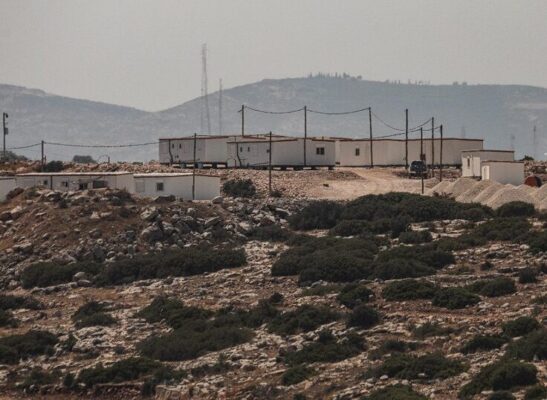
Israeli occupation authorities have advanced a new administrative measure to formalize and legalize the colonial outpost known as Givat Harel, built on Palestinian land near the town of Sinjil in the central occupied West Bank’s Ramallah governorate.
The measure gives the outpost independent administrative and planning jurisdiction, enabling infrastructure development, budget allocations, and expanded construction as part of Israel’s broader effort to entrench and legalize outposts across the central West Bank.
The Wall and Colonization Resistance Commission said Monday that the Israeli “Civil Administration” had approved Givat Harel’s jurisdictional boundaries, completing another step toward converting the outpost into a standalone settlement under Israel’s colonial system.
The newly defined jurisdiction includes areas Israel previously declared “state land,” allowing structural planning, budget allocations and the construction of roads, water networks, electricity lines and public facilities. The Commission said these steps would further integrate the outpost into Israel’s settlement network.
The Commission said the development is part of a process that began in February 2023, when the Israeli cabinet decided to “regularize” the adjacent outposts of Givat Harel and Givat Haro’eh.
The process advanced further in June 2026, when Israel declared 465.4 dunams of land in Sinjil and al-Lubban al-Sharqiya as “state land.” The declaration paved the way to formalize Givat Haro’eh and establish an area for future expansion that is more than four and a half times the outpost’s built-up footprint.
According to the Commission, the latest announcement concerns the jurisdiction of Givat Harel, also known as Karmi Oz, while the June declaration supported the expansion of Givat Haro’eh.
The two sites are linked through the 2023 cabinet decision and form part of a single colonial project intended to consolidate a chain of settlements and outposts around Sinjil and the “Shilo Valley.” Each site is being advanced toward independent planning and expansion, the Commission said.
The colonial council known as “Binyamin” said separating the administrative files of the two outposts had allowed Israeli authorities to accelerate planning procedures and grant full recognition to each site.
The Commission warned that defining a jurisdictional boundary is a particularly dangerous step because it transforms an outpost from an informal cluster of structures into an administrative unit with clearly defined borders.
Once a boundary is approved, Israeli institutions can prepare structural plans, allocate land and budgets, and build roads, water systems, electricity networks, and public facilities. The Commission said this process effectively turns facts established by colonizers into permanent settlements with formal planning, protection, and funding.
It said Israel uses a gradual process to entrench its colonial project: a political decision to “regularize” an outpost, followed by the declaration of surrounding land as “state land,” the definition of jurisdictional boundaries, the preparation of structural plans, the allocation of budgets and, finally, the issuance of tenders and implementation of construction.
The Commission said these actions are not separate projects but sequential stages leading to a single outcome: the seizure of Palestinian land and the conversion of outposts into official settlements capable of continued expansion.
The Commission also said Israeli media repeatedly presents each stage as a new achievement, creating an impression of continuous colonial progress and providing Israeli officials with material for political and electoral messaging.
It cited a statement issued Monday by Israel’s far-right finance minister, Bezalel Smotrich, who said authorities had approved 104 colonial sites, advanced 160 colonial farms and allocated substantial funding for roads and infrastructure. The Commission said the statement illustrated how administrative measures are being used to advance Israel’s annexation agenda.
The Commission stressed the importance of tracking each administrative action according to its legal character to prevent the same measure from being counted more than once. It also called for a unified spatial record linking land declarations, jurisdictional boundaries, structural plans and tenders.
It said the latest announcement marks a new stage in formalizing and administratively organizing the outpost rather than a new declaration of land seizure.
The Commission warned that the process is intended to expand the colonial belt around Sinjil and al-Lubban al-Sharqiya and connect it with the settlements of Shilo and Ma’aleh Levona and nearby outposts.
It said this would further constrain Palestinian agricultural and urban space, restrict access to land, and reshape geographic continuity in favor of Israel’s colonial project.
All of Israel’s colonies in the occupied West Bank, including those in and around occupied East Jerusalem, are illegal under International Law, the Fourth Geneva Convention in addition to various United Nations and Security Council resolutions. They also constitute war crimes under International Law.
Article 33 of the Fourth Geneva Convention prohibits collective punishment and acts of terror against civilian populations.
Article 49 of the Fourth Geneva Convention states: “The Occupying Power shall not deport or transfer parts of its own civilian population into the territory it occupies.” It also prohibits the “individual or mass forcible transfers, as well as deportations of protected persons from occupied territory”.
Articles 53 and 147, prohibit the destruction of civilian property and classify pillage as a war crime.
