
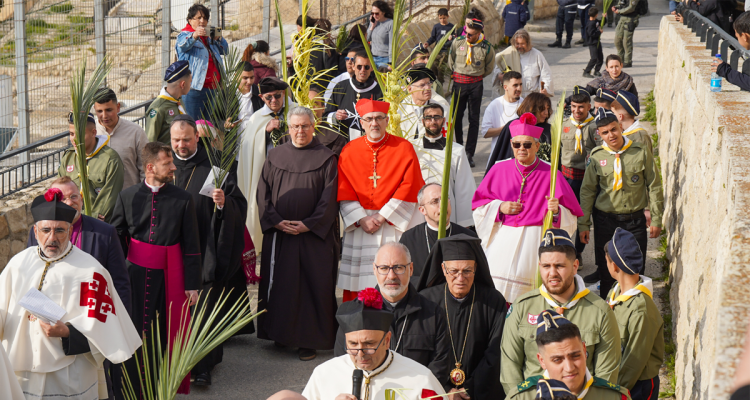
Jerusalem: for the first time in centuries, Israeli authorities prevented Palestinian and international Christians Palm Sunday Mass at the Church of the Holy Sepulchre.
Joint Press Statement Regarding Today’s Events
The Latin Patriarchate of Jerusalem and the Custody of the Holy Land The Holy City of Jerusalem Palm Sunday, March 29, 2026
Sunday morning, Israeli police prevented the Latin Patriarch of Jerusalem, His Beatitude Cardinal Pierbattista Pizzaballa—head of the Catholic Church in the Holy Land—alongside the Custos of the Holy Land, the Very Reverend Father Francesco Patton, the official guardian of the Church of the Holy Sepulchre, from entering the Church of the Holy Sepulchre in Jerusalem as they were heading to celebrate the Palm Sunday Mass.
The two were stopped en route while walking privately, without any procession or ceremonial display, and were forced to turn back. As a result, for the first time in centuries, the heads of the Church were prevented from celebrating the Palm Sunday Mass at the Church of the Holy Sepulchre.
This incident constitutes a dangerous precedent and expresses a disregard for billions of Christians around the world whose eyes are turned toward Jerusalem during this holy week.
The heads of the Churches have acted with full responsibility. Since the beginning of the war, they have adhered to all imposed restrictions: public gatherings were cancelled, attendance was prohibited, and arrangements were made to broadcast celebrations to hundreds of millions of believers worldwide who look to Jerusalem and the Church of the Holy Sepulchre during the Easter season.
Preventing the entry of the Cardinal and the Custos, who hold the highest ecclesiastical responsibility for the Catholic Church and the Holy Sites, constitutes a grave measure that is clearly unreasonable and excessive.
This hasty decision, marred by fundamental flaws and tainted by improper considerations, represents a sharp departure from the basic principles of reasonableness, freedom of worship, and respect for the Status Quo.
The Latin Patriarchate of Jerusalem and the Custody of the Holy Land express their deep sorrow to Christian believers in the Holy Land and across the world, as prayer on one of the holiest days of the Christian calendar has been barred in a manner that defies rationality, freedom of worship, and respect for the Status Quo.
In a statement, the Latin Patriarchate of Jerusalem said Pizzaballa arrived at the church accompanied by the Custos of the Holy Land, Father Francesco Elbo.
Both arrived “quietly and without any ceremonial procession,” but police barred them from entering, forcing them to leave the site.
The Patriarchate said the incident constitutes a historic breach, noting that “for the first time in centuries, the heads of the Church were prevented from celebrating the Palm Sunday Mass at the Church of the Holy Sepulchre,” effectively blocking one of the most significant Christian observances of the year.
In a joint statement, the Latin Patriarchate and the Custody of the Holy Land condemned the move as a “dangerous precedent” and an “utterly unreasonable and wholly inappropriate measure,” calling it a severe violation of basic principles of rationality, freedom of worship, and respect for the longstanding status quo.
They expressed “deep regret” that prayers were obstructed on one of the holiest days in the Christian calendar, saying the decision disregards the sentiments of believers worldwide.
The Jerusalem Governorate also condemned the decision, describing the prevention of the Palm Sunday Mass as a “flagrant violation” of international law, freedom of worship, and the city’s historical and legal status.
In a statement issued Sunday, the Governorate said the measure is “illegal and unjustified,” and part of a systematic policy aimed at undermining religious freedom and tightening control over Islamic and Christian holy sites.
The Governorate stressed that Israel, as an occupying power, “has no sovereignty over Jerusalem” and is obligated not to obstruct access to places of worship. It warned that the incident represents a “dangerous escalation” affecting the city’s religious and historical diversity, and called on the international community to intervene to halt such violations.
With access to the church blocked, the Palm Sunday Mass was held instead at the Latin Patriarchate headquarters in Jerusalem with limited attendance.
The Church of the Holy Sepulchre remained closed to worshippers, and prayers were dispersed across several locations in the city, including the Monastery of the Savior.
Italian Prime Minister Giorgia Meloni condemned the incident as an “offense to believers,” after the Latin Patriarch was prevented from entering the Church of the Holy Sepulchre. Meloni said the action “constitutes an affront not only to the faithful, but to any society that recognizes freedom of religion.”
Italian Foreign Minister Antonio Tajani announced on X that he had summoned the Israeli ambassador in Rome to protest the decision.
Israeli authorities have imposed restrictions on Christian religious gatherings, citing security concerns amid ongoing military escalation. Palm Sunday marks the beginning of Holy Week for Christians, leading up to Easter.
Church leaders in Jerusalem had called on Saturday for the reopening of the Church of the Holy Sepulchre ahead of Easter. The traditional Palm Sunday procession from the Mount of Olives to Jerusalem had already been canceled due to restrictions on access to religious sites.
Easter falls this year on April 5 for Western churches and April 12 for Eastern churches, amid continued limitations on access to holy sites in Jerusalem. Palestinian officials say these measures are part of a broader escalation targeting both Islamic and Christian holy places, as authorities continue to restrict worshippers’ access under the pretext of security.
Jordan’s Ministry of Foreign Affairs issued a strong condemnation of Israel’s decision to prevent the Latin Patriarch from reaching the Church of the Holy Sepulchre and leading the Palm Sunday Mass, calling it a blatant violation of international law, international humanitarian law, and the city’s historical and legal status.
Ministry spokesperson Ambassador Fouad Al-Majali reaffirmed Jordan’s rejection of Israel’s “illegal and restrictive measures” against Christians and its obstruction of free access to the Church of the Holy Sepulchre. He stressed the need to respect the city’s historical and legal status and reiterated that Israel, as the occupying power, has no sovereignty over Jerusalem.
Al-Majali also condemned Israel’s continued closure of the gates of the Al‑Aqsa Mosque/Al‑Haram Al‑Sharif and its restrictions on Muslim worshippers, calling it a grave violation of international law and the status quo. He warned of the dangers of continued restrictions.
He urged the international community to uphold its legal and moral responsibilities, compel Israel to halt its violations against Islamic and Christian holy sites in Jerusalem, respect the city’s historical and legal status, and support the Palestinian people’s legitimate right to establish an independent, sovereign state based on the two‑state solution.
