
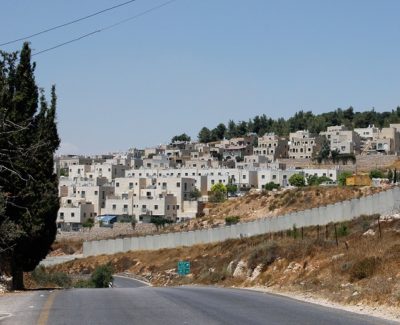
The Jerusalem Governorate said on Sunday that Israel’s “Planning and Construction Committee” in occupied Jerusalem is preparing to advance two major colonial construction plans that would significantly alter the landscape of East Jerusalem and further detach it from the rest of the occupied West Bank.
The governorate described the move as a serious escalation in long‑standing efforts to undermine Palestinian presence in the city, in violation of international law and UN resolutions.
According to the governorate, the first plan concerns the former Jerusalem International Airport site in Atarot, where Israeli authorities are planning to build nearly 9,000 colonial housing units on roughly 1,243 dunams north of the city.
The project would create a large colonialist block that severs the remaining geographic link between Jerusalem and Ramallah, effectively obstructing the possibility of a contiguous Palestinian state.
The plan had been scheduled for discussion in December 2025, but was postponed for political reasons before being placed back on the committee’s agenda.
The governorate said the Atarot project is part of a broader strategy to eliminate what was once envisioned as the future Palestinian state’s airport, a site that carried symbolic and political significance.
It also seeks to deepen the separation between Palestinian communities divided by the Annexation Wall by creating a dense colonial barrier that prevents territorial continuity.
The plan is tied to the Israeli “Greater Jerusalem” scheme, which aims to annex nearly 10 percent of the West Bank through a network of tunnels and bypass roads linking colonies northeast of the city.
The governorate added that Israel continues to reshape Jerusalem’s demographic balance through forced displacement, home demolitions, and population replacement, as reflected in official planning documents and land‑registration initiatives.
A second plan under review involves the “Nahalot Shimon” project in the Sheikh Jarrah neighborhood, in occupied Jerusalem, specifically in the Ard al‑Naqa’ area.
The proposal calls for demolishing the neighborhood and constructing a colony of 316 housing units on approximately seventeen dunams, displacing around 40 Palestinian families.
The plan relies on discriminatory legal mechanisms that allow colonist groups to claim properties allegedly owned by Jews before 1948, while denying Palestinians the right to reclaim properties from which they were forcibly expelled.
The governorate warned that developments in Sheikh Jarrah are part of a wider campaign to reengineer the neighborhood’s demographic and physical character.
Additional colonial projects are being advanced, along with efforts to link them to colonial outposts in the eastern part of the city, stretching through Karm al‑Mufti and Mount Scopus, including areas surrounding the Hebrew University.
This network would divide the neighborhood into northern and southern sections, facilitate Israeli control, and create a continuous colonial belt connecting East and West Jerusalem through Palestinian residential areas, particularly those historically located along the 1948–1967 armistice line.
The governorate noted that settler organizations, backed by Israeli authorities, have pursued organized eviction campaigns in Sheikh Jarrah for decades, using administrative and planning tools to forcibly remove Palestinian families and entrench colonial presence.
These efforts include large‑scale “urban renewal” projects proposing nearly 2,000 colonial housing units—far exceeding the number of existing Palestinian homes—alongside land‑registration processes favoring settlers, the confiscation of public spaces, and their conversion into religious and nationalist Jewish sites.
The governorate emphasized that Sheikh Jarrah is one of Jerusalem’s most historically and politically significant neighborhoods, long home to key Palestinian institutions and international missions, including the historic Shepherd Hotel, Karm al‑Mufti, the shuttered Palestine Liberation Organization office, and several Arab consulates that operated there until 1967.
Targeting the neighborhood, it said, is part of a broader attempt to erase its political and historical identity, dismantle what remains of the Green Line, and redraw Jerusalem’s geopolitical map to serve the colonial project.
The Jerusalem Governorate concluded that these plans amount to forced displacement and unlawful changes to the city’s status, affirming that it will continue pursuing all legal, political, and international avenues to defend Palestinian rights and uphold East Jerusalem as the capital of the State of Palestine.
All of Israel’s colonies in the occupied West Bank, including those in and around occupied East Jerusalem, are illegal under International Law, the Fourth Geneva Convention, in addition to various United Nations and Security Council resolutions. They also constitute war crimes under International Law.
Article 33 of the Fourth Geneva Convention prohibits collective punishment and acts of terror against civilian populations.
Article 49 of the Fourth Geneva Convention states: “The Occupying Power shall not deport or transfer parts of its own civilian population into the territory it occupies.” It also prohibits the “individual or mass forcible transfers, as well as deportations of protected persons from occupied territory”.
Articles 53 and 147, prohibit the destruction of civilian property and classify pillage as a war crime.
