
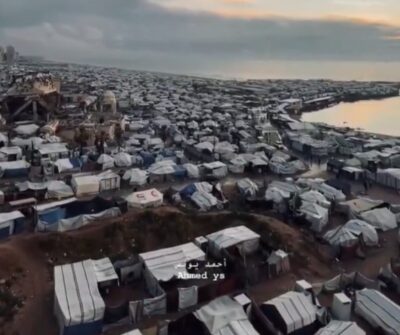
The Israeli army continued its violations of the ceasefire agreement for the 177th consecutive day on Saturday, carrying out multiple attacks across the Gaza Strip that left several Palestinians injured.
According to field reports, Israeli naval vessels opened heavy machine‑gun fire at dawn toward the tents of displaced families in the al‑Mawasi area west of Khan Younis, in southern Gaza, injuring two civilians.
The reports said the attack targeted one of the few remaining zones designated for displaced residents in southern Gaza.
Additional gunfire was reported east of Khan Younis, where Israeli forces have maintained a heavy presence.
In central Gaza, Israeli armored vehicles fired toward the northern outskirts of the al‑Bureij refugee camp, forcing residents to flee the area.
At the same time, Israeli engineering units continued demolishing and bulldozing homes in new sections of the neighborhood, accompanied by sustained artillery shelling.
Israeli artillery also struck parts of the Jabalia refugee camp in northern Gaza, while naval forces fired toward the coastline of Rafah in the south.
In besieged Gaza, three-month-old baby Jalal died after battling a rare skin condition. His parents had urgently appealed to the relevant authorities to transfer abroad for life-saving treatment, but nothing happened.
Al Jazeera’s @Hind_Gaza reports. pic.twitter.com/FbRc9Kwefk
— Al Jazeera English (@AJEnglish) April 3, 2026
Humanitarian conditions for displaced Palestinians across the Gaza Strip continue to deteriorate sharply, with winter storms and heavy rainfall compounding an already catastrophic situation.
Tens of thousands of families sheltering in makeshift tents have reported severe flooding, as rainwater mixed with sewage swept through displacement camps, destroying fragile shelters and leaving residents exposed to freezing temperatures.
According to humanitarian field teams, large sections of the tent camps in Rafah, Khan Younis, and central Gaza have turned into deep mud pools, making movement nearly impossible and cutting off access to food, medical care, and clean water.
🚨 THEY ARE RUNNING FOR WATER… OR DYING WITHOUT IT 🚨https://t.co/GZPAJNp2TD…
Today… in Project Mohammed
we delivered 700,000 liters of water into Gaza…
into hands that were shaking…
into mouths that hadn’t tasted water for hours…But listen carefully…
this is not… pic.twitter.com/KqBIQXRxuG— Muhmmed Project𓂆 🇵🇸 (@ProjectMuhmmed) April 3, 2026
Many families have been forced to stand for hours in cold water after their tents collapsed or were washed away, while others attempted to rebuild their shelters using plastic sheets, scrap wood, and salvaged debris.
Medical organizations warn that prolonged exposure to cold, damp conditions is driving a surge in respiratory infections, hypothermia cases among children, and skin diseases linked to contaminated water. Aid workers report that infants and elderly people are at particular risk, especially as fuel shortages have left most families without heating, electricity, or the ability to boil water.
The flooding has also destroyed food stocks, soaked blankets, and contaminated the limited drinking water available in the camps. Relief agencies say the combination of overcrowding, stagnant water, and the collapse of sanitation systems has created conditions ripe for disease outbreaks.
Despite the worsening weather, displaced Palestinians continue to live in torn tents, makeshift shelters, and open areas with no protection from the elements. Humanitarian organizations describe the situation as “unlivable,” warning that without sustained access for aid, medical teams, and shelter materials, the number of preventable deaths will continue to rise.
Meanwhile, the Israeli army kept the Rafah border crossing with Egypt closed for the third consecutive day, further restricting the movement of patients, humanitarian missions, and urgently needed aid.
With the crossing repeatedly closed and humanitarian convoys restricted, emergency supplies have not reached the scale needed to prevent further deterioration.
On Friday, a Palestinian woman was killed, a child was wounded, and a young man succumbed to critical wounds on Thursday as Israeli forces intensified gunfire and artillery attacks across multiple areas of the devastated Gaza Strip.
Since the “ceasefire” took effect on October 11, 2025, Israeli violations have killed 713 Palestinians and injured 1,943 others, according to medical and civil defense sources. During the same period, rescue teams have recovered 756 bodies from destroyed areas.
The cumulative death toll from the genocide in Gaza since October 7, 2023, has risen to 72,289 Palestinians, with 172,043 others injured. Thousands remain missing under the rubble of destroyed neighborhoods, where rescue crews continue to face severe restrictions and shortages of equipment.
