
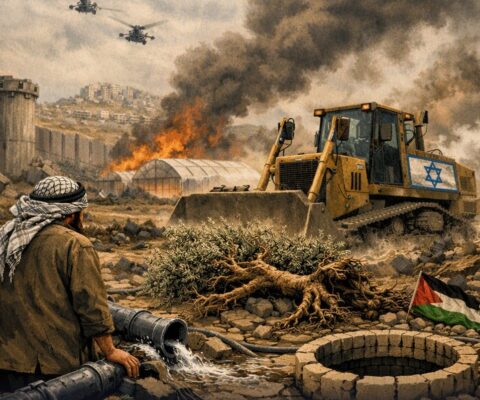
Israeli military operations have devastated farmland, water sources, and tree cover across the occupied West Bank and Gaza, according to Palestinian officials, researchers, and multiple UN agencies.
The destruction has accompanied expanding colonial projects in the West Bank and has compounded the humanitarian collapse in Gaza, where UN bodies have documented widespread damage from bombardment, bulldozing, and military operations.
Across both regions, the loss of agricultural land has uprooted thousands of trees, severed water networks, and left entire communities unable to sustain long‑term food production.
Farmers say the effects extend far beyond the plots directly hit by bulldozers, with destroyed wells, irrigation lines, and access roads leaving large agricultural zones dry and inaccessible.
Northern West Bank: Farmland Loss and Colonial Road Expansion
Jenin has faced some of the most extensive bulldozing in recent months. In Zububa, west of Jenin, farmer Munir Abu Bakr lost around 50 dunams of land planted with olive trees and irrigated vegetable crops, along with an artesian well.
Abu Bakr, one of roughly 50 farmers affected, said the land was his family’s only source of income and described the scale of destruction as “unbelievable,” noting that the village’s once‑green landscape has been transformed into bare earth. The village’s once green landscape has been transformed into bare earth”.
Zububa’s village council head, Zaki Jaradat, called the bulldozing “a massacre against agricultural land.” He said the targeting began nearly three years ago when Israeli forces blocked farmers from reaching large areas near the Annexation Wall, declaring them closed military zones.
Bulldozing has intensified over the past year, with new destruction reported almost weekly. Jaradat noted that Zububa has already lost thousands of dunams over decades—during the 1948 Nakba, after the 1967 occupation, through settlement expansion, and with the construction of the Annexation Wall in 2002.
Village statistics show that around 500 dunams were bulldozed in the past year alone, including 300 dunams planted with nearly 3,000 olive trees—some newly planted, others more than a century old.
Jenin Governorate data indicates that more than 500 dunams of olive groves have been bulldozed in several villages since late 2025, with the number doubling when other crops are included. In July alone, Israeli forces uprooted 1,051 olive trees.
Land researcher Raed Moqadi described the current period as “the largest colonial assault since 1967,” combining agricultural destruction with settlement expansion and new bypass roads.
He noted that Jenin has been the most heavily targeted area in recent months. Moqadi pointed to the establishment of the “Emek Dotan” colony on 72 dunams of land in Arraba three months earlier and a planned colonial road linking the “Tarsala” colony south of Jenin to Deir Sharaf near Nablus—projects that threaten farmland across multiple villages.
Villages west of Jenin have also faced new military orders converting large areas near the Annexation Wall into closed military zones, followed by bulldozing and destruction of farmland. Similar patterns have intensified in the Nablus area, affecting villages including Burin, Madama, Asira, al‑Sawiya, Beita, Aqraba, and Sebastia.
Central West Bank: Roadwork and Infrastructure Expansion
In the central West Bank, Salfit Governorate has seen expanded colonial roadwork and infrastructure projects on land belonging to Iskaka, Yasuf, and Kifl Haris, alongside major Israeli funding for settlement infrastructure across the West Bank.
Moqadi said these policies devastate farmers’ livelihoods, destroy vegetation and ecosystems, and coincide with the takeover of springs and water sources—especially in the Jordan Valley—along with pollution from settlement wastewater.
Jordan Valley: Water Infrastructure Destruction
In the northeastern West Bank, Tubas and the northern Jordan Valley have faced severe agricultural destruction since early 2026, particularly in Atouf and the al‑Baqi’a plain.
Israeli authorities began implementing the “Crimson Line” project, a military road and barrier stretching 22 kilometers from Ein Shibli to the Tayasir military roadblock.
Continuous bulldozing has dried out thousands of dunams in one of the West Bank’s most fertile plains.
Farmer Saad Bisharat, who owns 120 dunams of vegetable crops, said his fields dried up after irrigation lines were bulldozed.
Atouf village council head Abdullah Bisharat said bulldozing destroyed hundreds of dunams of crops and trees, with damage spreading to areas not directly hit due to the cutting of water sources.
He said the destruction of main water lines dried out around 30,000 dunams—one‑third of the plain’s total area of 96,000 dunams. Israeli forces also demolished three artesian wells last month that supplied 7,500 dunams, with more wells under threat.
West Bank Data: Military Orders and Environmental Damage
The Wall & Colonization Resistance Commission reported that Israeli authorities issued eight new military orders under the pretext of “security measures,” mandating the removal of vegetation and uprooting of olive trees across 316.636 dunams.
Six orders targeted Jenin, one targeted 3.716 dunams in Zawata near Nablus, and another targeted 2.052 dunams in Jaba’ north of occupied Jerusalem, giving landowners 24 hours to remove trees.
The commission said 59 military orders have been issued since early 2026 to remove tree cover, targeting a total of 2,480 dunams. Its mid‑year report documented 45,195 trees uprooted or damaged across the West Bank since January.
A joint report by the Palestinian Central Bureau of Statistics and the Environment Quality Authority recorded 685 environmental violations in the West Bank in 2025, up from 535 in 2024, with 310 violations recorded by April 2026.
The report documented bulldozing of farmland, destruction of trees, wastewater dumping, and damage to infrastructure—conditions linked to severe ecological degradation and threats to natural resources.
Regional Context: UN Documents Parallel Agricultural Collapse in Gaza
Although the Gaza findings arise from a different military and humanitarian context, they provide essential regional context for understanding the consequences of widespread damage to farmland, irrigation systems, livestock production, and food distribution.
United Nations agencies have documented a parallel and even more severe collapse of Gaza’s agricultural sector”.
Months of bombardment, bulldozing, and military operations have devastated nearly all productive farmland in Gaza, leaving more than two million Palestinians facing acute food insecurity.
A detailed UNOSAT satellite assessment found that by June 2025 Israeli attacks had destroyed roughly eighty‑six percent of Gaza’s agricultural land, including ninety‑four percent of farmland in northern Gaza.
UNOSAT attributed the destruction to continuous bombardment, armored vehicle movement, and the deliberate targeting of orchards, greenhouses, irrigation networks, and water reservoirs.
The UN Office for the Coordination of Humanitarian Affairs reported extensive destruction of cropland, orchards, livestock farms, and fishing infrastructure in Gaza, contributing to a rapidly worsening hunger crisis.
UNRWA said more than seventy percent of Gaza’s water wells and irrigation systems have been damaged or destroyed, leaving farmers unable to irrigate even small plots.
Bulldozing has flattened citrus groves, olive orchards, and vegetable farms that once supplied Gaza’s markets, while restrictions on fuel and equipment have prevented repairs to damaged irrigation networks.
The Food and Agriculture Organization described Gaza’s agricultural sector as decimated, documenting major losses in livestock, poultry, and dairy production.
Destroyed fodder fields and water sources have forced farmers to abandon surviving animals, and FAO warned that agricultural infrastructure had sustained extensive structural damage.
The World Food Programme reports that Gaza’s population is experiencing catastrophic hunger. WFP said families now rely almost entirely on limited humanitarian aid, as the destruction of farmland has removed Gaza’s ability to produce food independently.
The agency warned that Gaza is now completely dependent on external assistance for survival.
UN Secretary‑General António Guterres said the level of environmental and agricultural destruction in Gaza raises profound concerns under international humanitarian law.
He noted that the obliteration of food systems directly threatens civilian survival and called for unrestricted humanitarian access, protection of agricultural infrastructure, and the immediate restoration of water and irrigation systems.
Despite references to a ceasefire, UN agencies report continued violations, including bombardment near remaining agricultural zones, obstruction of humanitarian convoys, and ongoing restrictions on fuel and equipment needed to rehabilitate irrigation networks.
UNRWA said these conditions make it impossible for farmers to restore damaged land or resume planting.
This report is derived from WAFA News and supported by interviews with farmers, village officials, land researchers, and verified data from Palestinian agencies and United Nations bodies.
