
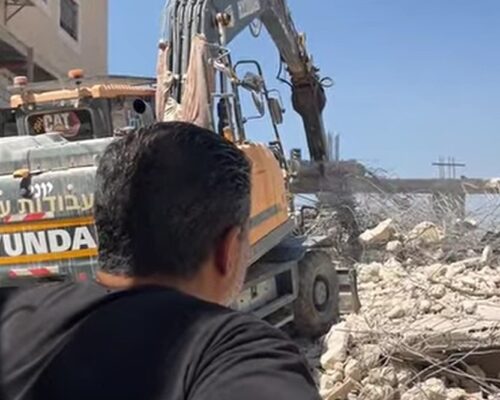
On Friday, Israeli occupation authorities compelled Palestinian, Abdullah Hawwas to demolish his own home in the Shu’fat refugee camp, north of occupied Jerusalem, in the West Bank.
The Jerusalem Governorate reported that Hawwas was forced to demolish two residential units that housed seven family members.
The apartments formed an entire floor within a multi-story building and were targeted under the pretext of lacking Israeli-issued construction permits.
Fearing structural damage to the rest of the building, Hawwas had no choice but to rent heavy machinery to carry out the demolition himself, incurring a financial burden estimated at 30,000 shekels.
Israeli authorities had issued Hawwas a deadline to self-demolish the property by the upcoming Sunday.
Failure to comply would have resulted in the deployment of Israeli bulldozers and the imposition of exorbitant demolition fees and fine on the homeowner.
This incident reflects the broader policy of coercive demolitions and punitive measures targeting Palestinian residents in occupied East Jerusalem, where building permits are systematically denied, and families are forced to choose between financial ruin or the destruction of their homes.
Israeli authorities have intensified the pace of home demolitions across East Jerusalem and other parts of the occupied West Bank in 2025, marking one of the most aggressive years since the beginning of the occupation.
By early September, nearly 800 Palestinian structures had been torn down, displacing over a thousand residents, many of them children.
These figures exclude the widespread destruction in refugee camps, where hundreds of homes and shelters were razed in Jenin, Tulkarem, and Nur Shams, leaving entire communities uprooted.
In East Jerusalem, the demolition campaign has been particularly severe. Last year alone saw the destruction of 255 structures, including 181 residential units, the highest annual toll ever recorded in the city.
This year, the trend has continued unabated, with dozens of demolitions already carried out in the first quarter. Families are routinely forced to demolish their own homes under threat of heavy fines or imprisonment, a practice known as “self-demolition.”
More than a hundred households were coerced into this form of punitive compliance in 2024, and the number continues to rise.
The legal “justification” often cited by Israeli authorities is the absence of building permits. However, the permit system itself is deeply discriminatory, with Palestinian applications routinely denied while settlement expansion proceeds unhindered.
In 2024, only a handful of Palestinian housing plans were approved, despite the urgent need for thousands of units to accommodate growing families. This deliberate restriction on urban development has left many Palestinians with no legal pathway to build, forcing them into a cycle of vulnerability and displacement.
Recent incidents underscore the human toll of this policy. In Jabal al-Mukaber, two families were forced to vacate and watch their homes reduced to rubble.
In Ethna, west of Hebron, demolition orders were issued to six households in a single week. In East Jerusalem, residents like Mutawakil al-Mohamad faced forced eviction followed by the destruction of their homes under claims of military zoning.
These cases are not isolated—they reflect a systematic effort to make life untenable for Palestinians in key areas of the city.
Beyond physical destruction, these demolitions carry deep psychological and economic consequences.
Families lose not only shelter but also generational investments, community ties, and access to basic services.
The trauma of watching one’s home destroyed—often in front of children—is compounded by the financial burden of fines, legal fees, and reconstruction costs.
The ongoing demolitions in East Jerusalem and the West Bank violate these international laws and treaties and have drawn repeated condemnation from human rights organizations.
Yet the practice continues, forming part of a broader strategy to alter the demographic and geographic landscape of the city, marginalize Palestinian presence, and entrench control and expand the illegal colonies, built in violation of International Law.
All of Israel’s colonies in the occupied West Bank, including those in and around occupied East Jerusalem, are illegal under International Law, the Fourth Geneva Convention in addition to various United Nations and Security Council resolutions. They also constitute war crimes under International Law.
Article 33 of the Fourth Geneva Convention prohibits collective punishment and acts of terror against civilian populations.
Article 49 of the Fourth Geneva Convention states: “The Occupying Power shall not deport or transfer parts of its own civilian population into the territory it occupies.” It also prohibits the “individual or mass forcible transfers, as well as deportations of protected persons from occupied territory”.
Articles 53 and 147, which prohibit the destruction of civilian property and classify pillage as a war crime.
