
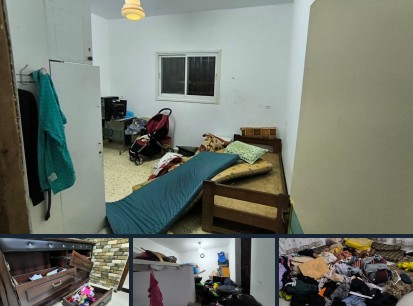
Israeli forces abducted at least 273 Palestinians across the occupied West Bank during invasions reported on Wednesday, broke into homes in several communities, and forced residents to evacuate houses in Beita ahead of the planned demolition of two homes. The operations also disrupted schooling and restricted movement.
Local sources said Israeli forces had converted six residential buildings and a café into military barracks and rooms for field interrogations during invasions across the West Bank in the preceding hours.
In the Nablus district in the northern West Bank, Israeli forces invaded Beita, south of the city, on Wednesday morning.
Media sources said military vehicles deployed in the town and soldiers began forcing residents to evacuate homes in its western area in preparation for demolishing two houses belonging to Palestinian detainees Ibrahim Abdul Karim Daoud and Zakariya Mohammad Daoud.
Israeli forces also fired stun grenades during their invasion of the western area of Beita ahead of the planned demolition of the two homes.
Beita Municipality said more than 5,000 students would be unable to attend school on Wednesday because of the Israeli invasion.
Israeli forces continued their invasion of Burin, south of Nablus, for a second consecutive day, breaking into and searching dozens of homes, damaging their contents, and turning some into military barracks.
Samer al-Jamal, director-general of the South Nablus Education Directorate, announced a shift to assignment-based learning, with in-person classes scheduled to resume next Tuesday. He said the decision aimed to protect students, teachers, and administrative staff while maintaining education under the current conditions.
In Yasid, north of Nablus, Israeli forces damaged a home after breaking into it during their invasion of the town. Soldiers also broke into homes in the eastern neighborhood of Salem, east of Nablus.
Local sources said the invasion of Salem continued, with soldiers searching several homes amid a military deployment in the village.
In Burqa, northwest of Nablus, Israeli soldiers attacked Palestinians while harvesting their olive trees and abducted four residents, identified as Husam Saif, Osama Saif, Maher Saif ad Mohammad Saif.
In Tubas, in the northeastern West Bank, local sources said Israeli forces abducted Abdullah Yahya Abdul Razeq after breaking into his family’s home.
Local sources also reported that several Israeli military patrols invaded Tammun, south of Tubas, and soldiers broke into a number of residents’ homes. No abductions were reported in the town.
Soldiers also invaded Sanur, south of Jenin in the northern West Bank. Israeli forces are also cutting a new road between Tura and Umm Dar, west of Jenin, for use by the Israeli military.
The roadwork is taking place among Palestinian-owned trees near a section of the illegal Annexation Wall.
In Qalqilia, in the northwestern West Bank, Israeli forces abducted 12 Palestinians before dawn. Local sources told the Palestinian news agency WAFA that soldiers invaded the city through its eastern entrance and deployed in the Sufin, ath-Thaher, al-Naqqar, and Kafr Saba neighborhoods. They broke into homes, searched them, and disturbed their contents before withdrawing approximately two hours later.
 The sources identified those abducted as former political prisoners Mohammad Abu Khadr, Maisara Afana, Muhtadi Dallal, Mohammad Khadrawi, and Mutasem Khadrawi, along with Mohyi Salmi, Ibrahim Subh, Ibrahim Hamdan Nazzal, Nahel Melhem, Siwar Qar’an, Majd Adnan Dawoud, and Aysar Shreim.
Israeli forces also invaded Hajjah, east of Qalqilia, deploying large numbers of soldiers on foot in the village center. Soldiers stopped residents and checked their identification, obstructing movement, and broke into homes in the eastern neighborhood. They forced the family of Rabea’ Yasser Rabea’ to leave their home and converted it into military barracks.
For a second consecutive day, Israeli forces kept the entrance to nearby Nabi Elias closed with an iron gate, hindering residents’ access to workplaces and other daily activities.
In Tulkarem, in the northwestern West Bank, WAFA reported that Israeli forces abducted four Palestinians before dawn, including a journalist and his two brothers. Local sources told the agency that soldiers broke into the home of Mohammad Salem al-Qass, 40, a lieutenant colonel in the Palestinian General Intelligence Service, in the city’s western neighborhood and abducted him.
Soldiers also abducted journalist and former political prisoner Hamza Mohammad Mustafa Salama, 33, and his brothers, former political prisoner Momen, 30, and Mustafa, 35, after breaking into their homes in the northern neighborhood.
A separate local-source account also named Amin al-Qarout among those abducted in Tulkarem. It identified Hamza Salama as a former political prisoner previously released in a prisoner exchange.
In the Ramallah district in the central West Bank, Israeli forces continued their invasion of al-Mughayyir, northeast of the city, carrying out extensive home break-ins.
Northeast of occupied Jerusalem, Israeli forces invaded the Jabal al-Madaris area of Hizma. Hundreds of Palestinians were also stranded in their vehicles at the Jaba military roadblock, north of occupied Jerusalem, as Israeli forces tightened restrictions.
Israeli forces also closed the entrances and exits of Hizma, preventing residents and vehicles from traveling into or out of the town. The previous night, soldiers invaded ar-Ram, north of occupied Jerusalem, deployed near its entrance, and set up a military roadblock at the roundabout leading to the town. Military patrols in the area further obstructed movement. Israeli forces also invaded Beit Duqqu, northwest of occupied Jerusalem, on Wednesday morning.
In the Bethlehem district in the southern West Bank, Israeli forces invaded Tuqu, southeast of the city, and deployed in several neighborhoods. Media sources said soldiers broke into the home of Ibrahim Fuad Ibrahim Sabbah, 30, and held him for several hours before releasing him.
Israeli forces also continued to close roads and entrances across the Bethlehem district on Wednesday for a sixth consecutive day, obstructing travel between towns, villages, and the city center.
The closures affected the as-Seder and Qasr Nassar roads west of Bethlehem, the District Coordination Office “DCO” entrance in Beit Jala, entrances to Jannata to the east, the entrances to al-Manshiya and Marah Rabah to the south, and all entrances to Tuqu, southeast of Bethlehem.
Protests also broke out in Beit Fajjar, south of Bethlehem, after Israeli forces invaded the town. Soldiers fired live ammunition and stun grenades.
The soldiers deployed in several Beit Fajjar neighborhoods and fired stun grenades and tear gas at residents, with no injuries reported. Israeli forces had also invaded the town on Tuesday morning and broken into several homes.
In the Hebron district in the southern West Bank, Israeli forces abducted four Palestinians while they were picking olives in ash-Shuyukh, north of the city. They were identified as brothers Abdullah, Abdul Basit, and Mohammad al-Mashni, along with Ayyoub al-Mashni. Soldiers took them to a colony identified as “Asfar” (Metzad) in the local-source account.
In Masafer Yatta, south of Hebron, Israeli colonizers attacked Issa Awad in Khirbet al-Fakhit, injuring his face. Israeli forces also abducted Mohammad Youssef Makhamra after colonizers attacked him near the hamlet.
Israeli military operations in Hebron continued for a sixth consecutive day. The al-Jilda and Deir Bahha areas remained closed as soldiers broke into homes, forced families to vacate parts of their houses, and imposed severe restrictions on residents’ movement.
Israeli forces also invaded Ethna, west of Hebron in the southern West Bank, and the Ein al-Sultan refugee camp, north of Jericho in the eastern West Bank.
