
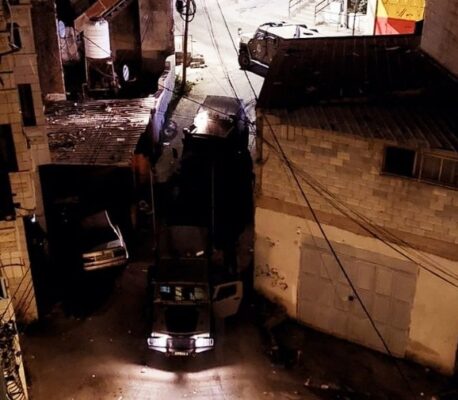
Israeli forces abducted more than 20 Palestinians, including children, during invasions across the occupied West Bank, while soldiers and colonizers assaulted residents, obstructed the olive harvest, closed roads, demolished property, and uprooted hundreds of olive trees.
In Qalqilia, in the northwestern West Bank, soldiers invaded the city through its southern entrance and abducted former prisoner Husam Abu Lebda, Khaled Nofal, and Hamza Hotari after breaking into and searching their homes on Al-Wad Street.
The army also installed a military roadblock near the Hableh tunnel, stopped vehicles, and inspected residents’ identification cards. In Azzun, east of Qalqilia, soldiers deployed in the Al-Safha neighborhood and fired concussion grenades and tear gas.
In Nablus, in the northern West Bank, soldiers abducted Wadi’ Abu Zant, Sultan Abdul-Karim Al-Hallaq, Obada Khattab, and Jihad Yousef Al-Qanni after invading the Al-Ma’ajin and Ad-Dahiya neighborhoods and the Askar and Al-Ein refugee camps, where they broke into homes, searched them, and damaged property.
In Beita, south of Nablus, colonizers assaulted and injured a 17-year-old boy, according to the Palestinian Red Crescent Society, while other colonizers attacked farmers harvesting olives.
Colonizers also bulldozed land in Beit Dajan and Burin, opened roads east of Beit Dajan, and leveled land near the Soufan family home in Burin in preparation for a new colonial outpost. In Beit Furik, they prevented farmers from harvesting and threw collected olives onto the ground.
In Hebron, in the southern West Bank, soldiers abducted eight Palestinians, including four children, and assaulted several of them.
In Al-Burj, southwest of Dura, soldiers beat and abducted Rajeh At-Talahma and Osama Al-Amayra after breaking into their homes, searching them, and destroying their contents.
In Sa’ir, northeast of Hebron, soldiers abducted Anas Ahmad Mohammad Al-Halayqa and four boys—Ammar Eyad Ahmad Shalalda, 15; Mo’taz Wissam Mohammad Ayayda, 15; Morad Mohammad Abdul-Qader Jaradat, 14; and Ezzeddine Majdi Mohammad Al-Halayqa, 15—after severely beating them. They also abducted Mahmoud Mansour Abdullah Nshash, 62, from Beit Ola, west of Hebron.
In Ath-Thaheriya, south of Hebron, soldiers abducted Amir Akram Al-Hawarin and detained his wife, Alaa Rabay’a. The army took them to the Kiryat Arba colony, interrogated them in the field for several hours, and released them. Soldiers also installed a military roadblock in the Bir Al-Hummus area of central Hebron, stopped and searched residents and vehicles, and assaulted several people.
In occupied Jerusalem, soldiers abducted Mousa Shadi Mustafa, a child, after breaking into his family’s home in Al-Isawiya, northeast of the city. Soldiers accompanied by personnel from the occupation municipality also invaded the Al-Bustan neighborhood in Silwan, south of the Al-Aqsa Mosque.
In Mikhmas, northeast of occupied Jerusalem, colonizers invaded the village after midnight and set fire to a mosque, a nearby olive tree, and a vehicle, which was completely destroyed.
In Tulkarem, in the northwestern West Bank, soldiers abducted Amjad Mustafa Taha from Allar and Anas Sheikh Hussein from the city’s southern neighborhood. They also broke into and searched the homes of Abdullah Abu Qeia and his son Bassam in Ezbet Shoufa, south of Tulkarem, and damaged the contents. No abductions were reported during the home invasions in Ezbet Shoufa.
Near the Jabara military roadblock south of the city, soldiers abducted Samah Mustafa Abdul-Rahman Shehadeh, 47, from Tulkarem refugee camp. She is the mother of Jihad Mihraj Shehadeh, whom Israeli forces killed in November 2023.
Later, soldiers invaded the Shweika suburb, deployed infantry units, obstructed residents and traffic, detained passengers, and fired tear gas and rubber-coated steel bullets; no injuries were reported.
In Tubas, in the northeastern West Bank, an undercover Israeli unit infiltrated Tammun before military reinforcements invaded the town, surrounded a home, and abducted Samer Bani Odeh. Soldiers broke into other homes, detained families, and interrogated them in the field during a military assault that continued for several hours. The army withdrew in the afternoon and invaded the town again that evening. Soldiers also beat and injured a 90-year-old man and a 34-year-old woman.
In the northern Yarza community, east of Tubas, colonizers damaged irrigation networks and agricultural lines and stole farmers’ water valves and meters.
In Salfit, in the central West Bank, soldiers abducted Luay Younis while he was harvesting olives on his agricultural land north of the city. The army also sent military reinforcements accompanied by a bulldozer toward Salfit.
Soldiers invaded the city, deployed in its streets, took positions on the rooftop of a building, blocked traffic, and closed the northern entrance. Israeli forces also closed the road connecting Bruqin and Salfit with earth mounds and invaded Rafat, where soldiers broke into homes.
They invaded the local office of the Detainees and Ex-Detainees Affairs Commission, damaged its contents, tore up photographs, and interrogated employees in the field.
Soldiers also invaded the Palestinian Red Crescent Society headquarters and the Martyr Yasser Arafat Hospital in Salfit. They seized surveillance recordings from the society’s headquarters and demanded the hospital’s recordings, threatening to open fire if administrators did not surrender them.
The soldiers then withdrew to the hospital entrance before invading the facility again later that day.
Near the entrance to Haris, west of Salfit, the army demolished three vehicle-repair shops owned by brothers Mohammad and Nadi Hassan Saleh Suleiman. Mohammad’s shop measured about 120 square meters, while Nadi’s two shops measured approximately 170 and 150 square meters.
In Qarawat Bani Hassan, west of Salfit, colonizers attacked farmers in Wadi Abbas, sprayed them with pepper spray, and caused one farmer to suffer breathing difficulties.
In Ramallah, in the central West Bank, soldiers invaded Deir Dibwan, Turmus Ayya, Qibya, and Burqa, broke into homes, and interrogated residents in the field.
Israeli forces also abducted Ahmad Ayoub Hamayel from Kafr Malek while he was working in Silwad, northeast of Ramallah, and confiscated his vehicle.
In the Abu Sharif area between Deir Dibwan and Burqa, soldiers detained and assaulted a Palestinian, confiscated his vehicle, and stole olives in his possession.
Colonizers also attacked olive harvesters in Turmus Ayya and tried to force them from their land, but residents drove the attackers back toward a colonial outpost on the town’s plain.
In Kafr Malek, east of Ramallah, Israeli military bulldozers uprooted hundreds of productive olive trees and leveled 35 dunams of agricultural land beside a bypass road south of the village.
Local sources said the military had issued an order ten days earlier to level dozens of dunams and uproot hundreds of trees in the same area, after bulldozing 56 dunams containing hundreds of trees several months ago.
In Jenin, in the northern West Bank, soldiers began installing an iron gate at the main entrance to Wadi Daouq, in the southern part of the governorate, and closed the road to vehicles amid a heavy military deployment.
The measure followed the installation of iron gates at the entrances to Arraba the previous day and further restricted access to neighboring towns, workplaces, agricultural land, and essential services.
South of Jenin, soldiers fired tear gas at farmers from Al-Fandaqumiya, Jaba’, and Silat Ath-Thaher and forced them to leave land they had reached under prior coordination for the olive harvest.
Colonizers also attacked farmers in Ya’bad, southwest of Jenin, assaulted them, stole harvested olives, and forced them from their land despite prior coordination permitting access to areas north of Al-Sahl Road, from the Kufeirat junction to Imreiha.
In Bethlehem, in the southern West Bank, colonizers assaulted three Palestinians in the Abu Njeim area, southeast of the city. Dirar Salah was hospitalized for treatment.
Israeli forces also kept all seven entrances to Tuqu’, southeast of Bethlehem, closed for a second consecutive day with iron gates and blocked other roads with earth mounds, isolating the town and restricting residents’ access to work and daily needs.
|Earlier Report: Ongoing Israeli Attacks Across West Bank|
In Khirbet Eghzeiwa, in the Masafer Yatta area south of Hebron in the southern West Bank, soldiers demolished an 80-square-meter home belonging to the Shatat family and another dwelling. They also confiscated a portable toilet.
This morning the apartheid regime’s demolition forces arrived to Ghzewi area, near Susiya, where they destroyed an agricultural structure, a kitchen, and a restroom.
Afterward, the forces continued to the village of Umm al-Khaircredit: Eid al-Hathaleen https://t.co/JuDpMxBOJd
— מחוץ לעדר/ kivsa shchora (@masafering) October 14, 2026
In Khirbet Umm Al-Khair, the army demolished a 40-square-meter dwelling owned by Odai Yasser Al-Hathalin that sheltered a family of seven, and confiscated a portable toilet belonging to Ammar Shuaib.
A preliminary tally based on field reports documented 219 colonizer attacks from October 1 through October 12, including 136 incidents connected to the olive harvest. The Wall and Colonization Resistance Commission said the harvest-related reports included 92 direct attacks on olive pickers or incidents in which they were denied access to their land, and 45 incidents involving crop theft or damage to olive trees.
The reported attacks included beatings, forced expulsions, intimidation, gunfire, tear gas, abductions, theft of olives and harvesting equipment, and damage to trees. The incidents caused losses to farmers and obstructed their access to agricultural land during the olive harvest.
