
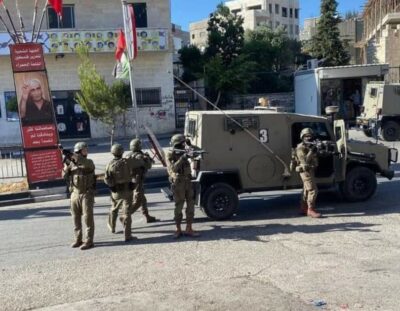
Occupied West Bank, Saturday — Israeli occupation forces and illegal paramilitary colonizers carried out widespread assaults and invasions across Palestinian towns and villages, intensifying restrictions and violence.
In the South Hebron Hills, armed colonizers attacked Mohammad Ahmad Abu Arram as he returned home to al-Halawa village, inflicting bruises and contusions. He received treatment on site.
Israeli troops also closed the Deir Sharaf military roadblock near Nablus in both directions, searched vehicles, and tightened control at the Beit Furik checkpoint, causing severe traffic congestion.
In Naqoura village, northwest of Nablus, forces invaded the archaeological site of Sheikh Sha’la Castle, inspecting vehicles and verifying IDs. The site has faced repeated colonizer incursions, which have intensified over the past two years.
In Jenin, Israeli forces invaded Qabatia town, south of the city, fired stun grenades and toxic gas, and spread through the streets. In Jaba’, southwest of Jenin, soldiers tore down posters of slain Palestinians, while in neighboring Zababda, troops fired live rounds at civilians. No injuries were reported.
In Qalqilia, movement was obstructed by a military roadblock at the city’s eastern entrance, where vehicles were stopped and passengers’ IDs inspected.
In Sinjil, north of Ramallah, Israeli colonizers attacked a municipal ambulance with stones, shattering its windows. The crew escaped unharmed. The municipality confirmed this was the second such attack amid rising assaults on residents and property.
In Nabi Saleh, northwest of Ramallah, one civilian suffered gas inhalation after Israeli forces fired toxic gas at vehicles during an invasion. The village faces daily incursions, road closures, and military checkpoints.
Troops also invaded the area around al-Am’ari refugee camp near Ramallah, deploying vehicles and foot patrols through al-Bireh. No abductions were reported.
In Salfit, Israeli forces abducted the mayor of Qarawat Bani Hassan, Ibrahim Asi, and confiscated a municipal bulldozer and crane. The equipment had removed a concrete barrier placed by Israeli forces months earlier, which had caused traffic accidents.
In Sheikh Jarrah, occupied Jerusalem, soldiers stopped a Palestinian vehicle and detained the young man driving it.
In al-Ram, north of occupied Jerusalem, troops invaded the al-Bareed neighborhood and fired gas canisters at vehicles. The area faces frequent invasions under the pretext of pursuing laborers heading to Jerusalem.
In Beit Fajjar, south of Bethlehem, soldiers deployed near the western entrance and restricted residents’ movement.
In Kisan, east of Bethlehem, illegal Israeli colonizers hurled stones at several Palestinian homes and cars, before the locals intercepted them and forced them away.
Separately, the Israeli military announced the deployment of two additional battalions to the West Bank, citing “security concerns” linked to the escalating genocide in the Gaza Strip and the anticipated recognition of Palestinian statehood at the United Nations. The reinforcements will remain throughout the Jewish holiday period to protect roads and colonies.
Earlier Saturday, Israeli forces conducted a series of invasions across the occupied West Bank, abducting civilians and assaulting residents in multiple towns and villages. Targeted communities included Jerusalem, Hebron, Jenin, Nablus, Qalqilia, and Ramallah, intensifying what rights groups describe as a systematic campaign of repression and territorial control.
The West Bank remains under siege, with more than 1,000 military checkpoints and iron gates restricting Palestinian movement for over two years.
On Monday, September 22, 2025, a high-level summit will convene at the United Nations General Assembly in New York, jointly led by Saudi Arabia and France. During the session, several countries—including the United Kingdom, Canada, Australia, Belgium, Portugal, Malta, and France—are expected to officially declare their recognition of Palestinian statehood.
