
Israeli occupation forces invaded communities across the occupied West Bank on Thursday, abducting approximately 30 Palestinians from Dheisheh refugee camp and at least 22 others in several governorates. Israeli colonizers also attacked farmers, burned olive trees, and stole agricultural equipment and crops.
At least eight Palestinians were injured in attacks by soldiers and colonizers in Salfit, Nablus, Jericho, and Tulkarem. In Biddu, northwest of occupied Jerusalem, Israeli forces demolished five residential buildings containing 12 apartments, displacing 105 Palestinians.
The reported violations also included property seizures, restrictions on the olive harvest, continued siege conditions in the northern Jordan Valley, and the closure of a Palestinian club in occupied Jerusalem.
Abductions Across Bethlehem, Hebron, Qalqilia, Nablus, and Ramallah
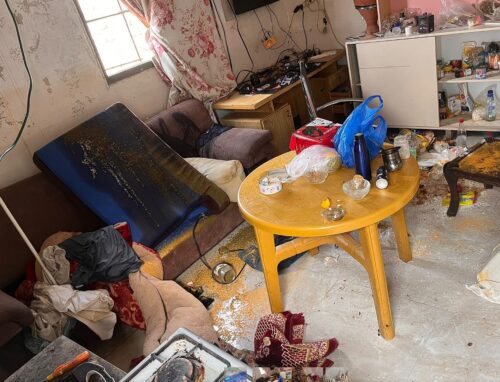
In Bethlehem, in the southern West Bank, soldiers invaded Dheisheh refugee camp, south of the city, broke into homes, destroyed belongings, and abducted approximately 30 residents.
In the Hebron governorate, activist Osama Makhamra said soldiers abducted seven Palestinians from Khirbet al-Halawa in Masafer Yatta: Issa Khalil Abu Arram, Issa al-Jabarin, Tareq Abu Arram, Hani Abu Arram, Mahmoud Abu Arram, Issa Jamil Abu Arram, and Jibril Abu Arram.
The soldiers also abducted Mohammad Ali al-Adra and Ismael al-Adra while they were harvesting olives on their land in Khallet Ameira, east of Yatta. Soldiers had also been detaining other members of the al-Adra family since the morning, preventing them from harvesting olives in the same area.
Separately, Israeli forces abducted six Palestinians from the Yatta wilderness, south of Hebron: Fayez al-Hammadin, Zayed al-Budur, Mohammad al-Budur, Khalil al-Budur, Adnan al-Budur, and Yousef Hamadin.
In Qalqilia, in the northwestern West Bank, soldiers invaded the city through its eastern entrance, deployed in the Kafr Saba neighborhood, and searched several homes before abducting Haitham Salmi, Majid Shobaki, and Anas Hamdan.
In Nablus, in the northern West Bank, media sources said the soldiers abducted Sidqi Qaisar Jawabra from Asira ash-Shamaliya and Tareq Jihad Ramadan from Tal at dawn. The abductions occurred during invasions of Asira ash-Shamaliya, Tal, Urif, Talfit, and Ijnisinya, where soldiers searched homes and damaged their contents.
In the central West Bank city of al-Bireh, an Israeli army special unit invaded the industrial area and abducted Hamza Mohammad Ali Shahada, who was in the area at the time.
In al-Mughayyir, northeast of Ramallah, soldiers abducted Issam Mufid Abu Aliya during an invasion accompanied by intensive gunfire, according to village council head Amin Abu Aliya.
At Least Eight Palestinians Injured in Attacks on Farmers
In Salfit, three Palestinians were injured in assaults by Israeli soldiers and colonizers in Qarawat Bani Hassan, west of the city. The Palestinian Red Crescent Society said its crews treated three injured people and were transferring them to a hospital.
Activist Nathmi al-Salman said a large group of colonizers attacked olive pickers in Wadi Abbas and al-Wadi al-Qibli, between Deir Istiya and Qarawat Bani Hassan. The attackers sprayed the farmers with pepper spray and beat them with sticks while they were on their land.
In Jericho, in the northeastern West Bank, three Palestinians were injured after colonizers, under military protection, invaded Palestinian land and homes in Bedouin communities in the Sateh area of ad-Duyuk at-Tahta, west of the city.
Jihad Mahalis, a member of the local community committee in Ein ad-Duyuk, said the colonizers grazed their sheep on Palestinian land under military protection, beat residents, and sprayed them with pepper spray.
In Beita, south of Nablus, a Palestinian suffered wounds and bruises after colonizers beat him during an attack on farmers in the Bir Saleh area, between Beita and Osarin.
In Beit Lid, in the Tulkarem governorate in the northwestern West Bank, another Palestinian was injured when colonizers attacked farmers during the olive harvest, according to the Wall and Colonization Resistance Commission.
Home Demolitions Displace 105 Palestinians in Biddu
Israeli forces demolished five residential buildings containing 12 apartments in Biddu, northwest of occupied Jerusalem, displacing 105 Palestinians. The demolitions were carried out without prior warning, under the pretext of construction without permits.
Israeli authorities demolished five homes today in the West Bank town of Biddu, leaving 110 Palestinian civilians homeless. https://t.co/VlUahvA3Av
— Ihab Hassan (@IhabHassane) November 5, 2026
The soldiers invaded Biddu with military vehicles after bulldozing land around the military roadblock at Beit Iksa and uprooting trees. During the demolitions, they fired stun grenades and tear gas toward residents and prevented them from evacuating their homes and removing their belongings before the buildings were destroyed.
In Furush Beit Dajan, east of Nablus, Israeli bulldozers demolished Muayyad Fawaz Mashati’s home, which measured approximately 100 square meters.
In the al-‘Oqda area, west of Qarawat Bani Hassan in the central West Bank governorate of Salfit, soldiers began demolishing the home of Ali Rayyan.
The building consisted of one story measuring 100 square meters, plus a rooftop section. During the demolition operation, soldiers also issued a notice ordering a halt to work and construction on the nearby home of Majd Nasim Asi.
In Burqa, east of Ramallah, Israeli forces invaded the village, closed its entrance, and demolished a memorial to Qusai Matan.
In Deir Abu Daif, in the Jenin governorate in the northwestern West Bank, the army continued bulldozing land planted with olive trees to expand the Ganim colony.
The Wall and Colonization Resistance Commission said soldiers prevented landowners from reaching their fields to harvest the olives before the land was bulldozed.
Seizure of Vehicles, Agricultural Equipment, and Phones
In Masafer Yatta, south of Hebron, soldiers invaded the hamlets of at-Tabban, Esteifi al-Fauqa, and Esteifi at-Tahta, searched residents’ dwellings and caves, deliberately destroyed belongings, and seized agricultural tools and equipment. The affected owners were identified as Nasser Abu Ubaid, Mohammad Awad and his son Yaser, and Ammar Abu Ali.
Israeli forces seized a vehicle belonging to Mohammad Abu Arram and two agricultural tractors, one owned by Ahmad Yaser Abu Arram and the other by the Masafer Yatta Council. Colonizers had intercepted them while they were attempting to deliver animal feed to farmers in Khirbet Abu al-Halawa.
In the Yatta wilderness, soldiers seized a vehicle, an agricultural tractor, and a water tanker belonging to Ibrahim al-Budur. They also invaded the home of Farah al-Budur, detained several women, and confiscated 11 mobile phones.
In Urif, in the Nablus governorate, soldiers confiscated a mobile phone from the home of imprisoned Palestinian Muayyad as-Safadi.
In the northern Jordan Valley, colonizers spread organic fertilizer on Palestinian land in the al-Burj area in preparation for planting rain-fed crops. Human rights activist Aref Daraghma described this as one of the methods used to seize Palestinian land in the area.
Olive Harvest Attacks, Arson, and Theft
The Wall and Colonization Resistance Commission recorded 13 attacks by Israeli forces and colonizers against olive pickers and their land in eight West Bank governorates between 6 a.m. and 6 p.m. on Thursday.
The reported attacks included beatings and pepper spray, live fire intended to intimidate farmers, the burning of dozens of mature olive trees, theft of crops and harvesting equipment, land bulldozing and tree uprooting, and the detention of farmers or denial of access to their land.
In the Ramin plain, east of Tulkarem, armed colonizers arrived in three tuk-tuk vehicles and surprised farmers harvesting olives, according to Manal Zidan, an activist with the Palestinian Farmers’ Union.
The colonizers attacked the farmers and attempted to steal harvesting equipment, olives, and collection sheets. Residents confronted them and prevented the theft. One colonizer fired live rounds into the air to intimidate the farmers and force them off their land.
In Burqa, east of Ramallah, colonizers set fire to dozens of olive trees in the al-Qibli area. Local sources said the attackers deliberately burned the trees one by one, while additional colonizers arrived from the al-Karam area as the fires spread.
Israeli forces also invaded Burqa and deployed in al-Modawwar, al-Aliyya, al-Masrabba, al-Khalla, and the roundabout area. Local sources reported the presence of Israeli police and soldiers, live gunfire, and the detention of several young men, who were later released.
In al-Mughayyir, soldiers fired tear gas toward farmers in the al-Aqaba area, while colonizers released livestock onto agricultural land.
In Majdal Bani Fadel, southeast of Nablus, colonizers renewed attacks on olive fields belonging to Maqbula al-Khatib and Mohammad Samir al-Khatib. The fields lie beside a recently established illegal pastoral colony outpost.
In al-Lubban ash-Sharqiya, in the Nablus governorate, colonizers invaded agricultural land, prevented residents from reaching their fields, and stole harvesting equipment.
In Arraba, in the Jenin governorate, three groups of colonizers invaded agricultural land in the al-Harayiq area and stole olives directly from trees belonging to Mahmoud Rahhal, Ahmad Shukri, and Abu Wasef.
In Qalqilia, colonizers stole four large olive collection sheets belonging to farmer Hammad Saleh Eid. His land is near the colony outpost between Kafr al-Qaff and Hajjah, east of the city.
Attacks on Shepherds and a Besieged Family in Yatta
In Khashem ad-Daraj, in the Yatta wilderness, armed colonizers assaulted shepherds and held several of them for many hours, according to activist Osama Makhamra.
In Wadi ar-Rakhim, south of Yatta, colonizers under army protection attacked the home of Yousef Shinnaran and his son, where 11 family members live.
🚨 For 31 days: The Shinaran family has been under siege in their home in Wadi Rakhim🚨
🧵 Israel imposes a blockade as a practice of ethnic cleansing https://t.co/FYw7kuDZ7o
— מחוץ לעדר/ kivsa shchora (@masafering) November 5, 2026
They threw balloons containing foul-smelling chemical substances toward the windows, frightening the family and forcing its members to gather in a single room. No injuries were reported.
Media sources reported that colonizers and Israeli forces had besieged the home for more than a month, preventing the family from leaving and blocking access or aid deliveries except through difficult coordination arrangements.
Tenders for 91 Colony Housing Units on Qalqilia Land
The Wall and Colonization Resistance Commission reported that Israeli authorities issued two land-marketing tenders in the first days of November for 91 housing units in the Oranit colony, built on land in the Qalqilia governorate. The tenders concern 86 units in multi-story residential construction and five low-rise units.
Tender 224/2026, published on November 5, covers four development complexes for 86 units. Submission of bids is scheduled to open on November 15, 2026, with a deadline of December 21, 2026.
Tender 228/2026, published on November 3, covers three development complexes for five low-rise units. Bid submissions are scheduled to open on November 16, 2026, and close on December 29, 2026.
The commission said the tender booklet had not been published as of November 5. These are reported tenders for planned construction, not completed housing units.
Home Invasions, Roadblocks, and Temporary Detention
In Deir al-Ghusun, north of Tulkarem, Israeli military vehicles invaded the town at dawn. Soldiers established a military roadblock at its entrance, stopped and searched vehicles, checked residents’ identification documents, and broke into homes, searching them and damaging their contents.
The soldiers took over the home of Bassam Saifan and converted it into a military post. They brought several Palestinians to the house for interrogation, confiscated their identification documents and mobile phones, and detained them for more than four hours.
In Bal’a, east of Tulkarem, soldiers searched homes belonging to the Abu Sitta family, stopped passing vehicles, and obstructed residents’ movement. No abductions were reported.
In Tubas, Israeli forces invaded the city the previous night, deployed in several neighborhoods, and searched homes, damaging their contents.
In Nablus, Israeli military jeeps entered the New Nablus and Rafidia neighborhoods in the morning. No home searches were reported during those specific incursions.
Ar-Ras al-Ahmar Under Siege for the 44th Consecutive Day
Israeli forces continued their siege of ar-Ras al-Ahmar, south of Tubas, for the 44th consecutive day. Abdullah Bisharat, head of the Atuf and ar-Ras al-Ahmar village council, said the closure had forced 24 Palestinian families to leave, while another 24 families remained in the community.
Bisharat said that, following intervention by the relevant authorities, the army allowed limited quantities of animal feed and drinking water to enter for the remaining families on Thursday.
Israeli Authorities Close Abna al-Quds Club in Occupied Jerusalem
Israeli authorities closed Abna al-Quds Club in the Sa’diya quarter of Jerusalem’s Old City, under an order issued by Israeli National Security Minister Itamar Ben-Gvir.
The Jerusalem Governorate described the closure as another measure targeting Palestinian national, sporting, and social institutions in the city, within what it called a systematic policy of restricting Palestinian presence in Jerusalem.
The governorate said the long-established club serves local youth and plays an important role in their sporting, social, and community life, describing its closure as an attack on an institution serving the Palestinian community.
