
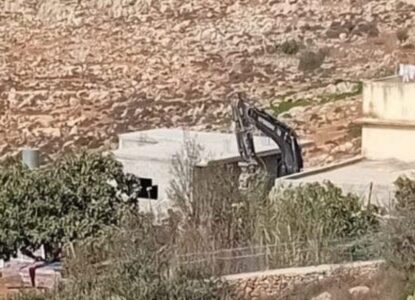
Israeli occupation forces demolished a Palestinian home on Wednesday in the village of al-Walaja, west of Bethlehem in the occupied West Bank.
According to Khader al-Araj, head of the village council, the demolished home belonged to Palestinian resident Ehab Sabri Radwan and was located at the village’s only entrance, adjacent to an older structure.
Al-Araj confirmed that the house was inhabited before the soldiers forced the family out and demolished the property.
Israeli forces sealed off the area completely, blocking the movement of vehicles and residents, effectively isolating the site and preventing public access or documentation.
This marks the second demolition in al-Walaja within a week. On Wednesday, November 5, Israeli forces razed two other inhabited homes in the village, including an 80-square-meter residence belonging to the Abu Razek family in the Ein Jweiza area.
In related news, Israeli forces demolished a Palestinian home in Silwan, south of Al-Aqsa Mosque in occupied Jerusalem in the West Bank.
Despite years of attempts to obtain building permits, residents were denied by Israeli authorities—a pattern widely documented as part of a broader policy to restrict Palestinian development while expanding illegal Israeli colonizers on stolen Palestinian lands.
The repeated demolitions reflect a sustained campaign of dispossession in al-Walaja, aimed at fragmenting the village, tightening control over its remaining land, and severing its connection to surrounding areas.
While Israel continues to build and expand its illegal colonies, Palestinian communities and towns in occupied Jerusalem and various areas in the occupied West Bank continue to be denied the right to build homes and property under various allegations meant to prevent the expansion of Palestinian towns and neighborhoods.
All of Israel’s colonies in the occupied West Bank, including those in and around occupied East Jerusalem, are illegal under International Law, the Fourth Geneva Convention in addition to various United Nations and Security Council resolutions. They also constitute war crimes under International Law.
Article 33 of the Fourth Geneva Convention prohibits collective punishment and acts of terror against civilian populations.
Article 49 of the Fourth Geneva Convention states: “The Occupying Power shall not deport or transfer parts of its own civilian population into the territory it occupies.” It also prohibits the “individual or mass forcible transfers, as well as deportations of protected persons from occupied territory”.
Articles 53 and 147, prohibit the destruction of civilian property and classify pillage as a war crime.
