
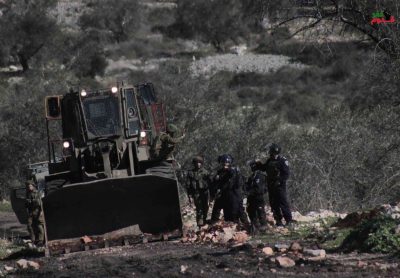
On Wednesday morning, Israeli forces accompanied by military bulldozers invaded the village of Al-Walaja, northwest of Bethlehem in the occupied West Bank, targeting the “Jabal Roweisat” area, before destroying agricultural roads and removing recently restored stone retaining walls.
Al-Walaja Village Council head, Khader Al-A’raj, stated that several military vehicles, including bulldozers, invaded the village and destroyed agricultural roads.
He added that the army also demolished several retaining walls that were recently rehabilitated and restored by the Village Council and the residents.
Al-A’raj stated that the Israeli army issued demolition orders for two inhabited homes belonging to brothers Mahmoud and Hamza Hassan Abu Al-Tin in the “Khallet Al-Hour” neighborhood.
He added that the army also ordered the demolition of a bakery owned by resident Ali Odeh and the removal of a prefabricated caravan near the village’s main entrance in “As-Sarj,” citing a lack of construction permits.
This incident reflects an ongoing intensification of violation in Palestinian rural communities in the Bethlehem area, where infrastructure and private property continue to face the threat of erasure under contested claims of unauthorized construction.
On Monday, July 15, the soldiers invaded Al-Walaja village, and demolished a Palestinian home.
Al-Walaja faces repeated Israeli violations and attacks by the soldiers and the paramilitary colonizers; many of its homes and structures have already been demolished, and many other buildings are facing the same threats.
The Israeli violations against al-Walaja started in the 1980s when Israel implemented its plans to annex the Palestinian lands to build its illegal colonies, by denying all construction permits filed by the Palestinians, in addition to dividing the lands, zoning and designating large areas as “green zones,” to prevent the Palestinians from using them, not to mention surrounding them with the illegal Annexation Wall.
Al-Walaja is already surrounded by the illegal colonies on Gilo, Har Gilo, Givat HaMatos, and Har Homa, which were all built on stolen Palestinian lands, in addition to the large areas of lands that were annexed when Israel paved roads leading to these colonies, installing railways and designating lands as natural reserves, off-limits to the Palestinians.
The Wall & Colonization Resistance Commission said Israel demolished 318 Palestinian structures in the West Bank in the first half of this year, and 313 structures in 2023.
Since the beginning of the Israeli onslaught on Gaza, after October 7, 2023, Israel seriously escalated its demolition of homes and property across the occupied West Bank, including East Jerusalem, especially in Area C (About %60 of the West Bank”, in addition to the constant assaults and violations by the illegal paramilitary colonizers.
Only 30 percent of Area C land is designated for development by Palestinians. The remaining 70 percent is classified as closed military zones that are off-limits to Palestinians unless they obtain special permits from Israeli authorities.
These stringent restrictions on Palestinians’ spatial development continue to intensify even though without Area C, a Palestinian state is inconceivable. Indeed, Area C holds valuable natural resources and a rich cultural heritage, and it represents the bulk of available areas for the spatial development of a future Palestinian state.
Read More: Israel’s Stranglehold on Area C: Development as Resistance – Ahmad El-Atrash – Al-Shabaka
