
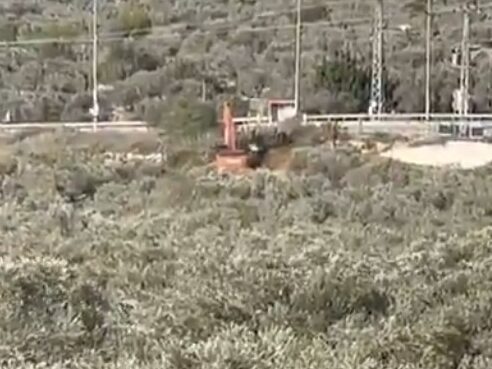
Israeli occupation forces on Wednesday began uprooting dozens of olive trees along the colonial road adjacent to the town of Deir Istiya, northwest of Salfit in the central occupied West Bank.
Local officials warn that the destruction could reach nearly 500 ancient olive trees, devastate Palestinian farmers’ livelihoods and accelerate colonization in the fertile Wadi Qana valley.
Abdul-Rahim Zidan, mayor of Deir Istiya, said bulldozers continue leveling land west of the town following earlier notices of uprooting.
He warned that the operation will lead to the destruction of hundreds of olive trees along the road stretching from Haris to Wadi Qana.
“This is a direct assault on our agricultural lands and our source of income,” Zidan said, describing the action as part of Israel’s policy of colonization and land seizure.
Wadi Qana, historically known for its olive groves and citrus orchards, lies at the heart of Palestinian agriculture in Salfit.
The valley is encircled by multiple illegal paramilitary Israeli colonizers’ outposts, which have steadily expanded onto Palestinian farmland. Farmers report repeated invasions, restrictions on access, and destruction of orchards.
In recent weeks, Israeli forces uprooted 135 olive trees in Deir Istiya belonging to three farmers, each more than seven years old.
Between December 4–11, 2025, occupation forces uprooted 1,608 olive trees across the West Bank, causing losses estimated at $1.3 million.
Palestinian officials documented more than 2,300 violations in 2025, including tree uprooting, arson, property seizure, and demolitions.
Olive cultivation covers half of all agricultural land in the occupied West Bank, with around 100,000 families depending on the harvest for income, including 15 percent of working women.
Farmers describe the uprooting as not only economic devastation but also cultural erasure. The olive tree, deeply rooted in Palestinian heritage, symbolizes resilience and continuity.
The destruction of olive trees is compounded by violence from illegal paramilitary Israeli colonizers, who frequently attack farmers during harvest season, burn fields, and prevent access to groves.
Human rights groups argue that these actions are part of a deliberate strategy to expand colonization, undermine Palestinian food security, and force families off their land.
The uprooting of trees and confiscation of land violates the Fourth Geneva Convention, which prohibits destruction of civilian property by occupying power.
UN experts have warned that restricting olive harvests and destroying orchards amounts to collective punishment and is designed to facilitate colonization.
The uprooting of olive trees in Deir Istiya underscores the broader reality of occupation: systematic destruction of Palestinian agriculture, expansion of illegal paramilitary Israeli colonizers’ outposts, and violation of international law.
For farmers in Salfit and across the occupied West Bank, each uprooted tree represents not only lost income but also an assault on heritage, identity, and the right to remain on their land.
