
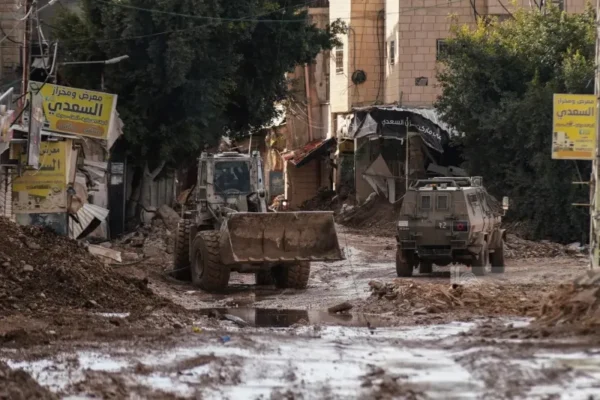
In the occupied West Bank, the Israeli military offensive on Jenin and Jenin refugee camp has entered its 592nd consecutive day, while military operations in Tulkarem and its refugee camps have continued for 586 days. In Nur Shams refugee camp, east of Tulkarem in the northwestern West Bank, Israeli forces have maintained their offensive for more than 560 days, causing widespread destruction and the displacement of tens of thousands of Palestinian refugees.
The prolonged military campaign has forcibly displaced more than 40,000 Palestinians from the Jenin, Tulkarem, and Nur Shams refugee camps. Residents were expelled beginning early last year and remain unable to return as Israeli forces continue demolitions, bulldozing operations, closures, and siege measures.
These continuing restrictions have intensified the humanitarian crisis facing displaced families, many of whom have been separated from their homes, property, livelihoods, schools, and local support networks for an extended period.
In Jenin refugee camp in the northern West Bank, Israeli military demolitions have completely or partially destroyed more than 600 homes and residential and commercial buildings. The destruction has affected a substantial portion of the refugee camp, which covers an area of less than half a square kilometer. Direct material losses inside the refugee camp have been estimated at approximately $30 million.
Israeli forces recently issued additional demolition notices affecting an estimated 95 to 100 homes and other structures in several neighborhoods of Jenin refugee camp.
The military has presented the demolition work as part of a plan to open roads and establish military corridors connecting the center of the refugee camp with surrounding areas.
Israeli military bulldozers have created approximately 15 roads through the densely populated refugee camp. Forces have also used explosives to demolish groups of homes simultaneously, including properties in the Al-Hawashin, As-Samran, and Al-Fallujah neighborhoods.
The offensive has emptied Jenin refugee camp of its residents, while thousands of forcibly displaced Palestinians from the camp and surrounding communities continue to endure difficult living conditions.
Persistent military closures prevent families from returning to their homes or entering the refugee camp to assess the condition of their property.
In Tulkarem in the northwestern West Bank, Israeli military operations have displaced approximately 11,500 Palestinians, constituting a major episode of forced internal displacement in the area in recent years.
Israeli forces continue to prevent residents of the Tulkarem and Nur Shams refugee camps from returning to their homes. The bulldozing of roads, closure of essential routes, and extensive destruction of infrastructure have disrupted nearly every aspect of life in and around the two refugee camps.
In a separate incident at Nur Shams refugee camp, Israeli soldiers raised an Israeli flag over the minaret of the Abu Obeida Mosque. According to local sources, the action prompted widespread anger among Palestinians.
The military siege has prevented residents and specialized teams from entering the Tulkarem and Nur Shams refugee camps, leaving the condition of nine mosques unknown.
The restrictions have obstructed efforts to inspect homes, religious sites, and public infrastructure or determine the full extent of the damage.
Access limitations have similarly prevented comprehensive assessments of mosques in Jenin refugee camp.
The continuing offensive has prevented displaced families from recovering possessions, examining damaged property, or making arrangements to rebuild. The destruction of roads and essential infrastructure has also complicated the delivery of humanitarian assistance and other services to affected communities.
The military operations are taking place amid expanding Israeli colonization in the northern occupied West Bank, including renewed Israeli activity at colonies evacuated in 2005.
Residents and observers say the destruction of homes and infrastructure exceeds the scope of Israel’s stated security justifications. They have expressed concern that the scale and pattern of the demolitions are intended to dismantle the social and physical structure of the refugee camps and weaken their significance to the Palestinian refugee cause.
Palestinian refugee camps throughout the northern occupied West Bank have faced repeated Israeli military invasions, home demolitions, and destruction of roads and public infrastructure. These operations have raised concerns about their long-term consequences for hundreds of thousands of Palestinian refugees.
As the offensives against the Jenin, Tulkarem, and Nur Shams refugee camps continue, statements by Israeli political and military leaders threatening operations against additional refugee camps have heightened fears of further escalation. Palestinians are concerned that an expanded campaign could forcibly alter the character of refugee camps across the occupied West Bank and occupied Jerusalem.
