
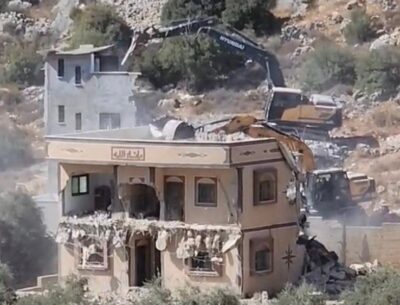
On Tuesday, Israeli occupation forces carried out the demolition of three residential homes in the Shuab neighborhood north of Bruqin, west of Salfit city in the central part of the occupied West Bank.
The homes belonged to Palestinian residents Bassam Jamal Al-Hajj, Samer Fayez Al-Hajj, and Faraj Abdel Nasser Al-Hajj.
The invasion began with a military incursion from the western entrance of Bruqin, accompanied by four armored bulldozers and a large contingent of Israeli troops.
Witnesses reported that the area was sealed off and placed under tight security as the demolition proceeded, displacing the three families.
Local sources described the destruction as sudden and forceful, leaving families displaced and property reduced to rubble, and added that the homes were demolished without prior notice.
This incident is part of a broader escalation in Israeli demolitions across the West Bank, particularly in areas near expanding settlements.
Bruqin has faced increasing pressure in recent months, with dozens of demolition orders issued against homes and agricultural structures.
Residents and officials warn that these actions are part of a systematic campaign to displace Palestinian communities and consolidate control over strategic land corridors.
The Palestinian Ministry of Local Government condemned the demolitions, calling them a violation of international law and a direct assault on civilian life. Human rights organizations have also raised alarm over the frequency and scale of such operations, which often target vulnerable families and occur without due process.
In 2025, Israeli authorities have stepped up the demolition of Palestinian structures across the occupied West Bank, including occupied East Jerusalem.
Between January and August alone, at least 1,164 buildings were torn down—ranging from family homes to farming facilities, water systems, and other essential infrastructure.
These demolitions have left more than 1,500 Palestinians displaced, many of them children, forcing families into uncertainty and deepening the strain on already fragile communities.
The situation in occupied East Jerusalem is especially harsh. A growing number of Palestinian families have been pressured into demolishing their own homes to avoid steep fines and legal consequences.
This practice—known as “self-demolition”—is most common in neighborhoods like Silwan and Jabal al-Mukaber, where Israeli authorities rarely grant building permits to Palestinians. With few options left, residents often choose to destroy their homes themselves rather than face forced eviction and financial penalties.
Refugee camps have also seen widespread destruction. In Jenin refugee camp, roughly 600 structures were lost this year alone. Tulkarem and Nur Shams camps suffered similar damage, with around 300 buildings demolished between them.
These actions have had devastating effects on already vulnerable populations, compounding displacement and eroding basic infrastructure.
Schools are under threat too. Across the West Bank and occupied East Jerusalem, at least 84 educational institutions currently face demolition orders. These include primary and secondary schools serving thousands of students—many of whom already struggle to access consistent education due to movement restrictions and settler violence.
Water access remains a critical concern. Seventy-three Palestinian communities are now without functioning water networks, largely due to the destruction of infrastructure and the refusal of Israeli authorities to approve repairs or expansions. This has heightened public health risks and deepened the humanitarian crisis in rural and semi-urban areas.
Human rights organizations and UN agencies have repeatedly condemned these demolitions, citing violations of international law—particularly the Fourth Geneva Convention, which prohibits the destruction of civilian property in occupied territories.
