
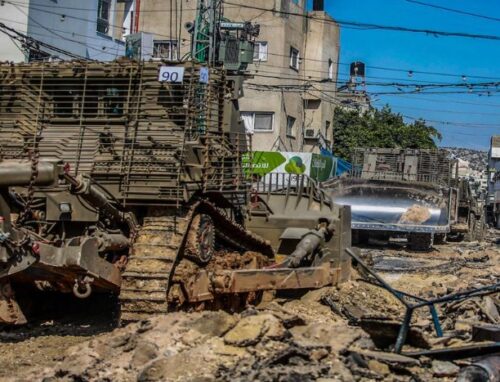
The Israeli military offensive in Jenin and its refugee camp in the northern part of the occupied West Bank has entered its seventh consecutive month, leaving behind casualties, extensive destruction, mass displacement, and deepening humanitarian fallout.
Bashir Matahin, Director of Public Relations at Jenin Municipality, stated that Israeli occupation forces have demolished over 600 homes and partially destroyed nearly 1,000 housing units since the invasion began on January 21.
These attacks have forcibly displaced approximately 22,000 residents from Jenin refugee camp.
Israeli troops remain permanently stationed inside the refugee camp, imposing a total blockade on movement in and out, which has severely hindered municipal teams from assessing the full extent of the damage.
“From our close observations,” Matahin stated, “it’s clear the occupation has redrawn the camp’s map entirely. erasing landmarks and carving new roads and passageways through its core.”
The ongoing invasion has exacerbated the displacement crisis, particularly affecting schoolchildren from the refugee camp. With eight schools forcibly closed by Israeli forces, overcrowding in nearby schools has surged, straining already limited resources.
Jenin Municipality estimates its direct financial losses at $400 million, with indirect losses mounting daily due to the prolonged economic collapse.
The crisis, which began three years ago amid repeated Israeli incursions, 62 prior to the current invasion, has devastated commercial activity, shuttered businesses, and derailed development projects across the city.
Matahin also highlighted the severe stagnation in Jenin’s markets, worsened by the closure of the Jalama military roadblock and the daily presence of Israeli troops. Main roads connecting Jenin’s commercial hub to surrounding villages have been systematically destroyed, further isolating the city.
In response, the municipality launched a rehabilitation campaign three months ago, supported by the Palestinian government, to restore key roads including Nablus Street, Haifa Street, and Nazareth Street, aimed at reviving civilian movement and economic life.
Efforts are also underway to rehabilitate the most affected neighborhoods, especially the eastern district and School Street, which has been repeatedly bulldozed by Israeli forces.
Since the start of the offsnive, 40 Palestinians have been killed, with dozens more injured or arrested.
As of September 1, 2025, Shireen’s observatory for human rights revealed that 197 Palestinians have been killed by Israeli soldiers and colonizers in the West Bank alone since the beginning of the year.
67 Palestinians were killed in Jenin, 35 in Nablus, 27 in Tubas, 17 in Tulkarem, 16 in Hebron, 13 in Ramallah, 9 in Bethlehem, 5 in Jerusalem, 4 in Qalqilia, 3 in Salfit and 1 in Jerusalem.
The site also confirms that at least five journalists have been killed, many while covering Israeli military operations or settler violence.
Since October 7, 2023, Israeli soldiers and paramilitary colonizers have killed 1,032 Palestinians in the West Bank, including 210 children, 22 women, 2 medics and 1 journalist; 291 in Jenin, 213 in Tulkarem, 127 in Nablus, 94 in Tubas, 93 in Hebron, 72 in Ramallah, 55 in Jerusalem, 37 in Qalqilia, 30 in Bethlehem, 13 in Jericho and 7 in Salfit.
Shireen Observatory was established in 2023 and officially launched on May 11 of that year, marking the first anniversary of the killing of Palestinian-American journalist Shireen Abu Akleh.
She was shot and killed by Israeli occupation forces while reporting from Jenin refugee camp, covering the ongoing violations and military aggression against the Palestinian people.
The observatory was founded to honor her legacy and to systematically document Israeli crimes, particularly those targeting journalists, civilians, and vulnerable communities in the occupied territories.
